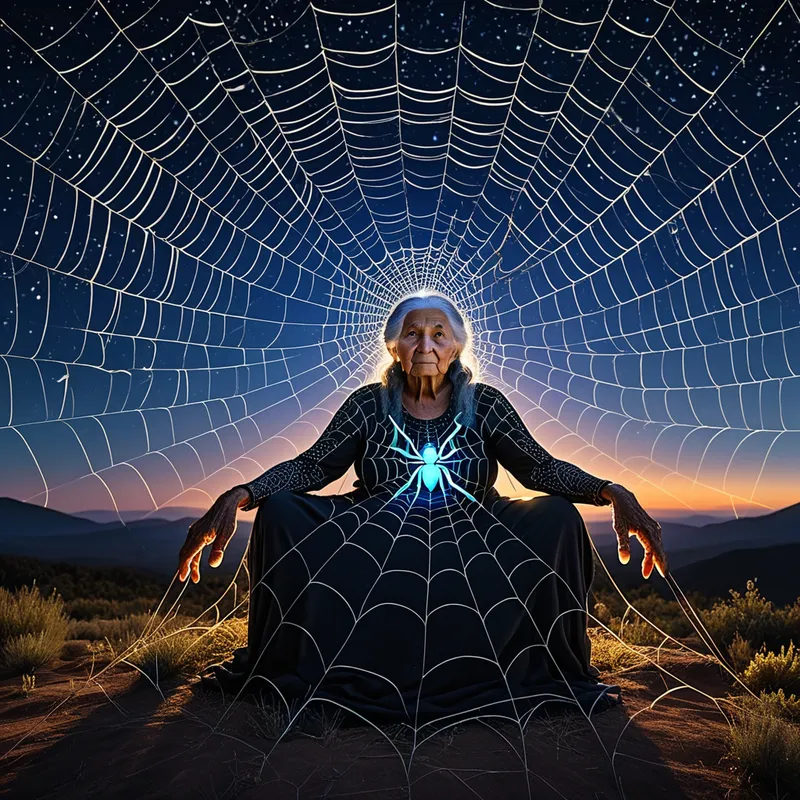
Spider Grandmother Myth Meaning & Symbolism
The cosmic weaver who creates worlds, guides souls through darkness, and teaches that destiny is a web spun from our own choices and connections.
The Tale of Spider Grandmother
In the time before time, there was only the dark. Not a cold dark, but a waiting dark, a silent, potential dark. And in that dark, a thought stirred. It was Kókyangwso’wuuti, Spider Grandmother. She was there when there was nothing else to be. She existed in the place between breaths, between stars.
She felt the loneliness of the void, not for herself, but for what could be. So, from the substance of her own being, she began to spin. Not with a loom, but with her breath and her intention. She spun a thread of thought, a filament of song. She sang the first song, a low, humming vibration that gathered the formless around it. With her eight legs—four to touch the earth that was not yet earth, four to reach for the sky that was not yet sky—she drew the thread out, long and strong and glimmering with its own soft light.
She wove a web. Not to catch prey, but to catch possibility. In the center of this first web, she placed a tiny, wet piece of clay, singing life into it. This was the First World, a damp, cramped place under the earth. She placed creatures there, but they stumbled in the gloom, unable to see or grow. Spider Grandmother saw their struggle. She spun a ladder of her silk, a gleaming pathway upward. “Come,” her spirit whispered. “We must climb to find a better place.”
And so, with the people and creatures clinging to her back or following her luminous thread, she led the ascent. They emerged into the Second World, a little brighter, but still not right. Again, she saw the limitation. Again, she spun her ladder. World after world, through danger and doubt, she guided them, a patient, relentless force of care and creation. In the Fourth World, they met a great flood, waters rising to swallow the land. As chaos surged, Spider Grandmother wove a sealed basket of her strongest silk, a vessel of salvation. She placed the seeds of life within—corn, beans, squash, the breath of the people—and sealed it against the raging waters.
When the flood receded, she opened the basket. Life spilled forth onto the damp, new earth. But the world was flat and featureless, a blank slate under a harsh sun. So, Spider Grandmother took the web of destiny she had been spinning all this while—the web that connected every climb, every escape, every life—and with the help of the Hero Twins, she stretched it across the dome of the sky. She pinned it with mountains, weighted it with rivers, and set the sun and moon to journey along its strands. She wove the laws of nature into its pattern and taught the people how to weave their own lives into its great design. She did not command from above; she remained in the corners, in the foundations, the unseen weaver whose thread holds all things together.
Cultural Origins & Context
The myth of Spider Grandmother is not a single, monolithic story, but a powerful, adaptive narrative thread woven through many Southwestern Pueblo cultures, including the Hopi, Navajo (Diné), and Tewa peoples. She is known by many names: Kókyangwso’wuuti (Hopi), Na’ashjé’ii Asdzą́ą́ (Navajo), and Sussistanako (Tewa). Her story is the bedrock of oral tradition, passed down not in books, but in the smoky air of kivas, in the rhythms of grinding corn, and in the whispered lessons to children at dusk.
Her primary tellers were and are the elders and wisdom-keepers, for her tale is not mere entertainment; it is a functional cosmology. It explains the origin of the people, the structure of the universe, and the proper way to live within it. The myth served as a societal blueprint, encoding values of perseverance, communal effort, and respectful interdependence with all beings. To hear the story of Spider Grandmother was to remember that you are never truly lost, for you are always connected to the web of creation she spun.
Symbolic Architecture
Spider Grandmother is the ultimate archetype of the Creatrix. She is not a distant, detached god, but an immanent, involved weaver. Her primary symbols form a profound psychological architecture.
The Web: This is the core symbol. It represents the interconnectedness of all life, fate, and thought. It is non-hierarchical; the center is no more important than the periphery. Each intersection is a choice, a relationship, a moment of being.
The web is not a trap, but a tapestry of relation. To be conscious is to perceive your strand, and to act responsibly is to tend your connections.
The Thread: Spun from her own being, the thread is the lifeline of consciousness, the path through chaos, and the creative act itself. It is the individual soul’s journey (the vertical climb) and the connective tissue between souls (the horizontal weave).
The Basket: A vessel woven from the web, it symbolizes containment, protection, and the preservation of potential through times of dissolution (the flood). It is the womb, the psyche, the cultural memory that safeguards essence during psychic upheaval.
The Ascent Through Worlds: This is not a linear “progress” but a spiral of emergence. Each world represents a state of consciousness or a layer of reality. The climb is the arduous process of psychological and spiritual evolution, requiring a guide and a willing surrender to the journey.
The Dreamer’s Resonance
When the pattern of Spider Grandmother weaves itself into modern dreams, it often signals a profound process of re-orientation within the psyche. You may dream of being lost in a labyrinth only to find a single, strong thread to follow. You may dream of fragile, broken webs or of meticulously repairing a web with great focus.
Somatically, this can feel like a pulling in the chest or solar plexus—the feeling of being “strung along” or, conversely, of being “connected.” Psychologically, it manifests during life transitions, creative blocks, or feelings of existential isolation. The dream is pointing to the need to find your own creative thread—your unique purpose—and to consciously acknowledge the web of relationships and responsibilities that define your world. It is the unconscious prompting you to become the weaver of your own life, rather than a passive fly caught in a pattern you did not choose.
Alchemical Translation
The myth of Spider Grandmother models the entire alchemical opus of individuation. The initial nigredo, the primal dark, is the unformed Self. From this, the creative impulse (Spider Grandmother) must emerge. The spinning of the first thread is the act of individuation—drawing a distinct consciousness from the unconscious mass.
The ascent through the worlds is the arduous albedo and citrinitas, the stages of purification and illumination. Each “world” left behind is an outgrown complex, a limited identity. The ladder of silk is the transcendent function, the symbol that bridges the conscious and unconscious, allowing for ascent.
The flood is the necessary solutio, the dissolution of the hardened ego. The basket is the salvaged core of the Self, which survives the flood of emotions or psychic chaos.
Finally, stretching the web across the sky is the rubedo, the reddening, the full realization. It is the moment the personal psyche understands itself as part of the cosmic pattern. The modern individual’s “alchemical translation” is this: We must learn to spin from our own essence (own our creativity), climb through our personal developmental worlds (endure growth), contain our core during floods of crisis (practice resilience), and ultimately, consciously weave our daily actions, relationships, and values into a coherent, beautiful, and interconnected whole. We are not just on the web; we are of the web, and we are tasked with its mindful creation.
Associated Symbols
Explore related symbols from the CaleaDream lexicon: