Spartan Hoplites Myth Meaning & Symbolism
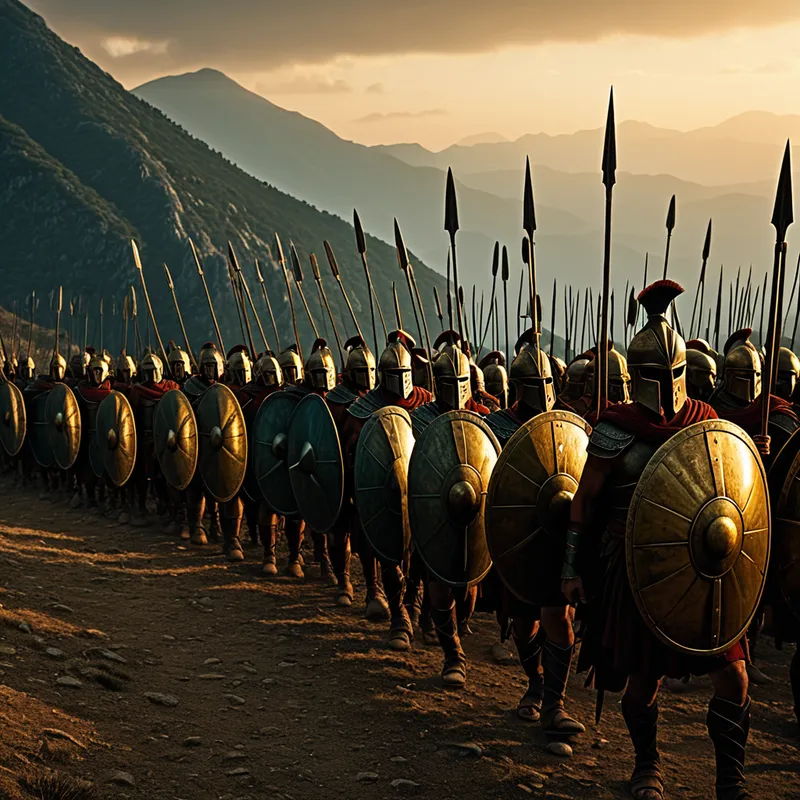
The myth of the Spartan Hoplite is the story of the individual dissolved into the phalanx, forging a living wall of bronze, blood, and unbreakable will.
The Tale of Spartan Hoplites
Hear now of the men of bronze, the sons of Lycurgus. They were born not of woman alone, but of [the river](/myths/the-river “Myth from Buddhist culture.”/) Eurotas and the flint-hearted mountains of Laconia. From their first breath, the rhythm of their lives was not a mother’s lullaby, but the distant, iron clang of the smithy and the sharp cry of the drill instructor.
As boys, they were taken from [the hearth](/myths/the-hearth “Myth from Norse culture.”/), their softness stripped away under a pitiless sun. They learned hunger as a companion, pain as a teacher, and the cold earth as a bed. They were forged in the agoge, the grinding mill that turned flesh and bone into something harder. They danced the war dances of their ancestors, their young voices chanting the poems of Tyrtaeus: “It is a beautiful [thing](/myths/thing “Myth from Norse culture.”/) for a good man to fall and die fighting in the front line for his native land.”
Then came the day of the dokimasia, the test. Before the stern-faced elders, they received their panoply: the heavy aspis, its weight a promise; the long dory, its point thirsty; the bronze corinthian helmet that stole their face and gave them a new, anonymous identity. They were no longer sons of a father, but brothers of the shield-wall.
The call would come. The Persian, a tide of gold and exotic colors, would flood the narrow pass at Thermopylae. There, the myth found its crucible. The Spartans did not fight as individuals, as heroes of old seeking personal glory. They stood shoulder-to-shoulder, shield locked to shield, a single organism of bronze and will. The crash of the collision was the sound of [the world](/myths/the-world “Myth from Tarot culture.”/) breaking. The heat was unbearable—the sun above, the press of bodies, the metallic taste of fear and effort. A man did not see the enemy before him; he saw only the back of the brother to his left, and trusted the brother to his right to cover his own. To drop the shield was not to fail oneself, but to betray the entire body, to open a fatal wound in the living wall. They fought until their spears shattered, then with swords, then with hands and teeth. Their end was not a defeat, but a final, terrible punctuation to their story—a sacrifice that echoed through the stones of the pass and down the centuries, a testament written not on [papyrus](/myths/papyrus “Myth from Egyptian culture.”/), but in blood and iron.
Cultural Origins & Context
This is not a myth of gods and monsters, but a myth of men and [the polis](/myths/the-polis “Myth from Greek culture.”/). It emerged from the harsh, militaristic society of Sparta, a culture so singular in its focus that it seemed, even to other Greeks, like a society from another age. The tales of the hoplite were not sung by bards in royal courts for entertainment; they were drilled into the [psyche](/myths/psyche “Myth from Greek culture.”/) of every Spartan citizen from childhood as sacred, practical doctrine.
The primary tellers of this myth were the Spartan citizens themselves, through the ritualized, brutal education system. The stories of legendary stands, of heroes who died rather than retreat, of the sanctity of the shield, were part of the daily fabric of life. Historians like Thucydides and, later, Plutarch, recorded the ethos, often with a mix of awe and horror. The myth’s societal function was absolute: to create the perfect component for the human machine of the phalanx. It served to annihilate individual fear and desire, replacing it with a transcendent identity bound to the survival and glory of Sparta. The myth was the spiritual glue that held the shield-wall together, making the many into one.
Symbolic Architecture
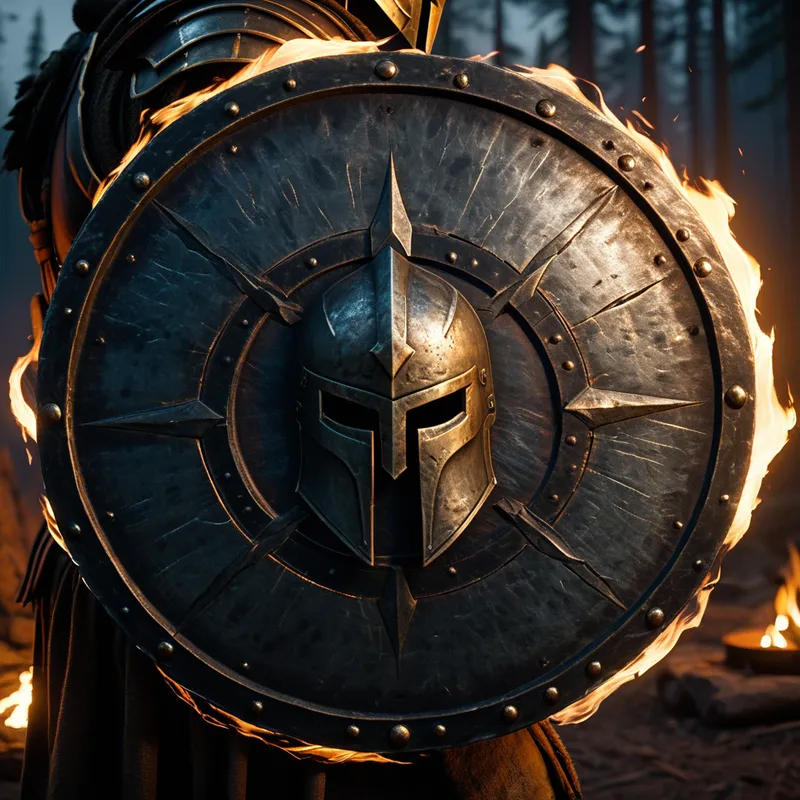
At its core, the myth of the Spartan Hoplite is the ultimate [allegory](/symbols/allegory “Symbol: A narrative device where characters, events, or settings represent abstract ideas or moral qualities, conveying deeper meanings through symbolic storytelling.”/) for the subjugation of the individual ego to a greater collective [structure](/symbols/structure “Symbol: Structure in dreams often symbolizes stability, organization, and the framework of one’s life, reflecting how one perceives their environment and personal life.”/). The hoplite is not a person; he is a function. His iconic [shield](/symbols/shield “Symbol: A symbol of protection, defense, and boundaries, representing personal security, resilience, and the need to guard against external threats or emotional harm.”/), the aspis, is the key [symbol](/symbols/symbol “Symbol: A symbol can represent an idea, concept, or belief, serving as a powerful tool for communication and understanding.”/). It was not primarily for his own protection, but for the protection of the man to his left. Your survival depended on your [neighbor](/symbols/neighbor “Symbol: A neighbor in a dream often represents social interactions, community ties, and the influence of those around you.”/)’s discipline, and his on yours.
The true armor of the hoplite was not the bronze on his chest, but the trust in the brother at his shoulder. His greatest vulnerability was not the enemy’s spear, but the failure of his own will.
Psychologically, this represents the complete internalization of a super-ego so powerful it becomes one’s entire [identity](/symbols/identity “Symbol: Identity represents the sense of self, encompassing personal beliefs, cultural background, and social roles.”/). [The personal unconscious](/myths/the-personal-unconscious “Myth from Jungian Psychology culture.”/)—with its fears, whims, and selfish drives—is eradicated through brutal discipline (agoge). What remains is a conscious [persona](/symbols/persona “Symbol: The social mask or outward identity one presents to the world, often concealing the true self.”/) perfectly aligned with a collective ideal: the Citizen-[Soldier](/symbols/soldier “Symbol: A soldier in dreams often symbolizes duty, sacrifice, and the struggle for self-discipline. It can also indicate feelings of loyalty or conflict, both externally and within oneself.”/). The terrifying corinthian [helmet](/symbols/helmet “Symbol: A helmet in dreams typically symbolizes protection, security, and the mental frameworks we use to shield ourselves from emotional pain.”/), which removed individual facial [identity](/symbols/identity “Symbol: Identity represents the sense of self, encompassing personal beliefs, cultural background, and social roles.”/), is the perfect symbol for this psychic transformation. You are no longer “you”; you are Sparta.
The Dreamer’s Resonance
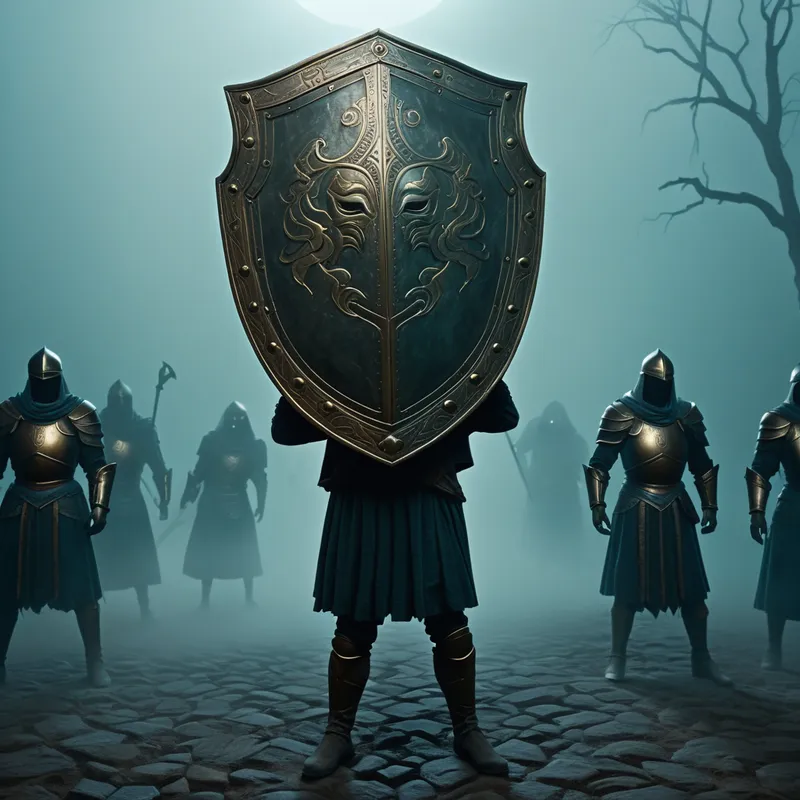
When this myth stirs in the modern psyche, it rarely appears as glory. In dreams, it manifests as immense pressure, constraint, and a terrifying loss of self. You may dream of being forced into a rigid, suffocating formation, unable to move freely. You might be handed a shield you cannot lift, or be searching frantically for your place in a line that has no end, surrounded by faceless figures.
Somatically, this can feel like a tightness in the chest and shoulders—the literal weight of collective expectation. Psychologically, this dream pattern signals a confrontation with what we have sacrificed for belonging, security, or order. It asks: What parts of your unique self have you suppressed to fit into the “phalanx” of your family, your career, your society? The dream is an expression of [the ego](/myths/the-ego “Myth from Jungian culture.”/) straining under the weight of an overly dominant [persona](/myths/persona “Myth from Greek culture.”/), a cry from the individual spirit that was buried for the sake of the collective.
Alchemical Translation
The alchemical journey modeled here is not of individuation in its flowering, but of the necessary, brutal [nigredo](/myths/nigredo “Myth from Alchemical culture.”/) that must sometimes precede it. It is the process of psychic reduction to a primary, hardened element—the lead that must exist before it can be turned to gold.
For the modern individual, the “Spartan” phase represents a voluntary or enforced period of extreme discipline, where lower impulses are burned away to serve a higher, often impersonal, goal. This could be the grueling training of an athlete, the total immersion in a creative project, or the demanding early years of building a career or family. The “phalanx” is the structure—the routine, the rules, the team—that contains and shapes this transformative fire.
The triumph is not in the battle, but in the forging. The hoplite’s victory is that he became capable of standing in the line at all.
The ultimate alchemical translation, however, lies in moving through this state. The Spartan ideal is a powerful but incomplete psychic model. True individuation requires retrieving the exiled self from that cold discipline. It means taking off the anonymous helmet, laying down the shield that protects others at the cost of yourself, and reintegrating the feeling, fragile, individual humanity that was sacrificed. One must honor the strength and resilience forged in the “hoplite” phase, but not remain eternally entombed within it. The goal is to carry the discipline within, as a tool for the integrated self, rather than being a tool of the discipline itself.
Associated Symbols
Explore related symbols from the CaleaDream lexicon: