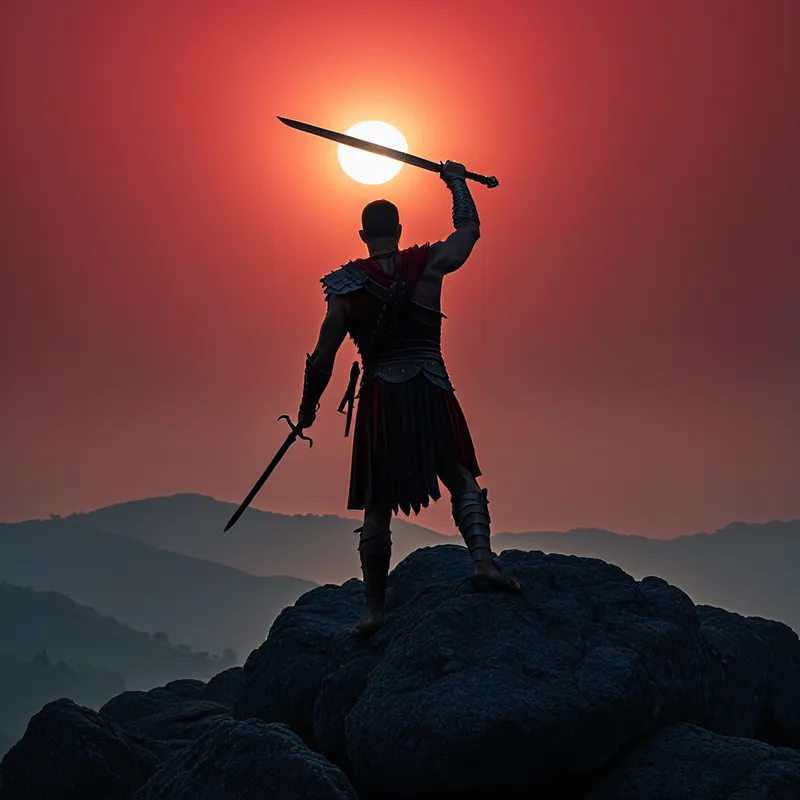
Spartacus Myth Meaning & Symbolism
A Thracian gladiator leads a slave revolt against the Roman Republic, forging a brotherhood of the oppressed in a doomed but transcendent quest for freedom.
The Tale of Spartacus
Listen. The story begins not with a king, but in the dark. In the stinking, sweat-and-blood soaked sand of the ludus in Capua. Here, men are not men; they are property, broken to the will of Rome, their spirits caged tighter than their bodies. Among them is a Thracian, a warrior who once knew the free winds of his homeland. They call him Spartacus.
He dreams not of glory in the arena, but of [the sky](/myths/the-sky “Myth from Persian culture.”/). The dream becomes a whisper, the whisper a conspiracy. In the deepest night, with the guards drowsy on their wine, Spartacus and seventy brothers seize the knives from the kitchen, the spits from the fire, the very tools of their servitude. They turn them into weapons of liberation. They burst from the gates not as fugitives, but as men reclaiming their breath. They flee to the slopes of Mount Vesuvius, a smoldering giant, as if drawn to the very heart of fire and upheaval.
From the mountain, they descend like a righteous storm. They are joined by herdsmen and shepherds, by farmers whose lands were stolen, by every soul crushed under the Roman heel. Spartacus forges them not into an army of Rome, but into a brotherhood of the desperate. They share the spoils equally. They fight with the ferocity of those who have nothing left to lose but their newfound, fragile freedom. They humiliate legion after legion sent to crush them. For two years, this republic of the oppressed moves through the belly of Italy, a living wound in the side of the empire.
But the dream has edges as sharp as a gladius. Some speak of marching north, over the Alps, to vanish into the wild lands from whence they came. Others, drunk on success, wish to turn south, to pillage and challenge Rome itself. The unity frays. The Senate, in its terror and fury, finally unleashes its full might. Marcus Licinius Crassus, the richest man in Rome, surrounds them with his legions in the southern reaches of Italy.
The final battle is not heroic; it is a slaughter. Spartacus, knowing the end, is said to have driven toward Crassus himself, cutting down two centurions before being overwhelmed. His body is never found. Six thousand of his followers are crucified along [the Appian Way](/myths/the-appian-way “Myth from Roman culture.”/) from Capua to Rome, a gruesome fence of dying men, a warning written in agony. Yet, as their last breaths fade into the Italian air, the warning becomes a promise. The name Spartacus does not die on the cross. It escapes, carried on [the wind](/myths/the-wind “Myth from Various culture.”/).
Cultural Origins & Context
This is not a myth born of poets in marble halls, but a history that was too dangerous, too potent, to remain mere history. The primary accounts come from Roman historians like Plutarch and Appian, men of the elite class who recorded the event as the greatest slave war, the Bellum Servile, a profound trauma to the Roman [psyche](/myths/psyche “Myth from Greek culture.”/). It was a story told with a mixture of horror and reluctant admiration in the senate, and likely with very different tones in the slave quarters and the crowded insulae of the poor.
Its societal function was dual and paradoxical. For the ruling class, it was a cautionary tale about the ever-present threat of the servile masses, justifying the need for brutal, absolute control. For the disenfranchised—the vast majority of the population—it was a latent dream, a secret legend of resistance. Spartacus transcended his historical reality to become a symbol. He was the proof that the machinery of empire was not invincible, that the foundational violence of slavery could be turned back upon the masters, if only for a season. The myth was passed down not in official state cults, but in the subcurrent of popular memory and later, in the works of writers and revolutionaries who saw in his struggle a timeless archetype.
Symbolic Architecture
At its core, the myth of Spartacus is the [eruption](/symbols/eruption “Symbol: A sudden, violent release of pent-up energy or emotion from beneath the surface, often representing transformation or crisis.”/) of the repressed. He represents the part of the [human](/symbols/human “Symbol: The symbol of a human represents individuality, complexity of emotions, and social relationships.”/) [spirit](/symbols/spirit “Symbol: Spirit symbolizes the essence of life, vitality, and the spiritual journey of the individual.”/) that cannot be commodified, the irreducible self that refuses to accept a designated [role](/symbols/role “Symbol: The concept of ‘role’ in dreams often reflects one’s identity or how individuals perceive their place within various social structures.”/) of subjugation.
The first act of freedom is not victory, but the conscious refusal to remain a thing.
Spartacus begins as a gladiator, the ultimate [symbol](/symbols/symbol “Symbol: A symbol can represent an idea, concept, or belief, serving as a powerful tool for communication and understanding.”/) of a man reduced to a spectacle of his own [death](/symbols/death “Symbol: Symbolizes transformation, endings, and new beginnings; often associated with fear of the unknown.”/). His rebellion is thus a radical act of re-subjectification. He reclaims his agency, his right to fight for his own [life](/symbols/life “Symbol: The symbol of ‘Life’ represents a journey of growth, interconnectedness, and existential meaning, encompassing both the joys and challenges that define human experience.”/), not for the entertainment of others. The brotherhood he forges, with its egalitarian sharing, symbolizes the creation of a new, authentic [social order](/symbols/social-order “Symbol: Dreams of social order reflect subconscious processing of hierarchy, belonging, and one’s place within collective structures.”/) from the ashes of a corrupt one. It is a fleeting attempt to build a world not on domination, but on mutual survival and respect.
His inevitable defeat is not a negation of this [symbolism](/symbols/symbolism “Symbol: The use of symbols to represent ideas or qualities, often conveying deeper meanings beyond literal interpretation. In dreams, it’s the language of the unconscious.”/), but its [crucible](/symbols/crucible “Symbol: A vessel for intense transformation through heat and pressure, symbolizing spiritual purification, testing, and alchemical change.”/). The crucifixions along the Appian Way are meant to be the ultimate display of imperial power, to erase the rebellion from [memory](/symbols/memory “Symbol: Memory symbolizes the past, lessons learned, and the narratives we construct about our identities.”/). Instead, they perform the opposite function. Each cross becomes a stark, terrible [icon](/symbols/icon “Symbol: A sacred image or revered figure representing divine presence, artistic genius, or cultural authority, often serving as a focal point for devotion or identity.”/) of the cost of freedom and the brutality of the [system](/symbols/system “Symbol: A system represents structure, organization, and interrelated components functioning together, often reflecting personal or social order.”/). The failure of the revolt is historical; its symbolic success is eternal. Spartacus becomes the martyr whose defeat seeds the future with the [idea](/symbols/idea “Symbol: An ‘Idea’ represents a spark of creativity, innovation, or realization, often emerging as a solution to a problem or a new outlook on life.”/) of [resistance](/symbols/resistance “Symbol: An object or tool representing opposition, struggle, or the act of pushing back against external forces or internal changes.”/).
The Dreamer’s Resonance
When the archetype of Spartacus stirs in the modern dreamer, it signals a profound interior rebellion. This is not about literal slavery, but about psychic captivity. The dreamer may be experiencing the “ludus” of their own life: a career, a relationship, a self-image, or a belief system that feels like a confining role, played for the approval of an internalized “Rome.”
Dreams of breaking chains, of escaping a prison with allies, or of standing defiantly against an overwhelming, faceless force (often represented by modern architectures like endless bureaucracies, monolithic corporations, or shadowy groups) are somatic echoes of this myth. The psychological process is one of gathering the fragmented, oppressed parts of [the self](/myths/the-self “Myth from Jungian culture.”/)—the neglected passions, the stifled voice, the denied anger—and uniting them into a conscious force. The anxiety in such dreams often centers on the fear of retaliation from the established order (the boss, the family, the internal critic) or the terror of the unknown freedom itself. To dream like Spartacus is to feel the terrifying and exhilarating rumble of the psyche preparing for a civil war of liberation.
Alchemical Translation
The alchemical journey mirrored in Spartacus’s story is the [Nigredo](/myths/nigredo “Myth from Alchemical culture.”/) leading to a fleeting, glorious Albedo, though the final [Rubedo](/myths/rubedo “Myth from Alchemical culture.”/) is achieved through sacrifice rather than worldly [triumph](/myths/triumph “Myth from Roman culture.”/). The starting matter is the [prima materia](/myths/prima-materia “Myth from Alchemical culture.”/) of the enslaved self, the leaden consciousness that believes it has no choice.
The first fire is applied in the darkness of the ludus: the spark of conscious outrage. This is the beginning of individuation—the realization that one is living a life not one’s own. The forging of the brotherhood represents the Coniunctio, the gathering and harmonizing of disparate, shadowy elements of the personality into a working whole, a Self that can act with purpose.
The revolution is not in toppling the outer tyrant, but in ceasing to obey the inner one.
The march through Italy is the illuminated phase, where the new Self operates in [the world](/myths/the-world “Myth from Tarot culture.”/), tasting its power and integrity. The final battle and crucifixion represent the most difficult alchemical truth: that the process of becoming whole often requires the sacrifice of the very form that the new consciousness first took. [The ego](/myths/the-ego “Myth from Jungian culture.”/)’s rebellion must be crucified so that the spirit of the rebellion can become immortal. For the modern individual, this translates to the painful understanding that the initial, reactive stance of the rebel (the angry quitting of the job, the dramatic breakup) is not the end goal. That ego-rebellion must be surrendered to a deeper, more enduring principle of inner authority and authenticity. The true triumph is not in lasting external victory, but in the irreversible internal fact that one has chosen, and fought for, one’s own soul. The legacy is not an empire, but a liberated perspective that can never be fully enslaved again.
Associated Symbols
Explore related symbols from the CaleaDream lexicon: