Sparrows of Aphrodite Myth Meaning & Symbolism
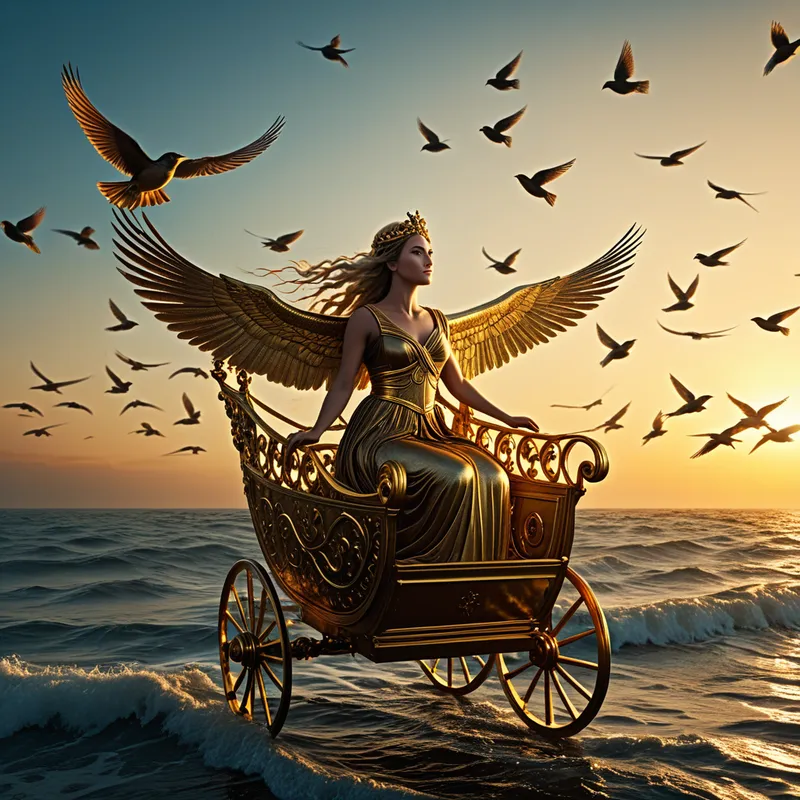
Aphrodite's chariot is drawn by sparrows, embodying love's sudden, fluttering arrival and the soul's ascent through earthly desire to divine connection.
The Tale of Sparrows of Aphrodite
Hear now the rustle of wings, not of eagles or hawks, but of creatures small and swift. From the foam-born depths where sky marries sea, she arrives. Not with the thunder of Zeus nor the strategic march of Athena, but on a whisper, a tremor in the air. She is Aphrodite, and her chariot is drawn by sparrows.
Picture it: [the chariot](/myths/the-chariot “Myth from Tarot culture.”/), wrought of pale gold and seashell [pearl](/myths/pearl “Myth from Chinese culture.”/), rests light upon the clouds. Harnessed before it, not steeds of muscle and might, but a flock—a chattering, fluttering, living cloud of sparrows. Their wings beat a rhythm like a quickened pulse, a sound both frantic and joyous. Their eyes are bright beads, knowing. They do not pull with brute force; they lift with collective desire, a rising current of yearning that carries the goddess from her oceanic origins to [the world](/myths/the-world “Myth from Tarot culture.”/) of mortals and gods alike.
When love is to be sown, when a heart of stone is to be cracked, or when divine passions are to be inflamed, it is these sparrows that bear her. They descend not as a single arrow, but as a shower. To the forge of [Hephaestus](/myths/hephaestus “Myth from Global/Universal culture.”/), they bring the scent of [the sea](/myths/the-sea “Myth from Greek culture.”/) and wild roses, stirring his lonely heart. To the fierce breast of Ares, they carry not peace, but a more captivating violence—the fever of possession. They are the first flutter in the stomach of [Psyche](/myths/psyche “Myth from Greek culture.”/) before she knows his name, the sudden, inexplicable warmth on the cheek of a shepherd gazing at a nymph.
Their flight is the arrival of the ineffable. One moment, the air is clear. The next, it is alive with their motion—a blur of brown and grey, a chorus of chirps that is the overture to obsession, to union, to the sweet agony of attachment. They are heralds of a force that disregards walls, status, and reason. As swiftly as they come, weaving the [threads of fate](/myths/threads-of-fate “Myth from Greek culture.”/) with each beat of their tiny wings, they can depart, leaving behind a heart forever altered, soaring or hollowed, in the silent space where their music once was.
Cultural Origins & Context
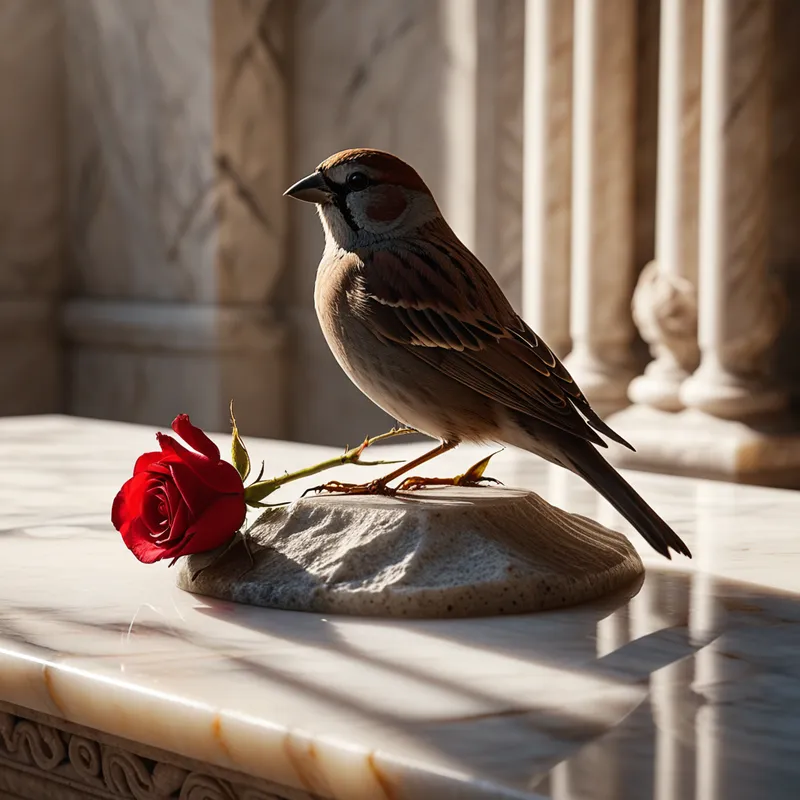
This evocative image of the sparrow-drawn chariot is not the product of a single epic poem, but a recurring motif woven into the fabric of ancient Greek lyric poetry and cult practice. We find it in the fragments of Sappho, where love is “limb-loosener” and “bittersweet,” arriving on wings. It is present in the Homeric Hymn to Aphrodite, which details her adornment and travel. The sparrow (strouthos) was sacred to the goddess, often sacrificed at her altars, particularly in her aspect as Aphrodite Pandemos.
The choice is profoundly deliberate. The Greeks, keen observers of nature, saw in the sparrow not a noble bird of prey, but a creature of prolific life, constant chatter, and bold, ubiquitous presence. It was a bird of [the hearth](/myths/the-hearth “Myth from Norse culture.”/) and the field, associated with fertility and commonplace vitality. By having her chariot drawn by these birds, Aphrodite’s power is framed not as remote and majestic, but as intimately connected to the everyday, to the persistent, bustling life-force that drives procreation and social bonding. The myth was passed down by poets and priests serving her cult, functioning as a symbolic explanation for love’s unpredictable, pervasive, and fundamentally physical nature in the human experience.
Symbolic Architecture
The sparrows are far more than quaint mythological transportation. They are the perfect psychopomps for [the force](/myths/the-force “Myth from Science Fiction culture.”/) of Eros. They symbolize the suddenness and swarming [nature](/symbols/nature “Symbol: Nature symbolizes growth, connectivity, and the primal forces of existence.”/) of desire—it rarely arrives as a single, clear thought, but as a flock of sensations, impulses, and fleeting images. They represent the libido itself: a restless, chirping, fertile [energy](/symbols/energy “Symbol: Energy symbolizes vitality, motivation, and the drive that fuels actions and ambitions.”/) that seeks [connection](/symbols/connection “Symbol: Connection symbolizes relationships, communication, and bonds among individuals.”/) and creation.
The soul does not always ascend on the wings of eagles; more often, it is lifted by the collective flutter of a thousand mundane urges, each seemingly insignificant, yet together capable of carrying us to the divine.
Their small size belies their power, mirroring how a seemingly minor [glance](/symbols/glance “Symbol: A brief, often unspoken visual connection between people, suggesting fleeting attention, hidden interest, or social assessment.”/) or touch can unleash cataclysmic emotional shifts. They are creatures of the air and the ground, bridging the heavenly [realm](/symbols/realm “Symbol: The symbol of ‘Realm’ often signifies the boundaries of one’s consciousness, experiences, or emotional states, suggesting aspects of reality that are either explored or ignored.”/) of the [goddess](/symbols/goddess “Symbol: The goddess symbolizes feminine power, divinity, and the nurturing aspects of life, embodying creation and wisdom.”/) and the earthy, embodied [reality](/symbols/reality “Symbol: Reality signifies the state of existence and perception, often reflecting one’s understanding of truth and life experiences.”/) of [human](/symbols/human “Symbol: The symbol of a human represents individuality, complexity of emotions, and social relationships.”/) [passion](/symbols/passion “Symbol: Intense emotional or physical desire, often linked to love, creativity, or purpose. Represents life force and deep engagement.”/). Crucially, they are a collective. No single sparrow draws the [chariot](/symbols/chariot “Symbol: The chariot signifies control, direction, and power in one’s journey through life.”/); it is the unified [effort](/symbols/effort “Symbol: Effort signifies the physical, mental, and emotional energy invested toward achieving goals and personal growth.”/) of the flock. This mirrors love’s nature as a force that connects—it exists not in [isolation](/symbols/isolation “Symbol: A state of physical or emotional separation from others, often representing a need for introspection or signaling distress.”/), but in the dynamic, often chaotic, [relationship](/symbols/relationship “Symbol: A representation of connections we have with others in our lives, often reflecting our emotional state.”/) between self and other.
The Dreamer’s Resonance
When the sparrows of Aphrodite flock into modern dreams, they signal an activation of the archetype of deep relational energy. To dream of a sparrow, or especially a flock, landing on you, surrounding you, or pulling you upward, often coincides with a somatic quickening. You may be on the cusp of a new relationship, a rekindling of creative passion, or a profound re-connection with your own capacity for desire and joy.
Conversely, dreaming of injured, silent, or dead sparrows can point to a libidinal depletion—a feeling that the inner wellspring of passionate engagement with life has dried up. The psyche uses this symbol to comment on the state of your Eros: is it chirping, active, and social? Or is it caged, muted, or isolated? The flight pattern in the dream is key. Chaotic, fearful swirling may reflect anxiety around emerging desires, while a harmonious, lifting flight suggests a healthy integration of this energy, carrying the dreamer toward a new level of emotional or creative expression.

Alchemical Translation
For the individual on the path of individuation, the myth models a crucial alchemical stage: the awakening and harnessing of the connective life force. The initial state is often one of psychic inertia or isolation (the unmoving chariot). The sparrows represent the primal, often undervalued, aspects of the psyche—the instincts, the bodily senses, the “base” urges for pleasure and union.
The alchemical gold is not found by transcending desire, but by allowing its flock to lift the chariot of the Self, transforming leaden isolation into golden relationship.
The process involves first acknowledging these “sparrows”—not dismissing them as trivial, but recognizing their sacred function. It then requires harnessing them. This is not indulgence, but conscious direction. It is the work of integrating these swarming, disparate impulses into a unified force that can propel the entire personality forward. The chariot is [the vessel](/myths/the-vessel “Myth from Alchemical culture.”/) of the evolving Self. The journey it takes, guided by this harnessed Eros, is toward greater connection: with the anima or animus, with the creative world, and ultimately, with a sense of belonging to [the web of life](/myths/the-web-of-life “Myth from Various culture.”/) itself. The goal is not to be drawn aimlessly by every passing whim, but to learn the art of the charioteer, who respects the power of the sparrows and guides their collective energy toward the destination of wholeness.
Associated Symbols
Explore related symbols from the CaleaDream lexicon: