
Sparrow as Divine Care Myth Meaning & Symbolism
A teaching of Jesus transforms the common sparrow into a timeless symbol of divine, intimate care for every soul, no matter how small.
The Tale of Sparrow as Divine Care
Listen. In the days when the Word walked in dust and the air hummed with a new kind of listening, there was a crowd. Not a grand assembly of kings, but a gathering of the worn—fishermen with salt-cracked hands, mothers with worry-lines like riverbeds on their brows, tax collectors hiding shame in the folds of their robes. The air was thick with the scent of dry grass and human fear.
They pressed in, these small souls, feeling the immense, terrifying weight of their own insignificance beneath a Roman sky and an indifferent heaven. What is my life, they whispered, but a breath on the wind? A number on a census? A coin in a vast, uncaring treasury?
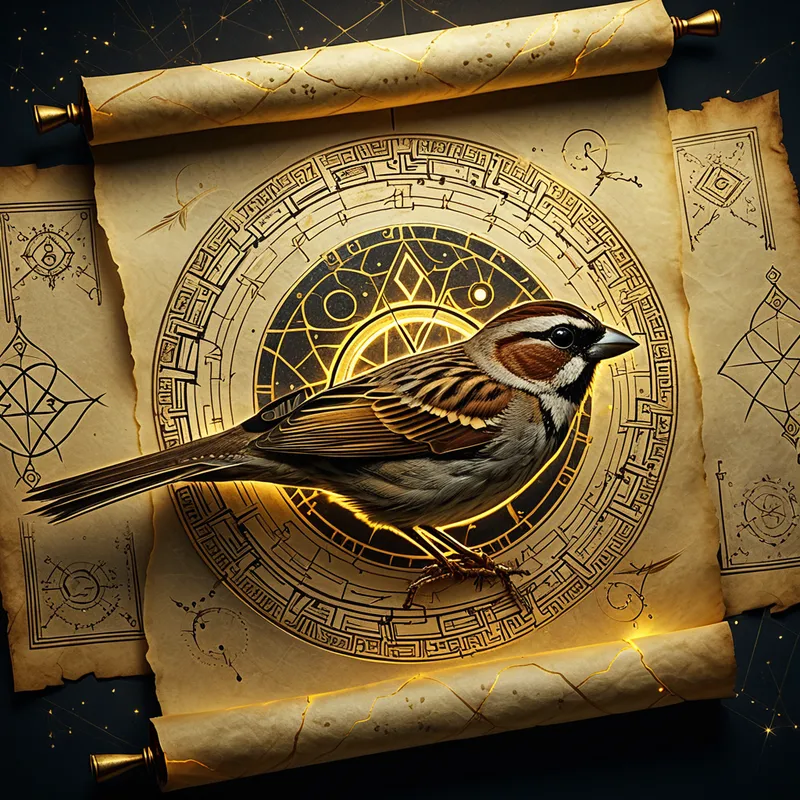
The Teacher saw them. He saw not a crowd, but a constellation of solitary anxieties. He did not point to the eagles, symbols of imperial power, nor to the sacrificial doves sold in the temple courts. His gaze fell lower, to the dusty ground, to the chittering, busy, utterly common sparrow.
“Look,” his voice carried, not as thunder, but as a quiet truth settling on the shoulders of each listener. “Are not two sparrows sold for a single, small coin? A quadrans? The cheapest thing in the market.”
He let the image hang—the image of two beating hearts, two bursts of life, traded for the most negligible of currencies. The crowd nodded. Yes. They are worth nothing.
Then came the turn, the hinge on which the universe pivoted for every listening soul. “Yet,” he said, and the word was a door opening, “not one of them falls to the ground apart from your Father.”
The silence was not empty, but full. The fall of a tiny, feathered body, unseen in a ditch—this event was not lost in the chaos. It was known. It was held. The divine gaze, which they believed tracked the movements of empires and the orbits of stars, was also bent low, intimately focused on the terminal flight of the most valueless of creatures.
He leaned into their stunned silence, his eyes meeting each pair in turn. “Fear not, therefore; you are of more value than many sparrows. Even the very hairs of your head are all numbered.”
In that moment, the myth was born. The sparrow was transfigured. No longer just a bird, it became the living proof, the feathered sacrament, of a care so meticulous, so relentless, that it attends even to the fall of that which the world prices at almost nothing. The divine economy was revealed: not one of interest in aggregates, but a heartbreaking, intimate accounting of every single one.

Cultural Origins & Context
This is not a myth from the age of heroes and epics, but from the Pax Romana, an age of vast bureaucracy, imperial weight, and individual smallness. The teaching is recorded in the Gospel accounts of Jesus’s Sermon on the Mount or his instructions to disciples being sent out. Its primary audience was not the theological elite but ordinary, often poor, and politically powerless people.
It functioned as a radical counter-narrative. In a culture where value was derived from lineage, wealth, religious purity, or social utility, this story asserted a value bestowed by divine fiat, inherent and unshakeable. It was oral teaching, repeated in house churches and whispered in catacombs, a psychological and spiritual defense against a world that said, “You do not matter.” It was pastoral theology in its purest form: a tool for soothing existential anxiety and constructing a bedrock identity of being seen and counted, directly challenging the feeling of being a faceless subject in an empire or a meaningless speck in the cosmos.
Symbolic Architecture
The sparrow is the perfect symbol because it is not perfect. It is not the majestic eagle, the pure dove, or the wise owl. It is the creature of the margins, the background noise of life. Psychologically, it represents the part of the self deemed ordinary, fragile, insignificant, and expendable—the shadow of our grandiosity.
The myth declares that the divine gaze finds its most profound focus not on our monuments, but on our fractures.
The “fall to the ground” is the central symbolic event. It represents every personal catastrophe the world ignores: a private failure, a hidden grief, a dream that dies unseen, the slow erosion of hope. The myth’s revolutionary claim is that these falls are not meaningless data points in a chaotic universe. They are sacred events witnessed by a consciousness that cares. The “numbering of hairs” extends this symbolism to an almost absurd degree of intimacy, suggesting a care that is not generic, but hyper-specific, attuned to the most minute details of our being.
The quadrans symbolizes the world’s appraisal—the harsh, reductive valuation of the marketplace that reduces life to utility and cost. The myth performs an alchemy on this coin, revealing it as a false measure. True value is assigned not by the marketplace, but by the unwavering attention of the Father.
The Dreamer's Resonance
When this myth stirs in the modern collective unconscious, it often manifests in dreams of smallness and watchfulness. To dream of a sparrow, particularly one that is injured, falling, or being held, signals a somatic and psychological process of confronting feelings of worthlessness and existential isolation.
The dreamer may be undergoing a period where they feel their work, their love, or their very presence is negligible. The psyche, through the sparrow image, is presenting the core wound: “I am unseen, and my struggles are irrelevant.” Yet, if in the dream the sparrow is observed, tended to, or its fall is somehow cushioned, it indicates the nascent activation of the inner caregiver archetype and a longing for—or a dawning sense of—an intrinsic, non-negotiable value. The dream is a negotiation between the ego’s experience of market-value worthlessness and the Self’s knowledge of inherent sacredness.

Alchemical Translation
The individuation process modeled here is the transmutation of anxiety into grounded trust, and shame into dignified belonging. The “base metal” is the ego’s identification with the world’s valuation—the quadrans. We believe we are only as good as our last achievement, our social status, our productivity. This leads to a brittle, anxious existence.
The alchemical fire is the searing, uncomfortable truth of one’s own perceived smallness. The philosopher’s stone is the realization that within that smallness lies the precise point of divine contact.
The myth guides us to consciously “become the sparrow.” This is not a regression into helplessness, but a courageous descent into vulnerability. It is to look squarely at the parts of ourselves we deem cheap, failed, or broken—the fallen sparrows of our inner landscape—and to begin to relate to them not with contempt, but with the same meticulous attention promised by the myth.
We perform the alchemy by internalizing the divine witness. We become the Father for our own fallen moments. We attend to our own falls with compassion, we number our own wounds with respect, and in doing so, we transmute the leaden weight of shame into the gold of self-acceptance. We realize our value is not something to be earned in the marketplace of the world, but a fundamental, witnessed fact of our existence. The sparrow’s flight, and its fall, becomes our own journey into a care that is first divine, then deeply, irrevocably, our own.
Associated Symbols
Explore related symbols from the CaleaDream lexicon: