Soulmates Myth Meaning & Symbolism
Humans were once four-limbed, two-faced wholes, split by Zeus. The myth of soulmates is a story of primordial unity, divine punishment, and an eternal search for completion.
The Tale of Soulmates
Listen. Let me tell you of a time before time, when the sun was younger and the earth still hummed with the first songs. In that dawn age, humans were not as you see them now—lonely, searching, two-legged creatures stumbling in the dust. No. The original human was a creature of terrifying beauty and profound power. Each being was a complete sphere, a perfect whole. They had four arms and four legs, and a single head with two faces gazing in opposite directions. They rolled, they tumbled, they moved with the grace and certainty of celestial bodies. They were three sexes: male-male, female-female, and the male-female, the androgynous whole.
These beings knew no lack. Their power was immense, their pride even greater. They did not look to the gods on Olympus for favor; they looked to each other, or rather, within themselves, and found everything they needed. They began to whisper of scaling the heavens themselves, of challenging the divine order.
On his high throne, Zeus looked down and felt not anger, but a cold, calculating dread. Such ambition could not be tolerated. The unity of these creatures was the source of their strength, and their strength threatened the cosmos. But he was a cunning god. He would not destroy them outright—that would be a waste of good worshippers. Instead, he would punish them with a curse so exquisite it would define their existence for all eternity.
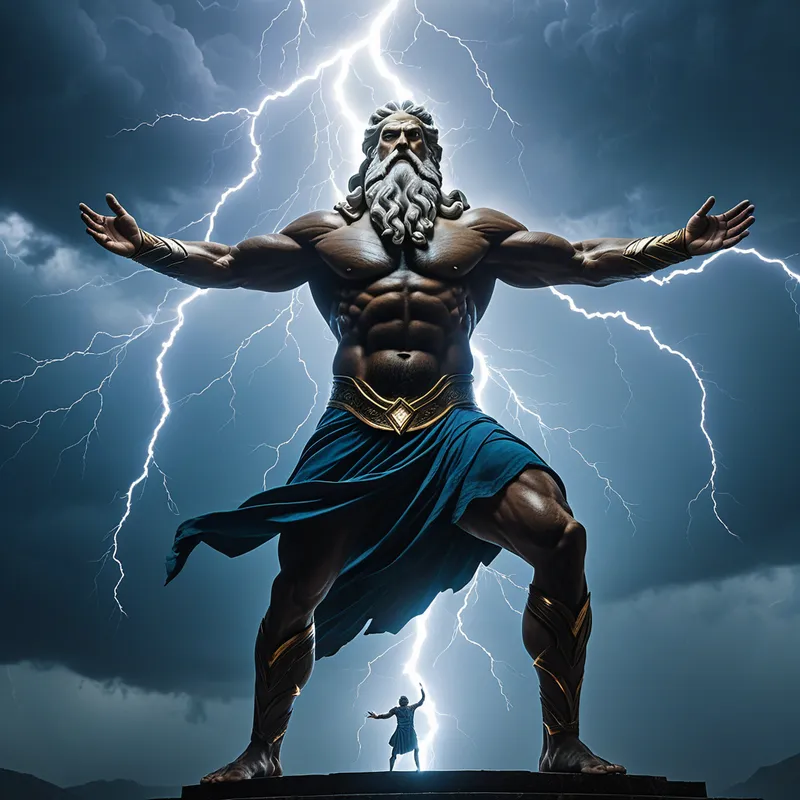
He summoned them, these rolling, glorious orbs of human flesh and spirit. With a nod to Hephaestus, the divine smith, the plan was set. There was no grand battle. There was only the sudden, searing flash of divine will. Like a gardener splitting a robust gourd, or a cook halving an egg, Zeus took his lightning and cleft each spherical human in two.
The sound was the universe cracking. Each whole was severed down the middle, the two faces torn apart, the four limbs divided. The raw, open wounds were sealed by Apollo, who pulled the skin taut around the navel, tying it off, leaving that eternal reminder of a lost wholeness. He turned the head to gaze upon the horrifying scar, so humanity would forever remember its crime and its loss.
And then… the agony. Not of the body, which healed, but of the soul. Each half, now a pitiful, bipedal thing, stumbled to its feet. Its first act was not to curse the gods, but to turn and seek its other half. They threw their arms around each other, clinging, desperate to fuse back into one being. They would not eat, they would not drink. They simply held on, trying to become whole again, to stop the terrible, hollow ache that now lived where completeness once was.
Seeing they would perish from this longing, Zeus took pity—or perhaps devised the final part of his punishment. He moved their genitals to the front. Now, when they embraced, they could find a fleeting, physical echo of that ancient unity. And so they lived, forever searching, forever grasping, two halves of a shattered sphere, driven by a memory written in their very flesh.
Cultural Origins & Context
This haunting story comes to us from the philosopher Plato, specifically from his dialogue, The Symposium. It is not a “traditional” myth in the sense of being part of the epic cycles of Homer or Hesiod. Instead, it is a myth created within a philosophical context. In The Symposium, a group of Athenian men at a drinking party take turns giving speeches in praise of Eros (Love). The comic playwright Aristophanes delivers this story as his contribution.
Its societal function was complex. On one level, it was a witty, imaginative explanation for human sexuality and the different orientations of love (explaining same-sex and opposite-sex attraction through the three original types). On a deeper level, it served as a profound philosophical metaphor within Plato’s larger body of work. It illustrated the human condition as one of inherent lack, of being severed from a state of perfect knowledge and unity (a theme echoed in his Theory of Forms). The myth gave a poetic, visceral reason for the philosopher’s relentless drive: the search for wisdom was, in essence, the search for one’s other half—the half that would make the soul complete and reconnect it to the divine whole.
Symbolic Architecture
The myth is not a prescription for romantic destiny, but a profound diagnosis of the human psyche. The original spherical human represents a state of psychic wholeness and self-containment before the dawn of consciousness and separation. It is the unconscious, paradisiacal unity of infancy, where the self and the world are not distinguished.
The split is the birth of consciousness itself—a violent, necessary divorce from the unconscious whole that creates the ego and the world of opposites.
The act of being severed by Zeus symbolizes the inevitable trauma of individuation. To become a conscious “I,” we must be cut off from the “we” of undifferentiated existence. The navel becomes the symbol of this primal wound, the physical proof of a connection that was violently severed, leaving us with an umbilical cord to nowhere.
The desperate clinging of the halves is the psyche’s compulsive drive for projection. We do not see others as they are; we see them as our missing half, the carrier of the qualities we have lost, disowned, or never integrated. Romantic love, in this ancient view, is initially a powerful form of psychic projection, where we mistake another person for our salvation.
The Dreamer’s Resonance
When this myth stirs in the modern unconscious, it manifests not as a dream of a perfect partner, but as dreams of profound searching, merging, or terrifying separation. You may dream of wandering through endless corridors looking for a room whose purpose you’ve forgotten. You may dream of a mirror that shows not your reflection, but the face of a stranger who is somehow deeply familiar. You may dream of being fused with another being, a blissful but suffocating union, or the horror of being torn apart from someone, feeling a literal, visceral rip in your chest.
These dreams signal a somatic and psychological process of recognition. The psyche is grappling with its own fragmented state. The longing felt in the dream is the soul’s longing for its own disowned parts—the anima or animus, the shadow, the inner child. The dream is a somatic map of incompleteness, pointing not outward to a savior, but inward to the territories of the self that have been walled off since that primordial “split.”

Alchemical Translation
The alchemical work modeled by this myth is not about finding your mythical other half, but about reclaiming your own wholeness. The modern journey of individuation is the conscious, willing repetition of the myth, but in reverse. It begins with the honest acknowledgment of the split—the feeling of lack, the compulsive searching, the projection onto others.
The true soulmate you seek is the integrated Self, waiting on the other side of your own divided nature.
The first operation is discernment: learning to distinguish the real other person from the projected image of your missing half. This is the painful withdrawal of projections, which feels like a second splitting, a loneliness even deeper than the first. The second operation is integration: turning inward to embrace your own opposites—the masculine and feminine within, strength and vulnerability, light and shadow. This is the slow, meticulous work of healing the jagged line left by Zeus’s bolt.
The final goal is not to become a rolling sphere again, regressing to unconscious unity. That is impossible for a conscious being. The alchemical triumph is to become a conscious circle. To hold the memory of the split within a newly forged container of self-awareness, where longing transforms from a desperate search for another into a creative force for inner union. In this state, relationship is no longer a frantic clinging of two halves trying to become one, but a sacred meeting of two wholes, choosing to share their completeness. The myth ends not with a finding, but with a becoming.
Associated Symbols
Explore related symbols from the CaleaDream lexicon: