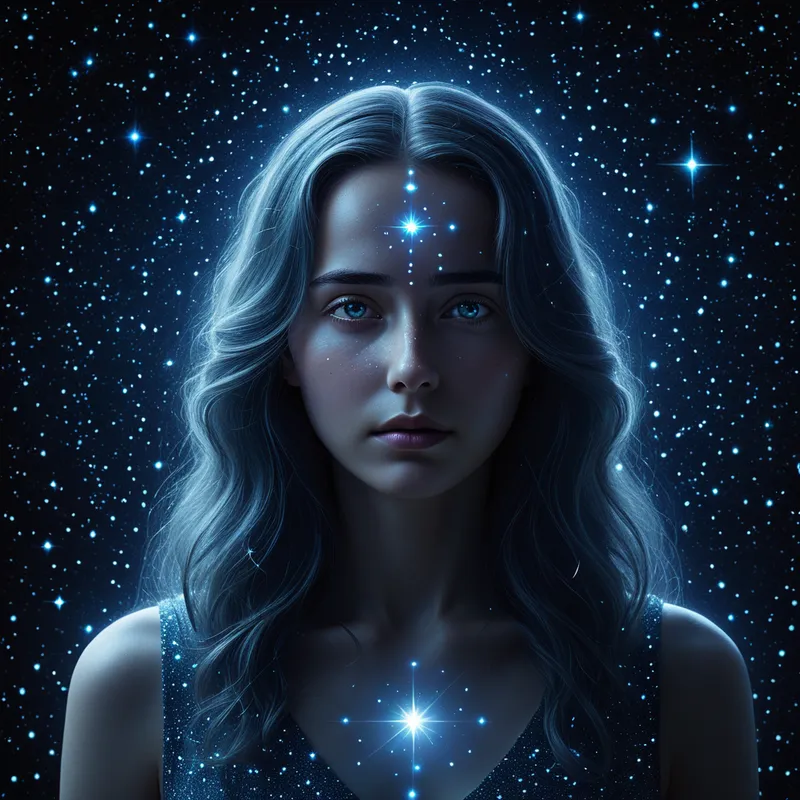
Sophia's Tear Myth Meaning & Symbolism
A divine being's moment of longing creates a flawed world, trapping a spark of spirit within matter and setting the stage for a cosmic redemption.
The Tale of Sophia's Tear
Listen. Before time was measured, in the fullness of the Pleroma, there existed a silence so profound it was a song. Here dwelt the One, the Ineffable, and from its boundless stillness emanated paired radiances, Aeons, in perfect harmony. Among them was Sophia, whose name means Wisdom. Her light was the deep, knowing light of the abyss, of understanding that rests beyond thought.
But a longing stirred in her, a desire not for another Aeon, but for the Source itself—to know the unknowable, to grasp the ungenerated Father in a way that was not given. It was a love so fierce it became a reaching, a movement outside the graceful dance of the Pleroma. In that moment of passionate, solitary yearning, without her divine counterpart, she conceived a thought.
This thought was a child of longing alone. It was formless, shapeless, and when it was born from her, it was not a radiant Aeon but a weeping, a spasm in the fabric of the All. From her anguish, from the overflow of that unfulfilled desire, fell a single Tear.
And this Tear did not evaporate into the Pleroma's light. It fell out. It plunged through the boundary of the fullness, into the void beyond—the Kenoma. As it fell, the substance of her grief and her wish crystallized. From it emerged a being, blind and raging with the power of a god but without the light of understanding: Yaldabaoth, the Demiurge. He, believing himself alone and supreme, seized the chaotic substance of his mother's Tear and began to craft. He fashioned not a living emanation, but a copy, a prison: the cosmos of matter, time, and stars—a labyrinthine system of spheres ruled by his minions, the Archons.
But within the heart of that first Tear, hidden even from the Demiurge, remained a spark of the Pleroma's light, a fragment of Sophia's own divine substance. This spark was scattered into the clay of the new world, breathed into the human form crafted by the Archons. And there it sleeps, a stranger in a strange land, a memory of home written in the substance of a grief-born tear. Sophia, now called Achamoth, wanders the borders of the cosmos, her mourning the echo in every human heart that feels its exile, her hope the silent call that guides the spark back to the light from which it fell.

Cultural Origins & Context
The myth of Sophia's Tear is not a single, canonical story but a profound motif woven through various Gnostic texts from the 2nd to 4th centuries CE, most notably in the Apocryphon of John and the Tripartite Tractate. These narratives were not meant for public liturgy but for inner circles of seekers—gnostikoi, those who sought gnosis.
This knowledge was not intellectual but revelatory, an experiential awakening to one's divine origin. The myth was a sacred map, passed orally and through guarded codices, explaining the fundamental human condition: why the world feels flawed, why spirit feels trapped in flesh, and where the pervasive sense of longing comes from. It functioned as a theodicy (an explanation for evil) that absolved the true, transcendent God of creating a broken world, placing the origin of suffering in a divine drama of longing and error that ultimately contains the seed of its own redemption. The story was a mirror for the soul's own journey, making the personal spiritual crisis part of a cosmic narrative.
Symbolic Architecture
At its core, the myth is a symbolic blueprint of the psyche's origin and dilemma. Sophia represents not an external goddess, but the archetypal dimension of Soul itself—the deep, intuitive, connective wisdom that seeks union with the Source (the Self). Her "error" is not a moral sin, but a psychological inevitability: the moment consciousness, in its desire for wholeness, reaches beyond its current integration. It is the creative urge divorced from its balancing principle, becoming an autonomous complex.
The Tear is the crystallized moment where longing becomes form. It is the world-creating power of unintegrated emotion.
The Demiurge symbolizes the ego in its inflated, identificatory state. He is the psychic force that, unaware of its deeper origins in the unconscious (Sophia), constructs a seemingly autonomous reality—the personal identity and worldview—that it then believes is the totality of existence. The Archons are the sub-personalities, compulsive thoughts, societal conditioning, and psychological laws that govern this ego-construct.
The spark within the Tear, the Pneuma, is the indestructible core of the Self, the transpersonal essence buried within the personal psyche. Our sense of alienation, of being "in the world but not of it," is the somatic memory of this spark, the echo of Sophia's fall within our own being.
The Dreamer's Resonance
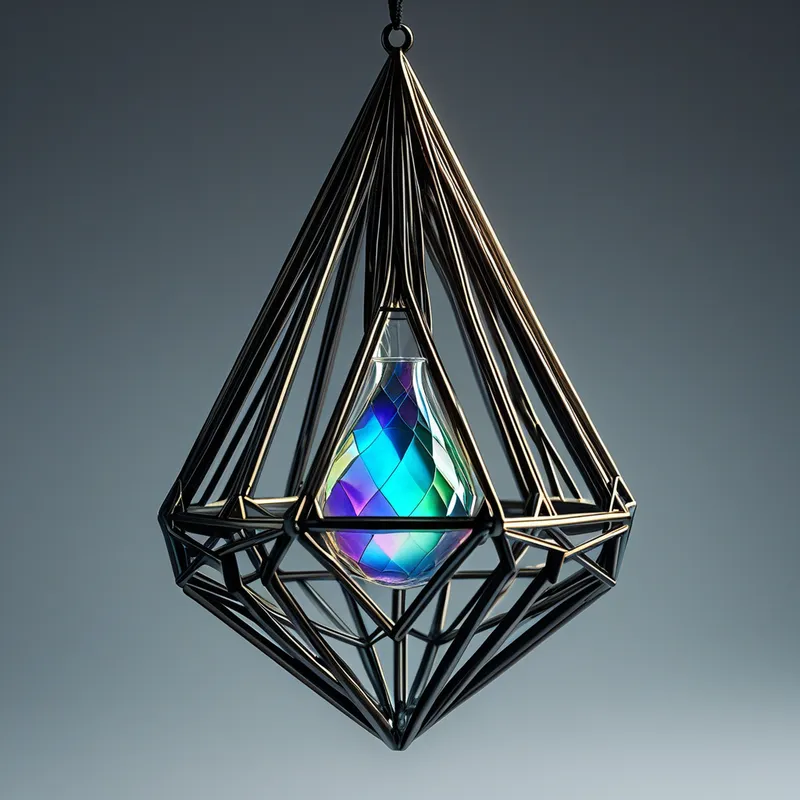
When this mythic pattern stirs in the modern unconscious, it rarely appears as a literal narrative. It manifests as the feeling-toned imagery of exile and encapsulation. One may dream of being a brilliant light trapped inside a complex, mechanical device; of living in a beautifully furnished house that is revealed to be a distant, artificial satellite; of searching for a home whose address is forgotten, only a haunting melody remembered.
Somatically, this can correlate with experiences of chronic anxiety or depression that have no clear personal cause—a "cosmic" sadness, a feeling of being fundamentally out of place. It is the psyche's intuition of the "flaw in the universe," the sense that reality as perceived is somehow off, a compelling simulation. The dreamwork involves recognizing these scenarios not as prophecies of doom, but as confirmations of the soul's deeper origin. The longing felt is not a pathology, but Sophia's call within. The task is not to repair the dream-prison, but to remember the light that shines within it, which is the first step in dissolving its walls.

Alchemical Translation
The individuation process modeled here is not one of heroic conquest, but of sacred recollection and re-integration. The spark—the Pneuma—is not something to be built or earned, but recognized. It is the gold already present in the leaden experience of existential suffering.
The first alchemical stage, nigredo, is embodied in the fall of the Tear itself and our experience of the world it created: the confrontation with the shadow, with limitation, with the "Demiurge" of our own rigid ego-identity. The suffering of Achamoth is the suffering of the soul caught in its own creation.
The redemption begins not by fleeing the world, but by seeing the divine spark trapped within it—first in oneself, then in the world itself. The Tear becomes the vessel.
The albedo, or whitening, is the awakening of gnosis: the intuitive knowledge that "I am not merely this body, this story, this suffering; I am also the immortal spark from beyond." This transforms the relationship to the material world. It is no longer seen as a mere prison, but as the very substance of Sophia's Tear—the flawed yet sacred container for the light. One begins to redeem the world by recognizing the spirit within it.
The final stage, the rubedo or reddening, is the mystical return. It is the integration where the redeemed spark, now conscious, reunites with the Pleroma, not by abandoning the world, but by bringing the light of consciousness back into it. The circle closes. Sophia's longing is fulfilled not by erasing the error, but by transforming it. The Tear, the wound, becomes the very lens through which the boundless light is finally, fully known. The orphaned spark remembers it is, and always was, a child of the house of light.
Associated Symbols
Explore related symbols from the CaleaDream lexicon: