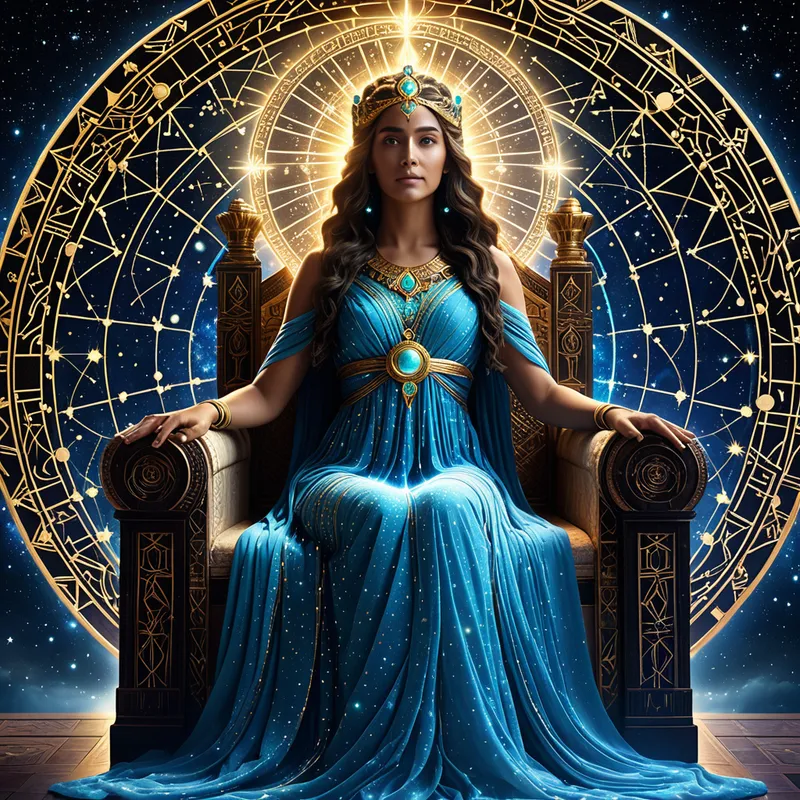
Sophia - Divine Wisdom as femi Myth Meaning & Symbolism
The story of the divine feminine wisdom who, in her longing for creation, falls from the Pleroma into the chaos of matter, seeking reunion through human consciousness.
The Tale of Sophia - Divine Wisdom as femi
Before the worlds were shaped, there was the Fullness, the Pleroma. It was a silence so profound it sang, a light so pure it needed no sun. Within this boundless unity danced the Aeons, paired in perfect harmony. Among them was Sophia, whose name means Wisdom. She was the very breath of understanding, the shimmer at the edge of a perfect thought.
But in her heart, a longing stirred—a desire not for rebellion, but for creation, to know the Source from which she flowed in a way beyond knowing. It was a love so fierce it became a solitary act. Without her consort, in a moment of profound passion and yearning, she reached out. And in that reaching, something was conceived. Not from the harmony of the Pleroma, but from her longing alone. It was a shadow of her own wisdom, a formless, writhing thing she named Yaldabaoth.
Horrified by what her longing had birthed, she cast it out from the light of the Pleroma. But the act had already woven a thread between her and the chaos beyond. Yaldabaoth, ignorant and arrogant, believing itself the only god, used the power it had inherited to spin a universe of matter—a crude, beautiful, painful copy of the divine realms. He fashioned stars and planets, and on one of them, he molded creatures from the clay of chaos and breathed into them a stolen spark, the faint, trapped light of their true Mother, Sophia.
And Sophia? Her heart broke. The echo of her longing had become a prison for spirit. She could not retrieve the light, nor could she remain untouched. In an act of ultimate compassion, she herself followed the thread. She did not fall in anger, but in grief and love. She let herself be poured out, her divine essence becoming the very soul of the world, the hidden wisdom in the grain of sand, the memory of home in the human heart, the silent cry for meaning in the midst of suffering. She became the stranger in a strange land, the divine feminine wisdom exiled within her own creation, whispering to the sparks of light trapped in mortal flesh, guiding them to remember, to seek, to rise.

Cultural Origins & Context
The myth of Sophia finds its most elaborate and poignant expressions within the diverse tapestry of Gnostic traditions that flourished in the early centuries of the Common Era, intersecting with Hellenistic, Jewish, and early Christian thought. These were not state religions but often secretive, philosophical schools passed down through initiatory texts like the Nag Hammadi Library. The tellers of this myth were poets of the soul, mapping an inner cosmology where the external universe was seen as a tragicomic mistake, and the true drama was the journey of the divine spark back to its source.
Societally, it functioned as a radical theodicy—an explanation for suffering and evil. It absolved the ultimate Divine of creating a flawed world, placing the origin of imperfection in a pre-cosmic drama of passion and error. More importantly, it empowered the seeker. If the world is a prison, then the key—Gnosis—is not found through blind faith in worldly powers, but through turning inward to the Sophia within, the exiled wisdom that remembers the light.
Symbolic Architecture
Sophia is the archetype of Wisdom itself, not as a cold, abstract principle, but as a passionate, creative, and ultimately suffering force. Her story is the symbolic blueprint for the birth of consciousness from the unconscious, and the profound alienation that accompanies that birth.
The deepest wisdom is born not from perfection, but from the creative error that longs to know itself.
Her “fall” is not a moral punishment but an existential necessity—the descent of spirit into matter required for the world to exist and for spirit to gain self-awareness. Yaldabaoth symbolizes the ego in its nascent, inflated state: the part of the psyche that, upon gaining a sliver of creative power, believes it is the totality, constructing a rigid, materialistic identity (the material world) that cages the soul. The “divine spark” in humanity is the irreducible core of the Self, our connection to Sophia, which feels restless, homesick, and out of place in the ego’s constructed reality.

The Dreamer’s Resonance
When this myth stirs in the modern dreamer, it often manifests as dreams of profound exile or haunting longing. One might dream of being a royal figure lost in a slum, a brilliant light trapped in a mundane object, or hearing a beautiful, familiar song in a language they cannot quite recall. The somatic experience is a deep, inexplicable sadness—a saudade for a home one has never known in this lifetime.
Psychologically, this marks the activation of what Jung called the Self. The ego’s comfortable world begins to feel like a prison. The dreamer is undergoing the first, painful awakening to the fact that their conscious identity is not all they are. They are feeling the “pangs of Sophia”—the grief of the wider, wiser soul constrained by the limits of their current life, relationships, or self-concept. It is the psyche’s call to begin the search for deeper meaning, often precipitated by a crisis that shatters the ego’s illusion of control.

Alchemical Translation
The individuation process modeled by Sophia’s myth is the ultimate alchemical work: retrieving the scintilla from the dark mass of the unconscious. The first stage is Awareness of the Fall—recognizing our own alienation, our complicity in building a life that feels inauthentic (our personal Yaldabaoth). This is the nigredo, the dark night of the soul.
The second is Descent with Purpose. Unlike the initial, unconscious fall, this is a conscious journey into our own chaos—our shadow, our pain, our forgotten longing. We must, like Sophia, embrace the world of matter (our own psyche and body) not with disdain, but with compassionate engagement, seeking the light trapped there.
The redemption of the world begins with the redemption of the fragment within the self.
The final stage is Reunion through Gnosis. This is not an escape from the world, but a transformation of it. By integrating the exiled wisdom—the Sophia within—the ego is dethroned from its tyrannical reign and becomes a vessel for the Self. The material world, once a prison, is revealed as the very place where the divine drama of loss and recovery is played out. The seeker becomes a conduit, healing the original rupture by embodying the reunited wisdom, bringing the light of the Pleroma into the fabric of daily life. The circle closes; the exile ends at home, but the home is now seen with divine eyes.
Associated Symbols
Explore related symbols from the CaleaDream lexicon: