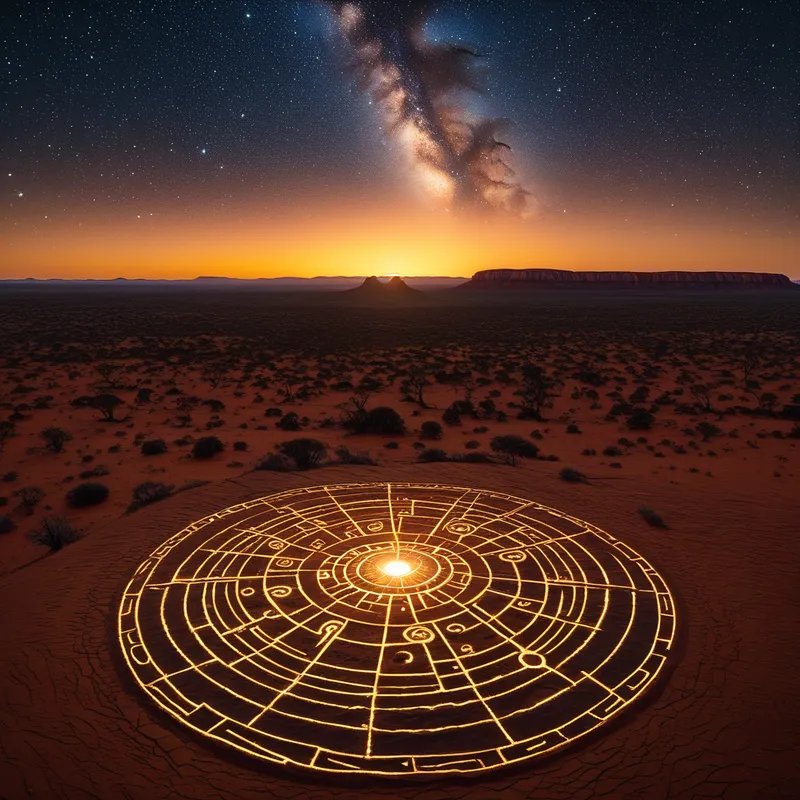
Songlines Myth Meaning & Symbolism
The land was sung into being by ancestral beings. Their journeys became Songlines, a living map of law, story, and identity, connecting all life.
The Tale of Songlines
In the Dreamtime, the world was a vast, sleeping plain. It was formless, silent, and waiting. Then, from the stars and from the deep earth, the Ancestral Beings awoke. They were not gods as others know them, but embodiments of the forces of life itself: the Rainbow Serpent, the Emu, the Kangaroo, the Honey Ant. They stirred, and in their stirring, they began to dream the world into solidity.
They did not build or command. They journeyed. The Wagyl slithered across the soft earth, and where its mighty body pressed, rivers carved their beds and waterholes sprang forth, cool and deep. The Mala bounded in great, joyful leaps, and the impact of its feet formed valleys and scattered the first seeds of the desert oak. The Gurumarra ran, its feathers brushing the ground to create sandhills, its call shaping the wind.
But these were not silent travels. With every movement, every act of creation, conflict, love, or hunting, the Ancestors sang. They sang the names of the places they made. They sang the essence of the water, the stone, the tree, the animal. The song was the action, and the action left a track. The track was the song. This song was not merely about the land; it was the land. It was a vibrational blueprint, a living memory etched into the very substance of the world.
Sometimes, an Ancestor would grow weary and sink into the earth, becoming a mountain. Another would throw a spear that became a ridge of hills. A fight would leave a scatter of rocks that held the echo of the struggle. At each of these places, the song changed, acquiring a new verse, a new note that described this transformation. Finally, having completed their epic wanderings, the Ancestors returned to the earth or the sky, but their power did not depart. It remained, sleeping in the places they shaped, alive in the songs they left behind.
And so the world was made: not from chaos, but from a symphony of journeys. The entire continent became a vast, interlocking web of these sung pathways—the Songlines. A person who knows the song for a stretch of country can walk it, singing it back into being with each step, navigating perfectly, because to sing the country is to become one with the Ancestor who created it. The land remembers. And it listens.

Cultural Origins & Context
The Songlines are the living heart of Aboriginal cosmology and law, a system of knowledge believed to be over 60,000 years old. This is not a single, unified “myth” but the foundational framework for hundreds of distinct Aboriginal nations across the Australian continent. The knowledge is not written but inscribed in ceremony, art, and, most critically, in song.
The custodians of specific Songlines are the elders of the clan or nation whose territory that segment of the dreaming track traverses. Knowledge is passed down through meticulous oral tradition, often in initiation ceremonies. To learn a Songline is to inherit a sacred responsibility. It is a legal title, a deed to country, a map, a history book, and a moral compass all woven into one melodic narrative. The song contains instructions for finding water, identifying food sources, understanding seasonal changes, and knowing the stories of creation specific to that place. Its primary societal function is to bind people inextricably to their Country. You are not on the land; you are of it, a living part of its continuing story.
Symbolic Architecture
At its core, the Songline is a profound symbol of the inseparability of consciousness and world, of psyche and matter. It represents the idea that reality is not a dead, objective space but a narrated, ensouled, and participatory field.
The path is not found by looking at the ground, but by listening to it. To know where you are, you must remember who you are.
The Ancestral Beings symbolize the archetypal forces of the collective unconscious—primal patterns of behavior, creation, and relationship that pre-exist the individual. Their journeys represent the process by which these amorphous potentials become manifest, taking specific form in the landscape of an individual life or a culture. The land itself becomes a symbol for the embodied psyche, with its mountains (lofty ideals), waterholes (deep emotions, the unconscious), and deserts (periods of aridity or challenge).
The act of singing the country is the ultimate symbol of recognition and relationship. It is an active remembering that heals the perceived split between the inner self and the outer world. You do not possess the song; the song possesses you, and in doing so, it reveals your true location within a vast, meaningful order.
The Dreamer’s Resonance
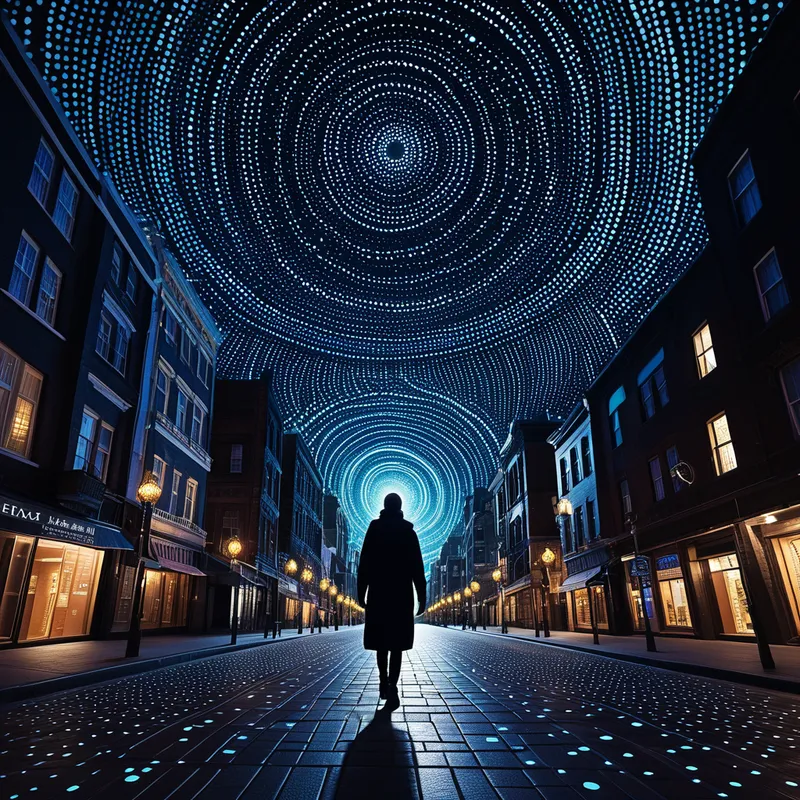
When the pattern of the Songlines emerges in modern dreams, it often manifests not as a literal Australian landscape, but as a profound experience of navigating by resonance. A dreamer might find themselves in a labyrinthine city or a featureless plain, yet feel an instinctive pull, a knowing of the correct turn or path based on a felt sense, a hum, or a fragment of melody. They are not following a map, but a frequency.
Psychologically, this signals a process of re-orienting the psyche according to its own innate, archetypal blueprint, rather than external, imposed directions. The somatic feeling is often one of deep relief and alignment—a “coming home” to the body’s wisdom. Conversely, dreaming of being lost in a known place, where all landmarks seem silent and unresponsive, reflects a state of disconnection from one’s inner Songline—a loss of personal myth and purpose. The dream is urging a re-attunement, a listening beneath the noise of the ego to the older, slower song of the soul.
Alchemical Translation
The alchemical process modeled by the Songlines is that of psychic orientation and individuation as re-membrance. The modern individual often experiences life as a series of disconnected events in a meaningless space. The Songline myth proposes that wholeness is found not by escaping this landscape, but by learning to sing it.
The first stage is the Nigredo: the feeling of being lost in a trackless, silent world (the uncreated plain). The conflict is disorientation. The alchemical work begins with the question: “What is the original song of my being?” This involves descending into one’s own Dreamtime—the unconscious—to connect with the archetypal patterns that shape our fundamental drives and talents (the Ancestors awakening).
Individuation is not a journey to a new place, but the recovery of the ancient song that has always described the contours of your soul.
The Albedo is the process of tracing these patterns through the landscape of one’s life—recognizing how a childhood trauma formed an emotional waterhole, how a period of passion carved a river of creativity, how a stubborn challenge stands as a mountain range. You give these features their true names through introspection and narrative.
The Rubedo, the reddening or culmination, is the act of consciously singing this personal Songline. It is the integration where you walk your life’s path not as a series of accidents, but as the faithful performance of your unique stanza in the world’s eternal song. You become, simultaneously, the Ancestor creating the track, the singer navigating by it, and the country being sung. In this act, the psychic substance is transmuted from leaden isolation into golden connection. You achieve orientation not by a compass, but by congruence, finding your way by becoming the way itself.
Associated Symbols
Explore related symbols from the CaleaDream lexicon: