Songbirds Myth Meaning & Symbolism
A tale of the gods' stolen music, a hero's harrowing journey to the Otherworld, and the sacrifice required to bring the soul's song back to the world.
The Tale of Songbirds
Listen now, and let the hearth-fire grow low. Let the shadows deepen in the corners of the hall. I will tell you of a time when the world was younger, and the music of creation still hummed in the stones and the streams.
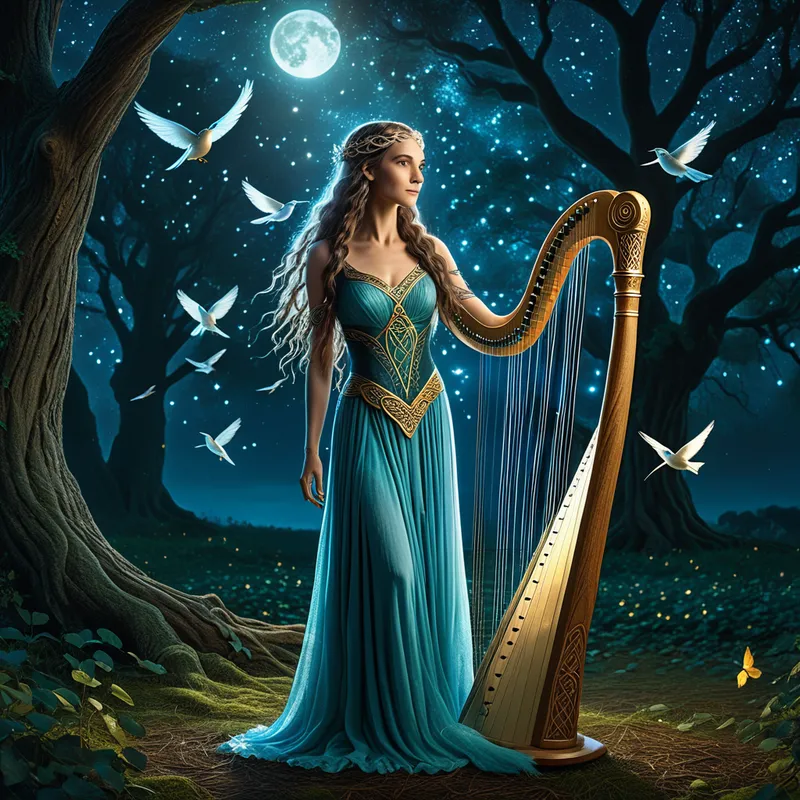
In the Sídhe, where time flows like honey and apple trees bear blossom and fruit together, there lived a goddess. She was Boann, and her voice was the source of all melody. When she sang, the rivers changed their course to listen. When she plucked the strings of her silver harp, three songbirds would alight upon its curve. These were no ordinary creatures. One was the colour of dawn’s first blush, one the deep blue of a twilight sky, and one the radiant white of the midday sun. Their song held the pattern of the seasons, the rhythm of the tides, and the secret name of every living thing. Their music was the soul of the land itself.
But a shadow fell from the north. Balor of the Evil Eye, who hated all beauty that was not his own power, coveted this song. He could not create, so he resolved to steal. On a night when the moon was dark, he sent a cold, silent wind that crept into the sídhe-mound. It did not ruffle a single petal, but it carried a sleep so profound that even Boann’s eyelids grew heavy. As she slumbered, the three luminous birds fell silent, their light dimmed. Balor’s shadowy servants, beings of smoke and spite, snatched the birds in nets of woven silence and fled back to their master’s fortress, a grim island of black stone in a sea of perpetual mist.
The world grew quiet. The rivers ran sullen and straight. The wind no longer whistled but only moaned. The hearts of the people grew heavy, for though they could not name what was missing, they felt a hollow ache in the very air they breathed.
A hero heard this silence. His name was Cú Chulainn, but in this tale, he was not the raging Hound of Ulster. He was a man who remembered the song from his childhood, a memory that pricked him like a thorn. He stood before the grieving Boann. “I will go,” he said, his voice the only sound in the silent hall. “I will bring back the songbirds.”
His journey was not one of clashing armies, but of deepening dread. He took a coracle of hide and wicker, and for nine days and nine nights, he rowed across a grey, soundless sea where no wave broke, only slid. He found Balor’s island, a place where the very rocks seemed to drink light. The fortress had no gate, only a mouth-like entrance. To enter, Cú Chulainn had to lay aside his spear and shield—the tools of war were useless here. He entered armed only with his breath and his beating heart.
Within, he did not find a monster to fight, but a labyrinth of echoes. Balor’s power was the power of absence, of vacuum. The hero felt his own memories of music being pulled from him, his courage leaching away into the stillness. In the deepest chamber, he saw them: the three songbirds, now dull and small, each in a separate cage of bone. And he saw Balor, not as a giant, but as a vast, listening silence in the shape of a man.
“You cannot take them,” the silence spoke into his mind. “To carry a song from this place, you must leave a song behind. Your voice for one. Your memory of love for another. Your hope of return for the third. This is the price.”
Cú Chulainn did not hesitate. For the dawn-bird, he sang his own battle-chant, his ríastrad, and felt his throat close, his warrior’s voice gone forever. For the twilight-bird, he gave the memory of his wife Emer’s face, and a cold emptiness took its place in his chest. For the sun-bird, he surrendered the image of his homeland’s green fields, and knew he would wander lost. As each sacrifice was made, a cage shattered. The birds, now free, grew bright. They did not fly to him, but through him, their light burning away the silence within.
He stumbled from the fortress, hollowed out, a shell of a man. The coracle bore him back, guided not by his hand but by the faint, rekindled song now held within his own breastbone. When he reached the shore of the Middle World, he could not speak to tell of his journey. But where he stepped, grass grew greener. Where his silent tears fell, flowers bloomed. He returned to Boann’s mound and simply knelt. As he did, the three songbirds flew from his parted lips, restored to their full glory, and alighted once more upon the goddess’s harp.
And their song returned to the world, richer and more poignant than before, for it now contained within its notes the memory of silence, the cost of sacrifice, and the echo of a hero’s lost voice.

Cultural Origins & Context
The motif of the stolen otherworldly treasure—often animals, cauldrons, or musical artifacts—is a deep vein in Celtic narrative, found across the Irish, Welsh, and broader Brythonic traditions. While no single, standardized “Myth of the Songbirds” exists in a primary text, the tale woven here is a composite tapestry of authentic Celtic patterns. It draws heavily on the Irish Mythological Cycle and the Ulster Cycle, where journeys to the Tír na nÓg or to the fortresses of Fomorian foes like Balor are common. The figures of Boann and Cú Chulainn are lifted directly from the lore, though their interaction in this specific story is a bardic synthesis.
This is a myth that would have been told not to record history, but to model a psychological and spiritual reality. It was likely the province of the filí, the poet-seers. Their role was to maintain the fírinne, the truth and integrity of the tribe, which was intimately connected to the health of the land. The story of the stolen songbirds is a metaphor for a tribe’s loss of fírinne—their collective spirit, identity, and harmony with the natural order. The hero’s quest is the necessary, perilous work of restoration, a work that always demands a price. It functioned as a sacred map for understanding crisis, loss, and the non-negotiable cost of retrieving one’s soul from the clutches of despair or corruption.
Symbolic Architecture
At its core, this myth is not about birds, but about the animating spirit—the soul’s unique melody. The three songbirds represent the tripartite soul found in many Celtic cosmological views: the vital spirit (dawn-bird), the emotional and relational heart (twilight-bird), and the higher consciousness or connection to the divine (sun-bird). Together, they form the complete “song” of an individual or a culture.
The theft of the song is the trauma that separates us from our own essence, leaving us functional but hollow, moving through a world stripped of meaning.
Balor is not merely a villain; he is the archetypal force of entropy, negation, and psychic theft. His island fortress is the psychological state of depression, dissociation, or complex trauma—a place where the inner world is frozen and void. The hero’s laying aside of weapons to enter signifies that this battle cannot be won by force of will or ego; it requires vulnerability and surrender. The price demanded—voice, memory of love, hope of return—is the brutal calculus of the unconscious. To reclaim a lost part of the self, one must often sacrifice a cherished, familiar part of the conscious personality. The warrior must give up his identity as a warrior. The lover must forget the face of love. The hopeful must release their attachment to a known future.
The triumphant return is notably quiet, even tragic. The hero is permanently altered, carrying the wounds of his exchange. This reflects a profound Celtic understanding of healing: it is not a return to a pristine, untouched state, but an integration of the loss. The song is restored, but it now contains the memory of the silence.
The Dreamer’s Resonance
When this myth stirs in the modern dreamer, it often manifests as dreams of theft, loss of voice, or encounters with mute, captive animals. You may dream of a cherished locket being stolen, of opening your mouth to scream in warning but producing no sound, or of finding a beautiful, fragile bird trapped in a dusty attic room. The somatic experience upon waking is often a tightness in the throat, a hollow ache in the chest, or a feeling of profound weariness.
These dreams signal that a vital part of the dreamer’s psychic energy—their creativity, passion, or sense of purpose—has been captured by a complex. This “Balor” might be an internalized critic, a past trauma, or a life circumstance that has drained their vitality. The dream is the first call from the Self, indicating that a part of the soul has gone missing in the misty lands of neglect or oppression. The dreamer is being positioned as the hero of their own story, not to fight, but to prepare for a journey of reclamation that will demand a heartfelt sacrifice. The feeling of emptiness is not the problem, but the diagnosis.
Alchemical Translation
The myth of the Songbirds is a precise allegory for the Jungian process of individuation, particularly the stage of confronting the shadow and reclaiming anima/animus energies. The journey to Balor’s island is the descent into the unconscious—the nigredo. Here, the bright, conscious attributes (the songbirds) are found to be imprisoned not by a foreign monster, but by the dreamer’s own unintegrated darkness (Balor as shadow).
The sacrifice demanded at the core of the labyrinth is the alchemical solutio—the dissolution of the old, rigid ego identity so that a more complete Self can coalesce.
Cú Chulainn’s sacrifices—his voice, his memory of love, his hope—represent the deconstruction of the persona. The warrior must release his need to be perceived as strong. The lover must let go of a sentimental, possessive idea of connection. The seeker must abandon the linear, guaranteed roadmap for the future. This is not destruction, but alchemical dissolution. The birds, flying through him, perform the albedo, a cleansing and illumination from within. He becomes the vessel for the transformed substance.
The return to the world, silent and wounded yet causing life to bloom in his footsteps, symbolizes the integrated individual. They may not have the loud, heroic glory of their former persona, but their very presence has a generative, healing effect on their environment. Their “song” is no longer a performance for the outer world, but an authentic, embodied frequency that restores harmony because it has integrated the dissonance. The myth teaches that our deepest wounds and most costly sacrifices are not the end of our song, but the very elements that give it depth, resonance, and true power.
Associated Symbols
Explore related symbols from the CaleaDream lexicon: