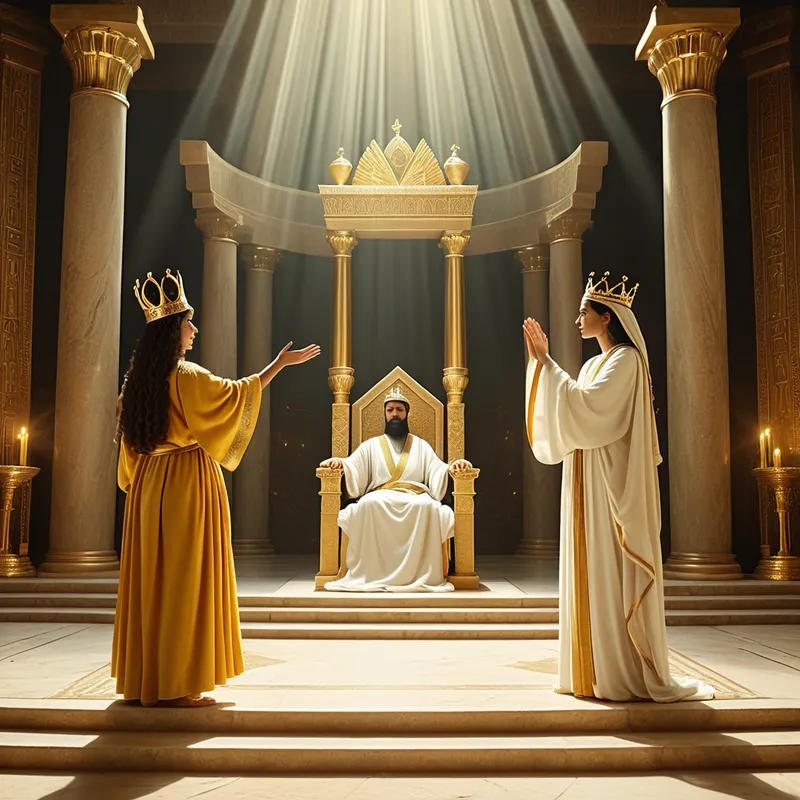
Solomon's Judgment Myth Meaning & Symbolism
A king's terrifying proposal to divide a living child reveals the true mother through her selfless love, embodying divine wisdom in human judgment.
The Tale of Solomon’s Judgment
Let the tale be told of the day wisdom wore a crown of flesh. In the city of Jerusalem, where the stones remembered the footsteps of the shepherd-king, his son now sat upon the lion-throne. He was Solomon, young, his brow still smooth, but his eyes held the weight of a prayer granted—a listening heart to govern the people.
The air in the hall of judgment was still, heavy with incense and the breath of supplicants. Then came the commotion: two women, their robes plain and worn by the same hardship, dragged before the dais. Between them was not a boundary stone or stolen lamb, but the silent, sleeping form of an infant, a boy, his life a tiny flame in the gloom. Their voices, sharp as flint, struck the air, each claiming the child as her own. “The living one is my son,” cried one, her face ravaged by a true and recent grief. “The dead is hers!” “No!” shrieked the other, her eyes burning with a possessive fire. “The living child is mine! Hers is the one who died!”
Back and forth the accusation flew, a serpent of words coiling around the truth. The court murmured. How to judge when love and lies wear the same face? How to peer into the dark womb of the night to see which heart had truly borne this life?
Solomon listened. He did not look to the law scrolls or to his advisors. He looked into the space between the women, at the child who belonged to the world of breath and cry. A silence fell, profound and terrifying. Then the king spoke, and his voice was not thunder, but the calm, terrible clarity of a blade being drawn.
“Bring me a sword.”
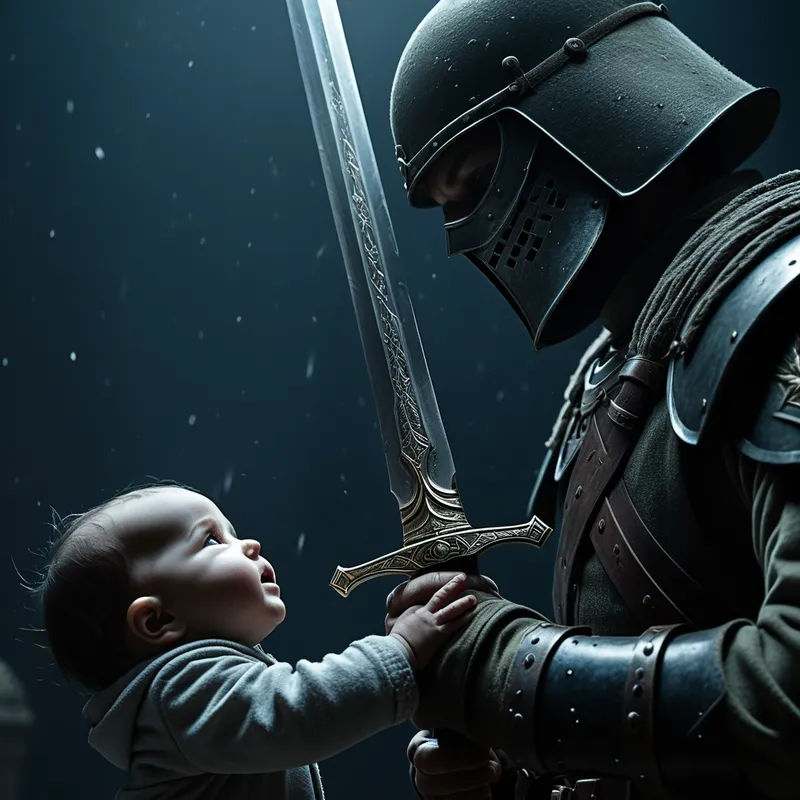
A gasp rippled through the hall. The guard approached, a length of cold, sharp iron in his hands. Solomon’s decree hung in the air, final as a falling stone. “Divide the living child in two. Give half to the one and half to the other.”
For a heartbeat, time shattered. Then, one woman’s face hardened into a grim acceptance. “He shall be neither mine nor yours,” she said, the words like ice. “Divide him.”
But the other woman—her soul was torn asunder by the king’s words. A cry was wrenched from the very root of her being, a sound that had no language but agony. She threw herself forward, her hands not reaching for the child, but flung out in desperate surrender to the king. “Oh, my lord,” she wept, her voice breaking upon the words, “give her the living child. Only do not kill him.”
In that cry, in that absolute, self-annihilating gift, the truth blazed forth. The king pointed, his gesture now one of gentle, irrevocable authority. “Give the living child to her,” he commanded. “She is his mother.”
And all Israel heard of the judgment, and they stood in awe of the king, for they saw that the wisdom of the divine was in him to execute justice. Not by probing the past, but by revealing the heart in the crucible of the impossible present.
Cultural Origins & Context
This narrative is embedded within the Tanakh, specifically in the First Book of Kings. It functions as the paradigmatic demonstration of the divine gift Solomon requested and received: a “listening heart” to discern between good and evil. In the ancient Near Eastern context, the king was not merely a political ruler but the earthly embodiment of justice, a conduit for divine order (Ma’at in Egyptian thought, Mishpat and Tzedek in Hebrew). This story served to legitimize Solomon’s reign, illustrating that his authority was rooted not in military might but in a wisdom that could see into the human soul.
Passed down orally and later scribally, the tale was likely told and retold in royal courts and at city gates, where judgments were rendered. Its societal function was multifaceted: it was a lesson for rulers on the nature of true judgment, a reassurance to the people of a just sovereign, and a profound theological statement about the character of the divine wisdom (Chokhmah) that orders the world—a wisdom that can use a shocking, almost cruel, proposition to coax selfless love into the light.
Symbolic Architecture
At its core, the myth is an alchemical drama of discernment. The two women represent the dualistic nature of a profound psychological or moral dilemma. They are not simply “truth” and “lie,” but two potential outcomes of a single, torn reality. One claims possession through biological fact; the other through the lived reality of care, even if born of theft and desperation. The child is the bone of contention, the undivided value—be it a soul, a truth, a creative work, or one’s own authentic self—caught between conflicting claims.
True wisdom does not choose between two presented options; it creates a third, transformative space where the heart’s deepest allegiance is forced to reveal itself.
Solomon, the Sage archetype, does not seek evidence. He engineers a crisis. The sword is the symbol of radical discrimination, the sharp edge that can sever illusion from reality. His proposed “solution” is a horrifying parody of compromise—splitting the difference. This forces the dilemma out of the realm of argument and into the realm of the somatic and sacrificial. The true mother’s reaction is not intellectual; it is a visceral, self-emptying surrender. Her love is proven not by what she claims, but by what she is willing to relinquish. The false mother’s acquiescence to the division reveals a heart where possession and envy have already killed the living connection.
The Dreamer’s Resonance
When this myth patterns a modern dream, the dreamer is in a state of profound inner conflict where two compelling, seemingly equal, or identical forces vie for ownership of something vital. You may dream of two identical houses, two demanding bosses, two paths, or two lovers. The central “child” could be your talent, a relationship, a career opportunity, or your own sense of identity.
The somatic feeling is one of being torn apart, of impossible choice. The dream often lacks a clear “Solomon” figure, leaving the dreamer in the agonizing position of both claimant and judge. This signals that the psyche is attempting its own discernment. The crisis point—the moment of the sword—manifests as a sudden, shocking dream event: a bridge collapsing, a vital object breaking, or a mandated sacrifice. Pay attention to your dream-body’s reaction. Which part of you is willing to let go to preserve life? Which part would rather see the whole thing destroyed than lose control? The dream is staging the conflict to force your own “true mother”—your deepest, most life-affirming instinct—to speak through surrender.

Alchemical Translation
The psychic transmutation modeled here is the movement from entangled conflict to clarified sovereignty. We all face internal “two women” scenarios: the part that wants security versus the part that wants freedom; the critic versus the creator; the persona versus the shadow. Each claims to be the rightful owner of our energy and life.
Individuation often requires the kingly ego to command the “sword” of conscious discrimination, not to destroy, but to provoke the soul’s authentic response.
The alchemical process is threefold. First, Presentio: bringing the conflict fully into the court of awareness (the two women before the throne). Second, Crucibulum: applying the heat of an impossible choice, the terrifying proposal of “splitting the child.” This is the conscious willingness to sit with the tension of opposites without rushing to a false, compromised solution. It feels like psychological torture, but it is the necessary fire.
Finally, Revelatio: the eruption of the authentic Self. The “true mother” is that core of the psyche whose primary allegiance is to life, growth, and wholeness, even at the cost of ego-possession. When we let that voice decide—the one that says, “Let the other part have it, just don’t kill the living spirit within me”—we perform Solomon’s judgment upon ourselves. The child—our vital essence—is made whole and restored to its rightful place within us. We integrate the conflict not by dividing ourselves, but by discovering, through a crisis of compassion, which voice truly nurtures our soul.
Associated Symbols
Explore related symbols from the CaleaDream lexicon: