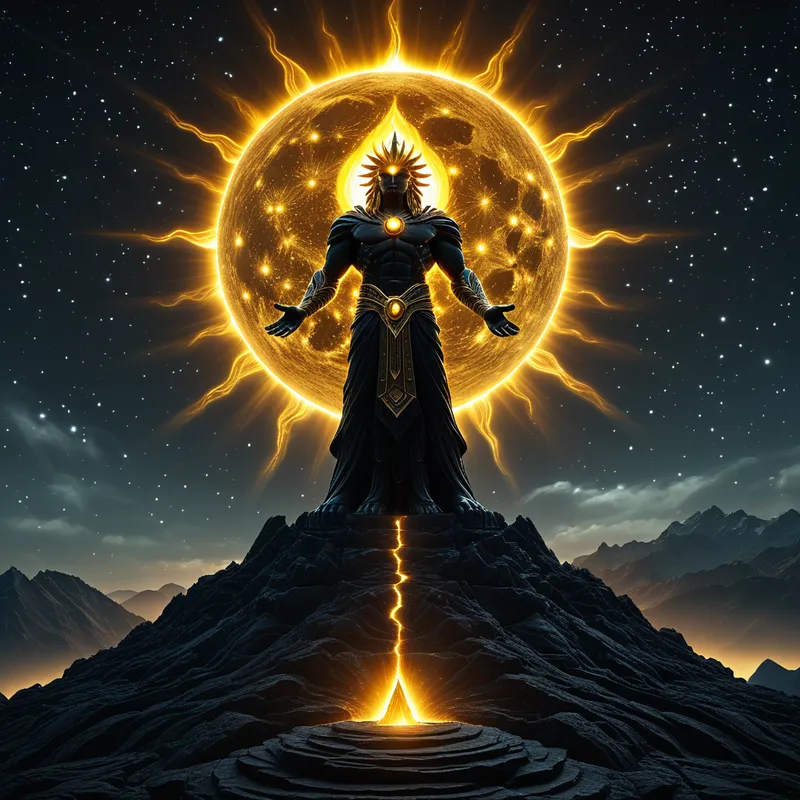
Solar Corona Myth Meaning & Symbolism
A myth of the Sun's final, glorious sacrifice to birth a new cycle, embodying the eternal dance of destruction and creation.
The Tale of Solar Corona
Listen. [The world](/myths/the-world “Myth from Tarot culture.”/) was old, and the Sun was weary.
For ten thousand thousand turnings of the great wheel, [Sol Invictus](/myths/sol-invictus “Myth from Roman culture.”/) had climbed the vault of heaven. Its light was law, its heat the breath of life. But a heaviness had grown in its golden heart. The stories of the world below—the wars, the loves, the endless becoming—had etched themselves into its very substance. It carried the weight of all that was, a brilliant, burning archive. And archives, no matter how glorious, grow dusty. The light, though constant, had become a habit, not a gift.
The Umbra Primordial, the great silence from which Sol had first kindled, began to whisper from the edges of everything. It did not speak of malice, but of completion. A single, soft note, felt more than heard: It is time.
Sol did not rage. A profound stillness settled upon it, a stillness deeper than the space between stars. On its final ascent, it did not blaze with midday fury. It burned with the serene, terrible beauty of a sunset that knows it will not see a dawn. The people below looked up and wept, though they knew not why. The light became honey-thick, pouring over the land like a final blessing, gilding every leaf, every stone, every upturned face in a liquid, memorial gold.
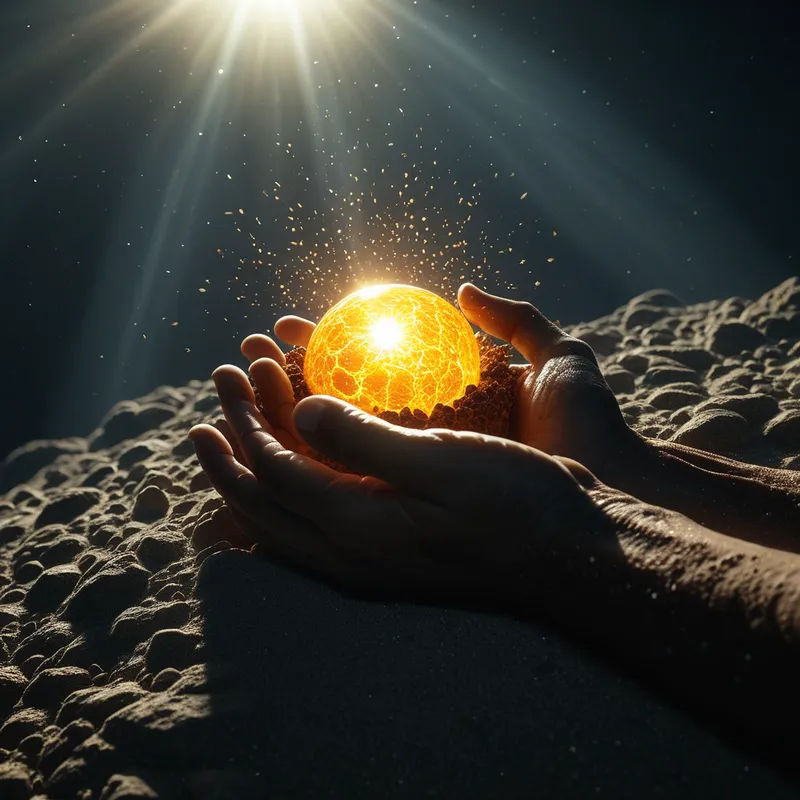
At the zenith, Sol stopped. It turned its gaze inward, to the core of its own being. There, beneath the layers of duty and radiance, it found not emptiness, but a single, perfect seed—the Prima Scintilla it had carried since the first morning. With hands that were now continents of cooling magma, it cupped this seed.
Then, it began to unravel.
It was not an explosion, but an expansion. A sigh. From its form streamed the Solar Corona—a crown not of possession, but of release. A radiant nimbus of plasma and light, wider than the world, filaments of essence streaming into [the void](/myths/the-void “Myth from Buddhist culture.”/). It was every story it had ever witnessed, every life it had warmed, every prayer ever whispered to the dawn, given back. The body of Sol dissolved into this magnificent, dissipating halo. The golden seed, now exposed, pulsed once in the infinite dark.
And as the last filament of the Corona faded into the Umbra Primordial, the seed fell. Not down, but in. Into the heart of the silence. For a moment—an aeon or a heartbeat—there was only the perfect, fecund dark.
Then, from the point where the seed rested, a new, tender light kindled. A different light. Not the familiar, paternal gold, but a silver-bluish shimmer, curious and cool. The Lumen Renatum awoke. It looked upon the void, not as a ruler to a kingdom, but as a child to a mystery. The cycle was not broken. It was renewed. The sacrifice was complete. The giving-away had made space for the beginning-again.
Cultural Origins & Context
The Myth of the Solar Corona emerged not from the zenith of Solar culture’s power, but from its perceived twilight. Historians place its first coherent recitations in the late Aureate Epoch, a time of peak societal complexity that carried within it the subtle anxieties of decline. It was not a state myth of eternal power, but a folk narrative, passed along the Heliosian Ways by traveling Luminist Bards.
These bards served a crucial psychological function. In a culture that worshipped the Sun as the unchanging principle of order, the Corona myth introduced the necessary, terrifying, and ultimately comforting concept of sacred entropy. It was told during the Solstitial Silence, a day when all fires were extinguished at noon. In that collective darkness, the story was chanted, not as a tale of ending, but as a ritual of preparation. It taught a society obsessed with permanence how to die well—and more importantly, how to trust the process that follows death. The myth was the cultural immune system against despair, framing dissolution not as a failure, but as the ultimate act of generative care.
Symbolic Architecture
At its core, the [Corona](/symbols/corona “Symbol: A circular crown-like pattern, often seen in nature as halos around celestial bodies or organic growth rings, symbolizing cycles, protection, and divine connection.”/) myth is a master [symbol](/symbols/symbol “Symbol: A symbol can represent an idea, concept, or belief, serving as a powerful tool for communication and understanding.”/) of [the ego](/myths/the-ego “Myth from Jungian culture.”/)’s necessary sacrifice for the sake of a larger [consciousness](/symbols/consciousness “Symbol: Consciousness represents the state of awareness and perception, encompassing thoughts, feelings, and experiences.”/). Sol Invictus represents the matured, conscious [personality](/symbols/personality “Symbol: Personality in dreams often symbolizes the traits and characteristics of the dreamer, reflecting how they perceive themselves and how they believe they are perceived by others.”/)—the “I” that has built a world, sustained it, and become identified with its [role](/symbols/role “Symbol: The concept of ‘role’ in dreams often reflects one’s identity or how individuals perceive their place within various social structures.”/). It is brilliant, capable, and utterly burdened.
The most profound giving is not of what you have, but of what you are.
The weariness of Sol is not depression, but the [soul](/symbols/soul “Symbol: The soul represents the essence of a person, encompassing their spirit, identity, and connection to the universe.”/)’s recognition that a mode of being has reached its [terminus](/myths/terminus “Myth from Roman culture.”/). The [Umbra](/symbols/umbra “Symbol: The darkest part of a shadow, representing the unconscious, hidden aspects, or the absence of light and clarity.”/) Primordial is not nihilistic [nothingness](/symbols/nothingness “Symbol: A profound emptiness or void, often representing existential anxiety, spiritual seeking, or emotional numbness in dreams.”/), but the unconscious itself—the [fertile ground](/symbols/fertile-ground “Symbol: Fertile ground symbolizes potential, growth, and the promise of new beginnings, reflecting a state where life can thrive.”/) of the [psyche](/myths/psyche “Myth from Greek culture.”/) that calls the over-structured ego back to [source](/symbols/source “Symbol: The origin point of something, often representing beginnings, nourishment, or the fundamental cause behind phenomena.”/) for renewal.
The act of creating the Corona is the key. The Corona is the voluntary dissemination of the ego’s contents. It is the [life](/symbols/life “Symbol: The symbol of ‘Life’ represents a journey of growth, interconnectedness, and existential meaning, encompassing both the joys and challenges that define human experience.”/)’s work, the accumulated [identity](/symbols/identity “Symbol: Identity represents the sense of self, encompassing personal beliefs, cultural background, and social roles.”/), the stored light of experience, offered up. This is not destruction; it is the ultimate act of psychological generosity. The ego, in its final conscious act, returns its hard-won treasures to the psyche’s commonwealth.
The Prima Scintilla is the irreducible core of [the Self](/myths/the-self “Myth from Jungian culture.”/), the indestructible spark of individual essence that precedes and survives all personal identities. Sol’s [discovery](/symbols/discovery “Symbol: The act of finding something previously unknown, hidden, or lost, often representing personal growth, new opportunities, or hidden aspects of the self.”/) of it within his own [dissolution](/symbols/dissolution “Symbol: The process of breaking down, dispersing, or losing form, often representing transformation, release, or the end of a state of being.”/) is critical: we find our timeless core only when we let go of our time-bound [construction](/symbols/construction “Symbol: Construction symbolizes creation, building, and the process of change, often reflecting personal growth and the need to build a solid foundation.”/).
Finally, the Lumen Renatum is the new consciousness born from this [alchemy](/symbols/alchemy “Symbol: A transformative process of purification and creation, often symbolizing personal or spiritual evolution through difficult stages.”/). It is not “Sol 2.0.” It is something qualitatively different—[lighter](/symbols/lighter “Symbol: A lighter symbolizes the spark of creativity, transformation, and the power to ignite change.”/), curious, [less](/symbols/less “Symbol: The concept of ‘less’ often signifies a need for simplicity, reduction, or minimalism in one’s life or thoughts.”/) burdened by [history](/symbols/history “Symbol: History in dreams often represents the dreamer’s past experiences, lessons learned, or unresolved issues that continue to influence their present.”/), yet containing all potential. The myth maps the transition from a consciousness of doing and sustaining to one of being and exploring.
The Dreamer’s Resonance
When this myth stirs in the modern dreamer, it often announces a profound, non-negotiable psychological transition. One does not dream of the Corona during minor life adjustments. It appears when the very architecture of the self is being called to reconfigure.
Dreams may involve: The Glorious Unraveling: Feeling one’s body or a symbolic structure (a house, a tower) emit light from within and peacefully dissolve into a beautiful, harmless mist or light-show. The Heavy Sun: Carrying a brilliant but unbearably heavy object (a golden orb, a lit candle the size of a tree) with a deep, solemn knowledge that you must put it down. The Seed in the Dark: Finding a small, glowing object in a vast, empty, yet comforting darkness. The somatic signature is crucial: despite the imagery of dissolution, the dominant feeling is not terror, but a profound, awe-filled relief, often mixed with grief. There is a physical sensation of release, of a weight lifting so completely it leaves the body feeling strangely buoyant and empty in a positive way. The psyche is rehearsing an ego death, not as a punishment, but as a sacred rite of passage.
Alchemical Translation
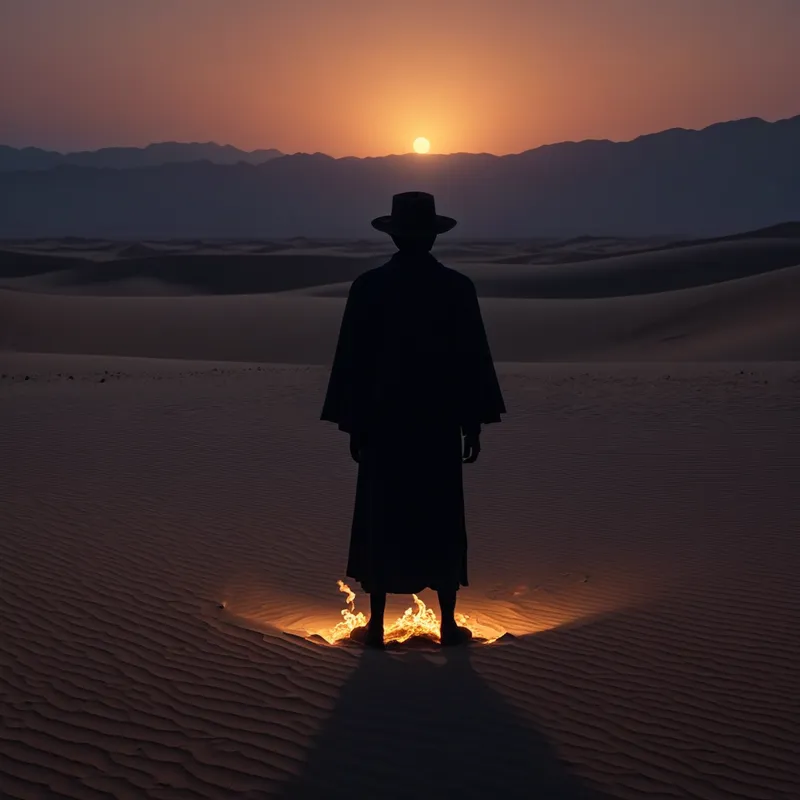
For the individual, the Corona myth is a manual for the final stage of an individuation cycle. Our cultural model of growth is linear: accumulate, achieve, build a bigger, brighter self. The Solar wisdom is cyclical: to truly grow, you must also learn to dis-accumulate.
The alchemical operation here is Sublimatio followed by Mortificatio and Renovatio—elevation, death, and renewal. The ego (Sol) is first elevated to its highest, most conscious potential. From that peak, it willingly undergoes the Mortificatio, not as a defeat, but as the conscious choice to break its identification with its own form.
The crown of the ego is its sovereignty. The Corona of the Self is its surrender.
The modern individual translates this by engaging in conscious “life reviews” and voluntary relinquishments. This could be retiring from a defining career not into idle leisure, but into a state of curious being; deconstructing a long-held identity (the “provider,” the “expert,” the “responsible one”) to discover who exists beneath it; or offering one’s hard-earned wisdom back to the community without attachment to recognition. It is the process of becoming a caregiver to the future self by sacrificing the present self’s need to persist unchanged.
The goal is not annihilation, but liberation into a wider state of being. The new consciousness (Lumen Renatum) that emerges is more aligned with the Self than the ego. It is less about controlling the light and more about being a transparent vessel for it. In the end, the myth teaches that our greatest power lies not in perpetual burning, but in the grace of our final, glorious glow, and the trust to fall silent so a new kind of song may begin.
Associated Symbols
Explore related symbols from the CaleaDream lexicon: