Solar Barque of Ra Myth Meaning & Symbolism
The sun god Ra sails a celestial barque through the sky and the perilous underworld each night, battling chaos to be reborn at dawn.
The Tale of the Solar Barque of Ra
Listen. The world holds its breath.
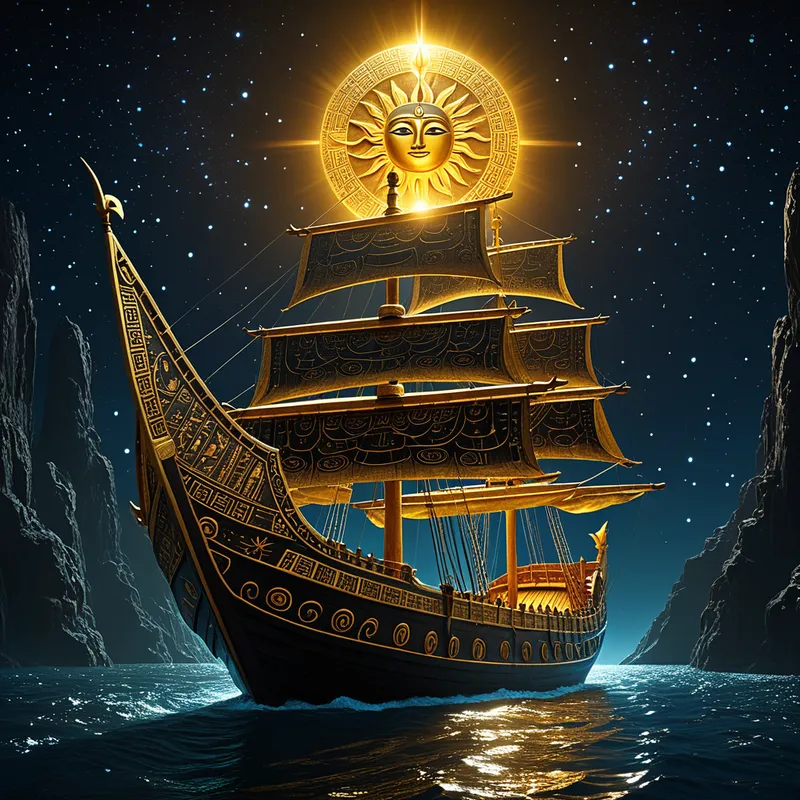
Above, the sky is a bowl of lapis lazuli, and upon it, a fire sails. This is the Mandjet, the Day Barque. Its passenger is Ra, his body the very substance of the sun, his eyes casting the light that defines every hill, every river, every living face. He is Ma’at—order, truth, life itself—made manifest. For twelve hours, he traverses the dome of heaven, and the world below is secure, known, and awake.
But the sun sinks. It touches the western horizon, and the great transition begins. The Day Barque docks at the edge of the known world. Here, at the mouth of the Duat, Ra does not rest. He transforms. He boards a different vessel, the Mesektet, the Night Barque. Its wood is the stuff of shadows and potential; its sail, the woven fabric of silence.
The gates of the Duat groan open, and the barque slips onto a black, subterranean river. This is not a journey of light, but of memory, decay, and essence. The familiar world is gone. The river winds through twelve cavernous regions, each a kingdom of the dead. Here dwell the blessed Akh, their forms shimmering like heat haze, who sing hymns to strengthen Ra’s heart. But also here lurk the demons of dissolution, the inert and the hostile dead, and the barren, silent fields.
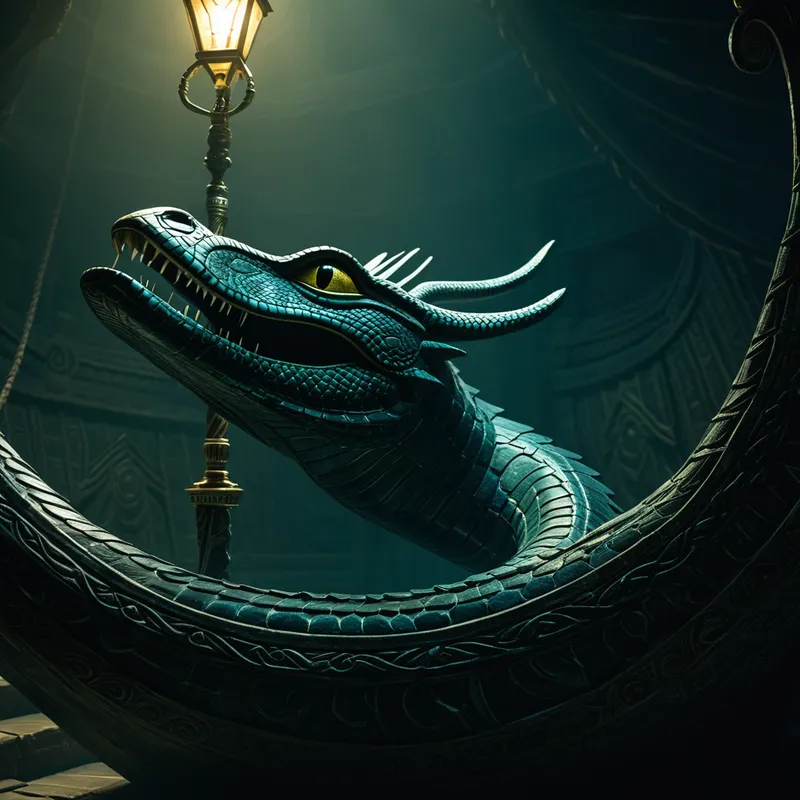
And there is the great adversary. From the primordial mud, from the chaos that existed before Ra spoke the first word, it rises: the serpent Apep. Its coils are as thick as mountain ranges, its maw a void that drinks light and sound. Its sole desire is to stop the barque, to swallow Ra and the sun, and plunge creation back into endless, watery nothingness. This is the central conflict of the night. The battle is joined not with brute force alone, but with magic, with true speech. The god Thoth speaks spells of binding. The warrior goddess Wadjet, a fiery cobra upon the prow, spits venom into the serpent’s eyes. The souls of the dead raise their voices in a protective cacophony. Ra stands unwavering, his light now a focused, defiant core within the oppressive dark.
The barque presses on, through regions of fire and mysterious lakes, past the corpse of Osiris, whose dormant power feeds the renewal. Ra grows old and weary in these depths; his light dims to a soft, moon-like glow. He becomes one with the dead, sharing in their state.
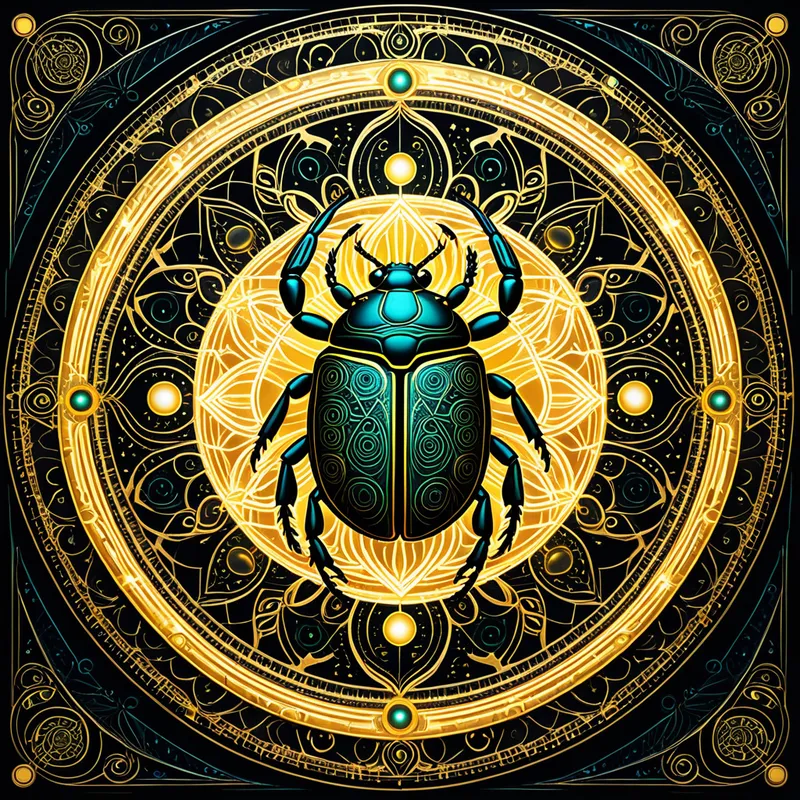
Then, the deepest hour. The twelfth gate. Here, at the nadir of the journey, a miracle occurs. Within the barque, in the form of a scarab beetle—Khepri—the sun is reborn. The old, diminished Ra merges with this new, burgeoning life. The barque, carrying this fused being of aged wisdom and newborn potential, begins its ascent.
It finds the eastern horizon from within. The sky outside pales. The hull of the Mesektet breaks the surface of the earthly Nile at the exact moment the scarab pushes the renewed sun-disk into the dawn sky. The Mandjet is ready. Ra, now young, vital, and radiant, boards it once more. The world exhales. Light returns. Ma’at is reaffirmed. The cycle is complete. For now.
Cultural Origins & Context
This was not a single story bound in a book, but a living, breathing cosmological engine at the heart of Egyptian civilization for over three millennia. Its primary texts are the Pyramid Texts, Coffin Texts, and most comprehensively, the Book of the Dead, along with the specialized Amduat found on tomb walls.
The myth functioned on multiple, intertwined levels. Cosmologically, it explained the sun’s motion and the necessity of night. Theologically, it established Ra’s supreme, yet vulnerable, kingship and his symbiotic relationship with Osiris, god of the dead. Societally, it mirrored the absolute authority of the Pharaoh, who was the “Son of Ra,” responsible for maintaining cosmic order on earth. But most intimately, it was a funerary map. The deceased hoped to join Ra’s crew, to be judged worthy by Osiris, and to sail with the sun god through the perils of the Duat, thus achieving eternal rebirth. The myth was a script for the soul’s most dangerous and vital journey, recited by priests and visualized in tomb art to guide and protect the dead.
Symbolic Architecture
The Solar Barque is the ultimate symbol of the conscious self navigating the waters of time and the unconscious. It represents the vessel of identity—the ego, the “I”—that must undertake the perilous journey from dawn to dusk to dawn again.
The sun must set to be renewed; consciousness must descend into the unconscious to be made whole.
Ra is the archetypal Solar Principle. He is focused awareness, cultural order, and life-giving energy. The Duat is the collective unconscious—the realm of all that is forgotten, repressed, potential, and chaotic. Apep is not merely a monster, but the psychic force of entropy, the pull toward dissolution of the self, depression, madness, and the undoing of all complex structures. The battle is the ego’s struggle to maintain coherence and purpose when immersed in the shadowy, non-linear logic of the deep psyche.
The rebirth as Khepri is the critical alchemical moment. The scarab, rolling its ball of dung, is an Egyptian symbol of self-generation, transformation from waste, and spontaneous creation. It signifies that renewal comes not from outside, but from within the journey itself, from the assimilation of the darkness traveled through.
The Dreamer’s Resonance
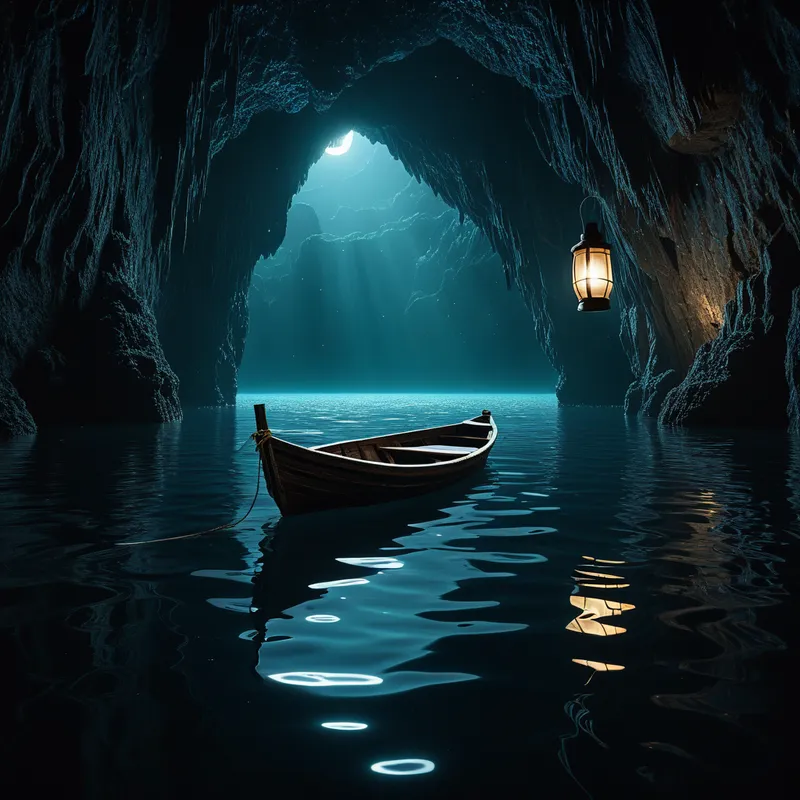
When this myth stirs in modern dreams, it rarely appears as an Egyptian tableau. Instead, one dreams of a profound, solitary night journey. You might be on a train speeding through a dark tunnel with no end in sight, or piloting a small plane through a monstrous storm. The vehicle—the modern barque—may feel fragile, lost, or pursued.
The somatic experience is key: a deep, existential fatigue, the feeling of being “old” and depleted (“Ra grows weary”). This often accompanies life phases of burnout, depression, or after a significant ending—a career, a relationship, an identity. The dreamer is in their personal Duat. The threatening force (the serpent, the storm, the pursuer) embodies the specific form their inner chaos or fear of dissolution is taking. Such dreams signal that the conscious self is undergoing a necessary, if terrifying, descent. It is not a breakdown, but a deep-cycle process where the psyche is stripping down the old structures of the ego to make way for a new formulation of the self.
Alchemical Translation
The myth of the Solar Barque is a master blueprint for the Jungian process of individuation—the journey toward psychological wholeness. It models the non-negotiable rhythm of psychic life: inflation (the bright, high noon of ego), followed by necessary descent (the night sea journey), confrontation with the shadow (Apep), and integration leading to renewal.
The alchemical work is in the sailing, not in avoiding the Duat. Our culture prizes the eternal “Day Barque”—constant productivity, optimism, and light. This myth insists that to live only in the day is to never be renewed. The individuating ego must learn to board the “Night Barque” voluntarily, to enter the interior darkness with purpose.
The heroism is in the endurance of the journey, in holding the lantern of consciousness steady while surrounded by the formless, and in allowing the old, rigid self to “die” so the Khepri-self can be born from within.
The allies in the barque—Thoth (insight, logic), Wadjet (instinctual defense), the singing dead (ancestral wisdom, memory)—represent inner resources we must call upon. To triumph is not to slay chaos, for Apep is eternal. It is to pass through it, to integrate its reality into our being, and to emerge each “dawn” with a consciousness that has been tempered, deepened, and subtly re-created by the journey through its own depths. We do not defeat the night; we are transformed by sailing through it.
Associated Symbols
Explore related symbols from the CaleaDream lexicon: