Solar Barque Myth Meaning & Symbolism
The sun god Ra sails his barque through day and night, battling chaos in the underworld to be reborn at dawn, modeling the soul's perilous journey of renewal.
The Tale of the Solar Barque
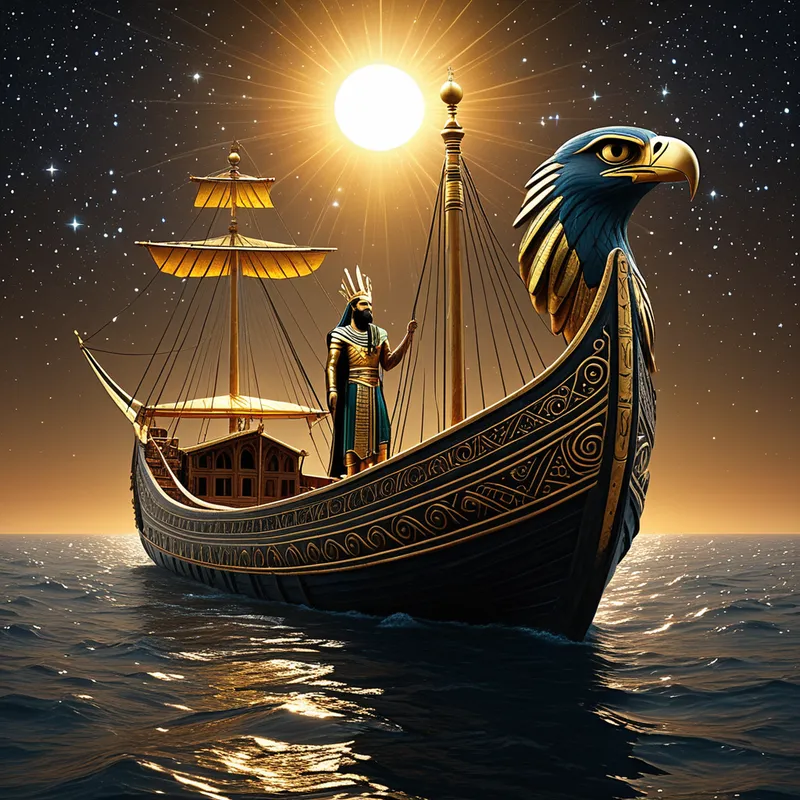
Listen, and hear the story that beats in the heart of the world. Before the first bird sings, in the profound silence that is not silence but a held breath, the great barque of the sun rests at the eastern horizon. Its hull is of cedar and acacia, inlaid with electrum that holds the memory of daylight. At its prow stands Ra, his form a man with the head of a falcon, crowned with a disk encircled by a serpent. His eye is the sun itself, a terrible and beautiful jewel.
With a whisper that is also a command, the barque begins to move. It does not sail on water, but on the celestial river of the sky, Nut, who arches her star-studded body above the earth. This is Mandjet, the Boat of Millions of Years. With Ra are his crew: Thoth, who marks the hours; Maat, whose feather is the measure of all things; and the mighty Horus, who watches the horizons. Together, they guide the light across the vault of heaven, bringing sight, warmth, and order to the Two Lands.
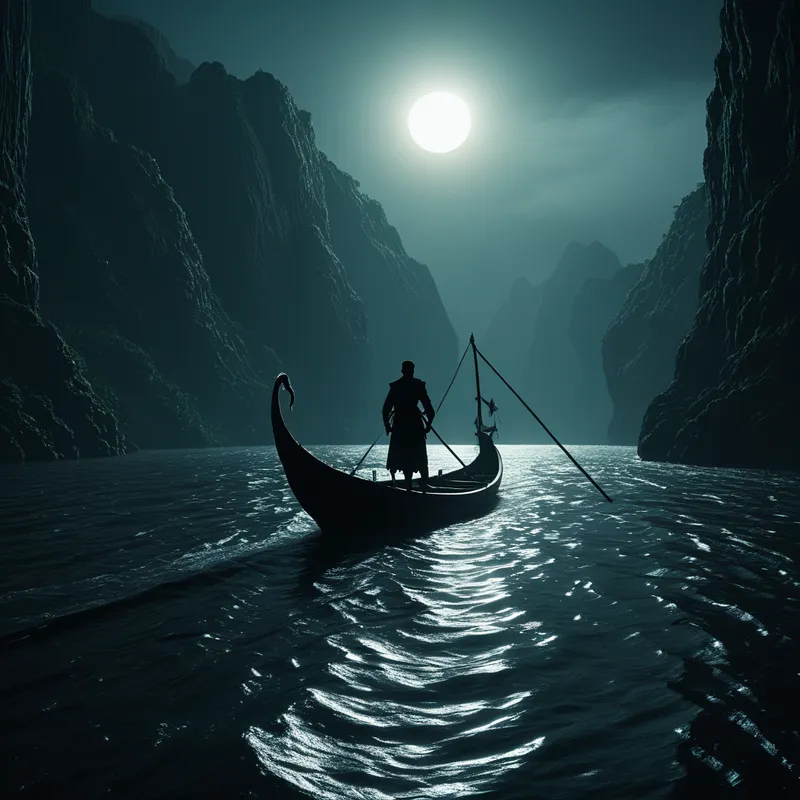
But as the barque reaches the western mountains, the tone shifts. The golden light deepens to blood-red, then to violet. The day is dying. The barque does not stop. It dips below the edge of the world, and the gates of the Duat yawn wide. Here, the celestial river becomes a subterranean stream, black and cold. This is the night barque, Mesektet.
The Duat is not empty. It is a landscape of fire-lakes and sand-banks, populated by demons with knives for fingers and the blessed dead who sing hymns to strengthen Ra’s heart. For twelve hours of night, the barque voyages through this realm of shadows. And in the deepest hour, the greatest peril stirs. From the primordial mud, the serpent Apep, embodiment of Isfet, rises. Its body is miles long, its maw capable of swallowing the cosmos. It seeks to devour the barque, to stop the sun forever, and return all creation to watery chaos.
This is the moment of truth. The crew leaps to action. Thoth speaks spells of binding. The dead raise their voices in a protective cacophony. The warrior goddess Sekhmet unleashes her fury. But it is Ra, in his aged, night-time form, who must wield the spear. A titanic struggle ensues on the black river—the flash of divine weapons, the hiss of the serpent, the boat rocking violently. Every night, Apep is vanquished, wounded, driven back into the abyss. But it is never destroyed, for chaos is eternal.
Wounded but triumphant, the barque sails on. As it approaches the eastern mountains once more, a transformation occurs. The aged Ra is rejuvenated. He merges with the scarab god Khepri, the becoming-one. The barque, scarred from its journey, is made whole. And then, as the first hour of the new day arrives, the prow of the barque breaks the horizon. The sun is reborn. The Eye of Ra opens, and light floods the world once more, a daily victory wrested from the jaws of eternal night.
Cultural Origins & Context
This was not merely a story to the people of the Nile; it was the fundamental operating system of reality. The myth of the Solar Barque is woven into the fabric of Egyptian civilization from the Old Kingdom onward, most completely detailed in funerary texts like the Pyramid Texts, the Coffin Texts, and especially the Book of Coming Forth by Day. It was recited by priests in temple rituals and inscribed on tomb walls to magically ensure the deceased’s safe passage through the Duat.
The Pharaoh was the living embodiment of Horus and the son of Ra. His primary duty was to maintain Maat—the divine order—against the constant threat of Isfet. The sun’s journey was the supreme metaphor for this cosmic duty. By ensuring the temples functioned and justice was upheld, the king participated directly in Ra’s nightly battle, helping to guarantee the sun’s rebirth and, by extension, the continuity of the state, the Nile’s flood, and life itself. The myth was thus a theological blueprint for kingship and a collective prayer for cosmic stability.
Symbolic Architecture
At its core, the Solar Barque is a perfect symbol for the conscious self—the ego—navigating the waters of existence. The sun represents the light of consciousness, awareness, and life-force.
The journey is not a straight line of progress, but a necessary descent into darkness for the renewal of light. One cannot have dawn without midnight.
The day voyage across the sky (Mandjet) symbolizes the external, active life: achievement, social order, and visible power. The night voyage through the Duat (Mesektet) is the inevitable journey into the interior, the unconscious. Here, the ego is not in control; it is vulnerable, aged, and dependent on its crew—the other aspects of the psyche (wisdom, order, instinct). The monstrous Apep is the ultimate shadow: formless chaos, existential dread, the psychic entropy that threatens to dissolve identity and meaning. The battle is not for annihilation, but for containment; the shadow cannot be erased, only continually integrated and managed.
The rebirth at dawn is the promise of the psyche’s resilience. It is the Khepri-moment, where the self, having faced its depths, is remade—not as it was, but renewed, carrying the scars and wisdom of the journey.
The Dreamer’s Resonance
When this myth stirs in modern dreams, it often manifests not as a literal barque, but as a core pattern of perilous nocturnal transition. You may dream of being on a night train through a terrifying landscape, a submarine in abyssal depths, or simply trying to keep a small light burning in an overwhelming darkness. The somatic feeling is one of profound vulnerability, a chill in the bones, and a focused, anxious determination.
This dream pattern signals that the dreamer’s psyche is engaged in its own journey through the Duat. It is a process of “night-sea work,” where a dominant attitude or life structure (the old “sun”) is dying or has died. The ego is in the underworld of the unconscious, forced to confront disowned chaos (Apep)—perhaps in the form of repressed grief, rage, or a foundational fear. The dream is a map of this inward, transformative crisis. The presence of helpers (the crew) suggests internal resources are being mobilized. The critical question the dream poses is: What serpent of chaos am I battling in the dark, and what must I do to ensure my own dawn?

Alchemical Translation
For the individual, the Solar Barque myth is a master narrative of individuation. It models the alchemical cycle of nigredo, albedo, and rubedo—the blackening, whitening, and reddening—as a daily, lifelong practice.
The nigredo is the descent into the Duat, the confrontation with the shadow (Apep). This is the painful but necessary dissolution of outworn psychic structures. The ego must “die” to its solar supremacy and face its fragility. The albedo is the purification and struggle on the river, aided by Thoth (insight) and Maat (integrity). It is the hard work of sorting, understanding, and holding the tension of opposites.
The goal is not to kill the dragon, but to learn the art of sailing past it, again and again, each time with greater skill and less fear.
Finally, the rubedo is the rebirth at dawn: the creation of a new, more complex consciousness that incorporates the night’s lessons. The individual is no longer just the sun-god ruling from on high, but also the scarab pushing its ball of dung—humble, persistent, engaged in the cyclical work of self-creation from the material of one’s own experiences, both light and dark.
To live this myth is to accept that life is not a perpetual noon. It is to have the courage to make the nightly descent into one’s own depths, to battle personal chaos, and to emerge, repeatedly, with a hard-won and renewed sense of purpose. It teaches that the light we bring to the world is only as enduring as our willingness to navigate the darkness within.
Associated Symbols
Explore related symbols from the CaleaDream lexicon: