Sol Myth Meaning & Symbolism
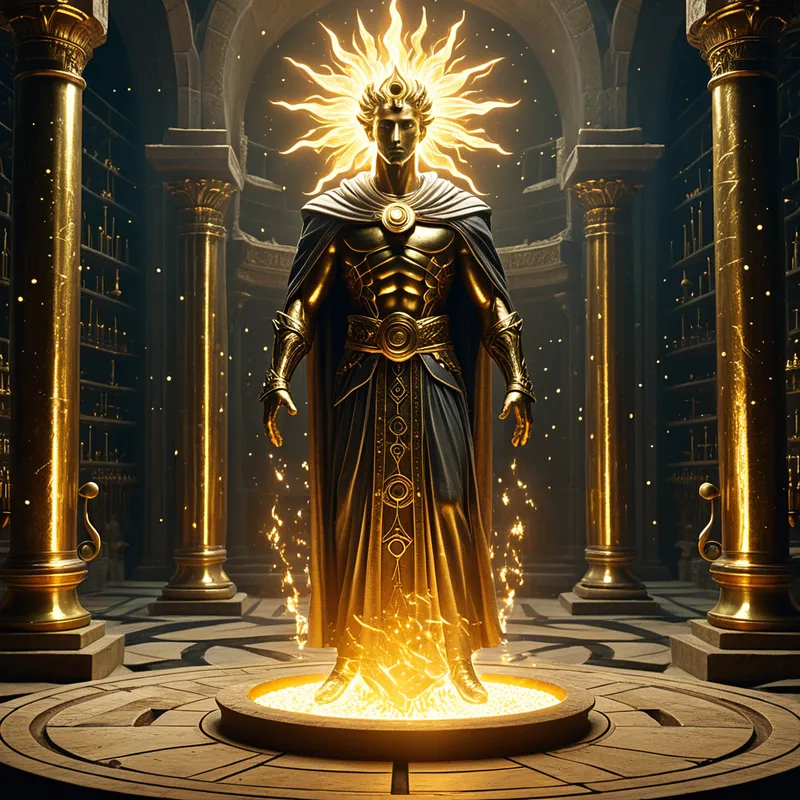
The myth of Sol tells of a radiant being who descends into darkness to be reborn, embodying the alchemical process of death, purification, and ultimate illumination.
The Tale of Sol
Listen now, and let the forge-fire light the tale. In the First Age, when the world-stuff was still heavy and cold, there walked a being of pure principle, not a god of the sky, but a sovereign of essence. His name was Sol. He was not born of flesh, but kindled in the heart of the primordial Chaos. His body was not bone, but a lattice of intention; his blood was not ichor, but a river of conscious light. He moved through the nascent realms, and where his gaze fell, potential crystallized into form. Metals dreamed of their luster in his presence; crystals remembered their facets.
Yet, Sol perceived a profound melancholy woven into the fabric of things. All he touched gained distinction, but also isolation. Gold knew it was gold, and thus knew it was not silver. Lead knew its heaviness. This was the First Separation, and with it came a deep, cosmic sorrow—the longing of the part for the whole. Sol’s brilliant light cast the deepest shadows, and within those shadows, a counterpart stirred: Luna, the silvered mirror of his soul, beautiful and remote, reflecting his light but forever separate, veiled in the mysteries of the deep.
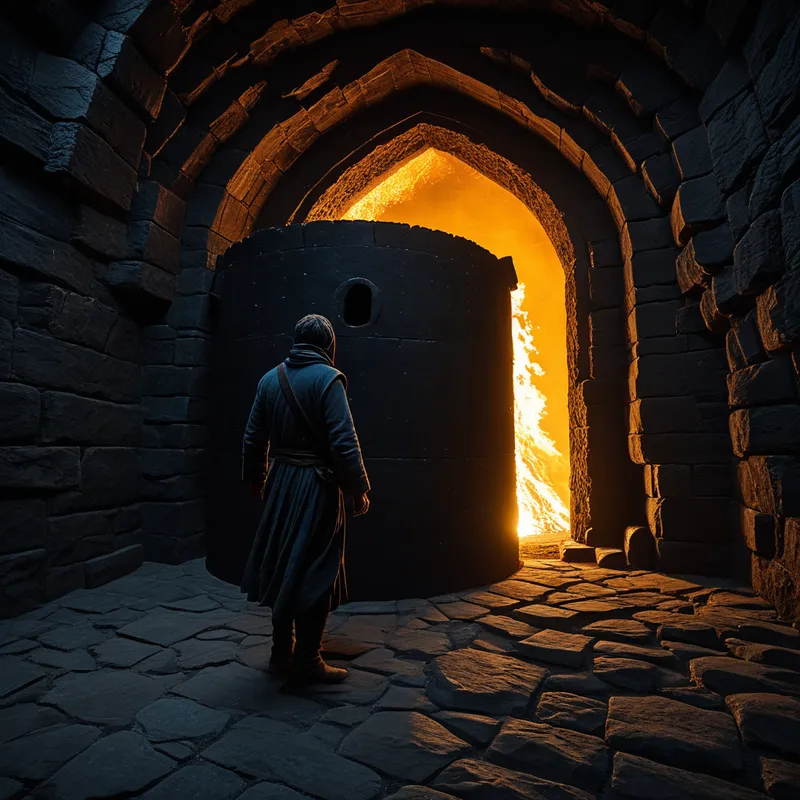
Driven by a compassion as vast as his power, Sol conceived a terrible, beautiful plan. He would not command unity from his throne of light. He would achieve it from within the very heart of separation. He announced his intention to the assembled principles of the world: the fiery Sulfur, the fluid Mercury, and the solid Salt. “I must cease to be Sol,” he declared, “to become something more. I will enter the Black Furnace.”
A great silence fell. The Black Furnace was not a place, but a process—the utter unmaking of distinction, the return to the featureless Prima Materia. To enter it was to consent to annihilation. Luna wept silver tears that hardened into streams of quicksilver upon the ground.
Without hesitation, Sol walked into the mouth of the Furnace. The glorious light was extinguished. His luminous form dissolved. His sovereign consciousness fragmented into a billion scattered sparks, each a memory of light trapped in the absolute dark. This was the Long Night, where Sol was not. The world grew cold, its forms brittle and meaningless.
But within that perfect blackness, a secret work began. The scattered sparks, in their utter isolation, began to yearn for one another. This yearning was a new kind of heat, not the blaze of sovereignty, but the gentle, persistent warmth of attraction. Spark sought spark in the dark. Slowly, imperceptibly, they began to move, to coalesce.
And then, at the nadir of time, a single, new point of light was kindled. It was not the solitary sun of before. It was a light that contained within it the memory of the darkness, a gold that had known itself as lead. From the Furnace emerged not Sol reborn, but the Filius Philosophorum, the Philosophical Child. This being was both gold and more than gold, both light and the knowledge of shadow. In its presence, the world did not just gleam; it understood. Luna’s veil parted, and she approached not as a distant reflection, but as a true conjunct, completing the sacred Coniunctio. The First Separation was healed not by force, but by a journey through the heart of its own consequence.
Cultural Origins & Context
The myth of Sol does not belong to a single people or a linear history, but to the underground river of Hermeticism that flowed beneath the official cultures of Medieval and Renaissance Europe. It was never a public cult. It was whispered in the scriptoria of monasteries, encoded in the grotesque illustrations of cryptic manuscripts like the Tabula Smaragdina, and pondered over by natural philosophers in their secret laboratories.
Its tellers were the Adepts, who served as its bards and guardians. They passed it down not as a religious dogma, but as an operational narrative—a story that contained direct instructions for both the transformation of matter and the transformation of the soul. The myth was society’s function for a disenfranchised intellectual and spiritual elite: it provided a complete cosmology and psychology that orthodox religion could not satisfy. It offered a path to the divine that was experiential, empirical, and intimately personal, conducted at the furnace and in the depths of one’s own mind.
Symbolic Architecture
At its core, the myth of Sol is a map of consciousness confronting its own limitations. Sol represents the differentiated ego, the brilliant but isolated “I” that brings order to the world yet feels fundamentally separate from it. His radiant light is the light of analytical intellect, which, while powerful, creates the very dichotomy of self/other, spirit/matter, gold/lead.
The King must die in order for the true Sovereign to be born.
The Black Furnace is the inevitable crisis of this isolated state—the depression, the dark night of the soul, where the ego’s projects fail and its light seems utterly extinguished. This is not a punishment, but a necessary descent into the unconscious, the realm of Luna. The fragmentation of Sol is the dissolution of the rigid ego-complex. The yearning sparks that move in the dark symbolize the nascent, psychic energy of the Self, beginning to organize the personality around a deeper, more inclusive center.
The triumphant emergence of the Filium Philosophorum symbolizes the birth of a new psychological principle: the transcendent function. This is not a return to the old, heroic ego, but the creation of a consciousness that can hold opposites—light and dark, thought and feeling, spirit and matter—in a living, creative tension.
The Dreamer’s Resonance
When this myth stirs in the modern dreamer, it announces a profound somatic and psychological initiation. One does not simply dream of a sun; one dreams of a sun that is failing, being swallowed, or willingly going out. The accompanying somatic sensation is often one of crushing weight, suffocation, or dissolving boundaries—the leaden embrace of the nigredo.
The dreamer may find themselves in a vast, derelict laboratory (the psyche’s workshop) where a crucial experiment has gone dark. They may be searching for a lost, precious substance that has turned black. Or they may witness a brilliant figure (often a mentor, a leader, or an aspect of the dreamer themselves) voluntarily entering a void or a machine that promises annihilation. These dreams are not portents of literal doom, but accurate reflections of the ego’s necessary capitulation. The psychological process is one of de-integration—the painful but vital breakdown of an outdated self-structure that has become too rigid, too bright, and too lonely to contain the totality of the person’s being. The dream is the psyche enacting its own alchemy, beginning the work in the only vessel it truly owns: the body and its nocturnal theater.
Alchemical Translation
For the modern individual, the myth of Sol models the non-negotiable journey of individuation. Our cultural conditioning celebrates the Solar principle endlessly: be bright, be successful, be conscious, be in control. We are taught to identify solely with the gold. The myth insists that this identification is the primary illusion and the source of our deepest suffering.
The furnace of transformation is fired not by ambition, but by surrender.
The alchemical translation is this: we must consciously consent to our own Black Furnace. This means allowing our cherished identity—the “I” who is the professional, the caregiver, the intellectual, the hero—to be dissolved by life’s inevitable failures, losses, and periods of meaningless depression. We must stop trying to rekindle the old, solitary light and instead learn to sit in the fertile darkness, attending to the faint, magnetic pull of the scattered sparks within. This is the work of shadow integration, of listening to the body’s wisdom (Luna), of valuing the leaden parts of ourselves we have rejected.
The ultimate transmutation, from lead to gold, is not about achieving perfection or eternal brilliance. It is the creation of a philosophical gold: a personality that has integrated its darkness, that carries its wounds as wisdom, and whose consciousness is no longer a spotlight creating separation, but a luminescent presence that unifies. The Coniunctio achieved at the myth’s end is the enduring marriage within us of the logical mind and the intuitive soul, where we are no longer at war with ourselves, but are a living, breathing crucible where spirit and matter forever create each other anew.
Associated Symbols
Explore related symbols from the CaleaDream lexicon: