Snegurochka Myth Meaning & Symbolism
A child of winter, born from snow, who yearns for human warmth. Her granted wish to love becomes the very sun that melts her away.
The Tale of Snegurochka
Listen, and hear the whisper of the north wind through the bare birch trees. In the time when [the world](/myths/the-world “Myth from Tarot culture.”/) was white and silent, held in the deep sleep of Morana’s reign, there lived an old man and an old woman. Their hearts were as warm as their hearth, but their home was as quiet as the falling snow. They watched the village children play and felt the hollow ache of a child never born.
One evening, as the last light bled from [the sky](/myths/the-sky “Myth from Persian culture.”/), the man turned to his wife, his breath a cloud in the frigid air. “Wife,” he said, his voice rough with longing, “let us make a child from the pure snow in our yard. Let us shape a daughter for our empty arms.”
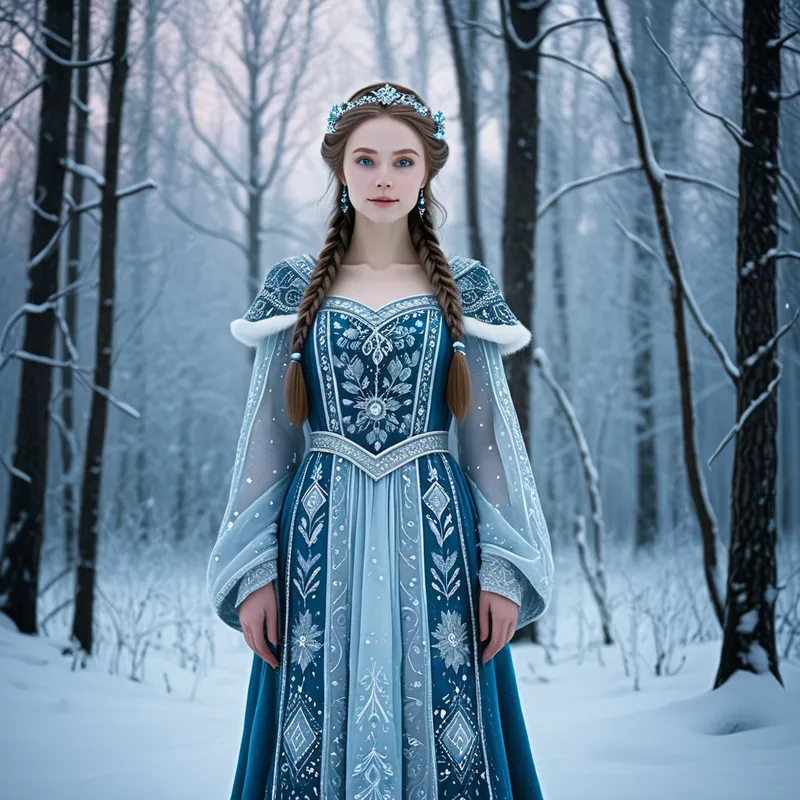
And so, under the watchful eye of the first evening star, they went into their yard. They gathered the freshest, cleanest snow, untouched by beast or bird. With tender, work-worn hands, they packed and shaped a small figure—a girl with a delicate face, limbs of snowy drift. As they placed two dark berries for her eyes and finished their work, a strange magic, older than the pines, stirred. The snow figure sighed, a sound like wind over ice. She blinked her berry eyes, shook her head of snow-powder hair, and stepped lightly onto the crust of the snow. They named her Snegurochka.
She was their joy. Her laughter was the tinkling of icicles, her touch was cool and soft. She danced in blizzards and sang with the howling wind. But she was of winter. She would hide from the great stove in their home, and when spring’s first breath whispered through the forest, a deep melancholy would settle upon her. She would retreat to the darkest, coldest corners of the house, growing pale and quiet.
Years passed. Snegurochka grew into a maiden of breathtaking, otherworldly beauty. Yet, her heart remained a chamber of ice. She watched the village youths and maidens during the spring festivals of Krasnaya Gorka, their faces flushed with warmth, their hands clasped, their eyes shining with a fire she could not comprehend. A terrible, beautiful yearning awoke in her frozen core. She went to her parents, her voice a tremble of frost. “Mother, Father,” she pleaded, “I see the love that binds the others. It is a sun I have never felt. I wish to love as they do. I wish to feel the sun on my skin and not fear it.”
Her parents, hearts breaking with foreknowledge, saw the depth of her longing. They sought the help of the [Leshy](/myths/leshy “Myth from Slavic culture.”/), or perhaps it was the ancient spirit of the land itself that heard their prayer. The wish was granted. Snegurochka felt a sudden, terrifying warmth flood her being. The ice in her veins thawed, replaced by a rushing, brilliant river of feeling. For the first time, she felt the true heat of the sun, and it was glorious. She met the gaze of a young shepherd, and her new heart swelled with a radiant, human love.
They joined the villagers in a great, laughing circle around a ritual bonfire, leaping over the flames in a traditional game. Snegurochka, delirious with newfound emotion, danced closer and closer to the fire’s edge. In a moment of pure, human joy, she leaped. But as she arced over the very heart of the flame, a brilliant, golden light enveloped her. She did not land on the other side. Instead, she dissolved into a shimmering, sighing mist that rose toward the stars—a final, gentle cloud that wept a soft, warm rain upon [the earth](/myths/the-earth “Myth from Hindu culture.”/), before vanishing into the endless spring night.

Cultural Origins & Context
The tale of Snegurochka is a skazka, a Russian folk fairy tale, collected and preserved by 19th-century ethnographers like Alexander Afanasyev. It belongs to the deep stratum of animistic belief that predates formal Slavic paganism, where the natural world—snow, frost, spring—is imbued with conscious spirit. The story was told during the long, dark winters, a narrative born from the very environment it describes. It served as an etiological myth, poetically explaining the transition from winter to spring: the melting of the last snowdrift personified as a tragic, willing sacrifice.
Furthermore, it functioned as a profound parable about boundaries and natural law. In the peasant worldview, every entity had its proper place and composition. To cross that boundary—for a being of winter to crave the essence of summer—was to invite a cosmic rebalancing. The story was not merely a warning but a recognition of the poignant cost of transformation, told to children and adults alike to illustrate that some desires, however pure, require the dissolution of [the self](/myths/the-self “Myth from Jungian culture.”/) that holds them.
Symbolic Architecture
At its core, Snegurochka is the [archetype](/symbols/archetype “Symbol: A universal, primordial pattern or prototype in the collective unconscious that shapes human experience, behavior, and creative expression.”/) of the Innocent who encounters the world of experience. She is the [soul](/symbols/soul “Symbol: The soul represents the essence of a person, encompassing their spirit, identity, and connection to the universe.”/) in its pristine, pre-conscious state—beautiful, beloved, but incomplete. Her snow-[body](/symbols/body “Symbol: The body in dreams often symbolizes the dreamer’s self-identity, personal health, and the relationship they have with their physical existence.”/) symbolizes a [consciousness](/symbols/consciousness “Symbol: Consciousness represents the state of awareness and perception, encompassing thoughts, feelings, and experiences.”/) that is protected, isolated, and untransformed by the fire of [life](/symbols/life “Symbol: The symbol of ‘Life’ represents a journey of growth, interconnectedness, and existential meaning, encompassing both the joys and challenges that define human experience.”/), [emotion](/symbols/emotion “Symbol: Emotion symbolizes our inner feelings and responses to experiences, often guiding our actions and choices.”/), and [relationship](/symbols/relationship “Symbol: A representation of connections we have with others in our lives, often reflecting our emotional state.”/).
The longing for love is the first crack in the ice of the isolated self, through which the terrifying and glorious light of the world can finally enter.
Her parents represent the benevolent but limited [human](/symbols/human “Symbol: The symbol of a human represents individuality, complexity of emotions, and social relationships.”/) [realm](/symbols/realm “Symbol: The symbol of ‘Realm’ often signifies the boundaries of one’s consciousness, experiences, or emotional states, suggesting aspects of reality that are either explored or ignored.”/) that can create form but cannot bestow authentic inner experience. The granting of her wish is the pivotal [moment](/symbols/moment “Symbol: The symbol of a ‘moment’ embodies the significance of transient experiences that encapsulate emotional depth or pivotal transformations in life.”/) of incarnation, where [spirit](/symbols/spirit “Symbol: Spirit symbolizes the essence of life, vitality, and the spiritual journey of the individual.”/) chooses to fully inhabit the conditions of [mortality](/symbols/mortality “Symbol: The awareness of life’s finitude, often representing transitions, impermanence, or existential reflection in dreams.”/), with all its attendant [vulnerability](/symbols/vulnerability “Symbol: A state of emotional or physical exposure, often involving risk of harm, that reveals authentic self beneath protective layers.”/). The [bonfire](/symbols/bonfire “Symbol: A bonfire symbolizes warmth, community, and the celebration of gatherings, often illuminated by the flame of shared experiences.”/) is the ultimate [symbol](/symbols/symbol “Symbol: A symbol can represent an idea, concept, or belief, serving as a powerful tool for communication and understanding.”/) of this transformative [energy](/symbols/energy “Symbol: Energy symbolizes vitality, motivation, and the drive that fuels actions and ambitions.”/)—it is [the communal hearth](/myths/the-communal-hearth “Myth from Various culture.”/), the [passion](/symbols/passion “Symbol: Intense emotional or physical desire, often linked to love, creativity, or purpose. Represents life force and deep engagement.”/) of love, the radiant sun, and the sacrificial pyre all in one. To become [human](/symbols/human “Symbol: The symbol of a human represents individuality, complexity of emotions, and social relationships.”/) is to consent to be consumed by the very forces that give life its meaning and warmth.
The Dreamer’s Resonance
When the pattern of Snegurochka surfaces in modern dreams, it signals a profound somatic and psychological process: the thawing of a long-frozen aspect of the self. One might dream of finding a beautiful, cold object or person in a winter landscape, of feeling an intense yearning to bring them into a warm house, only to watch them dissolve.
This dream imagery points to a nascent, fragile part of the [psyche](/myths/psyche “Myth from Greek culture.”/)—perhaps a capacity for vulnerability, creative expression, or intimate connection—that has been kept “on ice” for its own protection. The dreamer is now, like Snegurochka, feeling the painful and exhilarating urge to bring this frozen potential into the warmth of daily life and relationship. The somatic resonance is often a feeling of melting, of cold fear giving way to warm anxiety, or a literal sensation of warmth flooding the chest. The dream is a map of the perilous, necessary transition from the safety of isolation to the risky vitality of engagement, warning that the old form must die for the new feeling to live.

Alchemical Translation
The alchemical journey mirrored in Snegurochka’s myth is the [solutio](/myths/solutio “Myth from Alchemical culture.”/)—the dissolution. In the work of individuation, we all contain psychic structures—defenses, personas, old identities—that were perfectly formed for a winter season of the soul. They kept us intact. But when the inner spring calls, these crystalline structures become prisons.
Individuation demands not the careful preservation of the ego’s snow-sculpture, but the courageous leap into the transformative fire that alone can transmute isolation into connection.
The modern individual faces this when they choose to feel a long-suppressed grief, to risk genuine love after betrayal, or to express a true identity after a life of conformity. The “Snegurochka complex” is the recognition that to gain a human heart, you must sacrifice [the immortal](/myths/the-immortal “Myth from Taoist culture.”/), untouchable perfection of the snow-maiden. The warmth of authentic feeling will inevitably dissolve the rigid, beautiful form you once were. The [triumph](/myths/triumph “Myth from Roman culture.”/) is not in survival, but in transformation. The self that is lost does not vanish; it becomes the nourishing [water](/myths/water “Myth from Chinese culture.”/)—the tears, the empathy, the fluidity of a soul no longer rigidly defined—that allows new life to grow in the thawed ground of the psyche. Her ending is not a tragedy, but the completion of her incarnation. She finally becomes what she always was: not a creature apart from nature, but a vital, flowing part of its eternal cycle.
Associated Symbols
Explore related symbols from the CaleaDream lexicon: