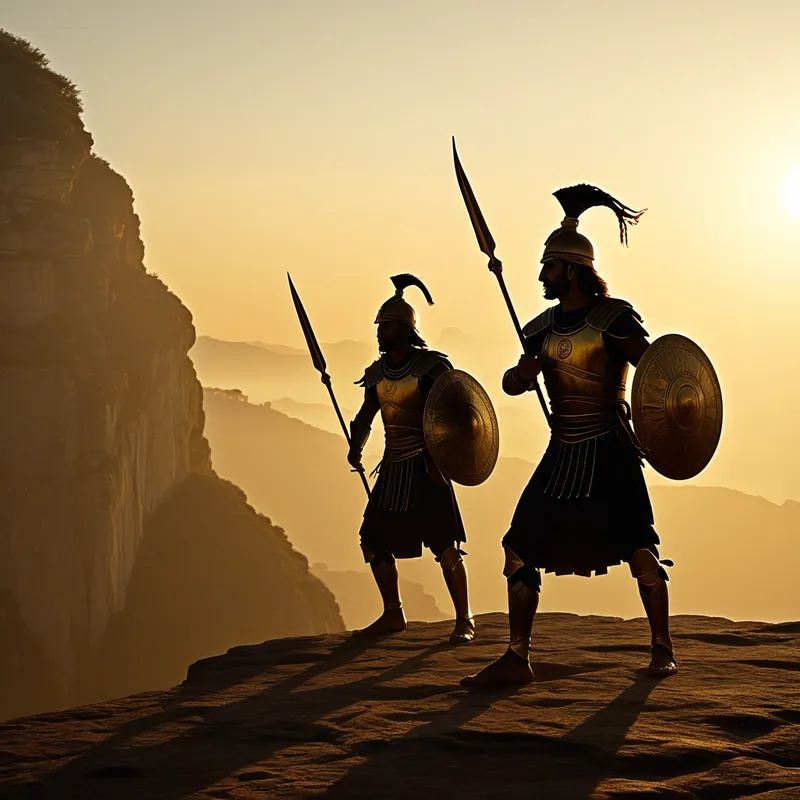
Slingers of Rhodes Myth Meaning & Symbolism
A myth of Rhodians who, blessed by Helios, defended their island with unerring slingshot accuracy, embodying the fusion of divine grace and human mastery.
The Tale of Slingers of Rhodes
Hear now, of the island born from [the sea](/myths/the-sea “Myth from Greek culture.”/)’s embrace and the sun’s first kiss. It is Rhodes, child of [Pontus](/myths/pontus “Myth from Greek culture.”/) and [Helios](/myths/helios “Myth from Greek culture.”/), who claimed her as his own before the gods drew lots for [the world](/myths/the-world “Myth from Tarot culture.”/). The air here is honeyed with light, the soil rich and red, and the people walk with the grace of those who know they are watched by a benevolent, blazing eye.
But even in a land beloved of a Titan, shadows gather. From across the wine-dark sea came the threat—not a monster of legend, but the dreadfully human menace of an invading host. Their ships were a dark stain on [the horizon](/myths/the-horizon “Myth from Various culture.”/), their intentions clear as they beached upon the sacred shores. The Rhodians were not a vast people, nor were they famed for a great army of hoplites. Their strength was in their harbor, their colossus, and their connection to the sun. As the enemy advanced, a silence fell, broken only by the crash of waves and the distant cry of gulls.
Then, a whisper moved through the men, not of fear, but of memory. They were farmers, herders, sailors—men whose hands knew the weight of a stone and the swing of a cord to ward off birds from the fields. The humble sling, a tool of the shepherd, became the weapon of the citizen. They gathered on the cliffs and bluffs, the high places where Helios’s light touched first and longest. They did not don bronze breastplates but stood in their tunics, the dawn wind at their backs.
As the first enemy ranks scrambled up the rocky slopes, the Rhodians let fly. It was not a hail of arrows, but something more personal, more precise. Smooth stones, gathered from riverbeds and shores, sang through the air. Each whir of the sling was a prayer; each release, an act of faith. And the sun, their patron, seemed to guide each shot. Stones found their marks with uncanny accuracy—striking shields from trembling hands, helmets with a resonant clang, turning the advance into a chaotic stumble. The invaders, expecting a conventional battle, were confounded by this rain of pinpoint strikes from an invisible foe. The air itself seemed to be their enemy. The assault faltered, then broke. The Rhodians, with their simple tools and unshakable nerve, had defended the gift of their god.

Cultural Origins & Context
The legend of the Slingers of Rhodes is less a formal myth recorded by poets like [Homer](/myths/homer “Myth from Greek culture.”/) or Hesiod and more a celebrated piece of local historiography and cultural identity. It emerges from the historical reality that Rhodian slingers were renowned mercenaries in the Hellenistic period, famed for their skill and sought after by armies across the Mediterranean. The mythos built around them served to elevate this practical, martial excellence into the realm of the divine.
The story was likely passed down through local historians like Antiochus of Syracuse and woven into the island’s foundational narratives. It functioned as an etiological tale, explaining why Rhodians were preeminent slingers: they were literally blessed by their divine progenitor, Helios. This connected civic pride and military reputation directly to the island’s unique theogony. It was a story told to inspire the young, to validate the skills of the common folk, and to remind all that their specific genius—their precision—was a sacred inheritance.
Symbolic Architecture
At its core, this myth is not about brute force, but about applied intelligence and focused skill winning against overwhelming odds. The sling represents the transformation of the mundane into the potent. The [stone](/symbols/stone “Symbol: In dreams, a stone often symbolizes strength, stability, and permanence, but it may also represent emotional burdens or obstacles that need to be acknowledged and processed.”/), an ordinary object, becomes a sacred projectile through [intention](/symbols/intention “Symbol: Intention represents the clarity of purpose and direction in one’s life and can symbolize motivation and commitment within a dream context.”/), skill, and divine alignment.
The true weapon is not the stone, but the space between the hand and the target—the arc of focused will.
Psychologically, the Slinger embodies the [archetype](/symbols/archetype “Symbol: A universal, primordial pattern or prototype in the collective unconscious that shapes human experience, behavior, and creative expression.”/) of the precise mind. The [enemy](/symbols/enemy “Symbol: An enemy in dreams often symbolizes an internal conflict, self-doubt, or an aspect of oneself that one struggles to accept.”/) represents diffuse, chaotic, or overwhelming pressures—the anxieties and threats that seem too large to confront directly. The Slinger’s [strategy](/symbols/strategy “Symbol: A plan of action designed to achieve a long-term or overall aim, often involving competition, resource management, and foresight.”/) is one of discrimination and exactitude. One does not fight the entire army; one identifies the critical pressure points and applies minimal, perfect force to disrupt the whole [system](/symbols/system “Symbol: A system represents structure, organization, and interrelated components functioning together, often reflecting personal or social order.”/). This is the [symbolism](/symbols/symbolism “Symbol: The use of symbols to represent ideas or qualities, often conveying deeper meanings beyond literal interpretation. In dreams, it’s the language of the unconscious.”/) of the [shepherd](/symbols/shepherd “Symbol: A shepherd symbolizes guidance, protection, and the nurturing aspects of leadership, often reflecting the dreamer’s desire for direction or support.”/)’s tool defeating the [soldier](/symbols/soldier “Symbol: A soldier in dreams often symbolizes duty, sacrifice, and the struggle for self-discipline. It can also indicate feelings of loyalty or conflict, both externally and within oneself.”/)’s arms: the wisdom of the periphery, of the one who watches and protects from a higher vantage point, triumphs over the centralized aggression of the invader.
[Helios](/symbols/helios “Symbol: Helios symbolizes the sun, embodying light, life, and divine energy in various mythological traditions.”/)’s [favor](/symbols/favor “Symbol: ‘Favor’ represents the themes of acceptance, goodwill, and the desire for approval from others.”/) symbolizes [consciousness](/symbols/consciousness “Symbol: Consciousness represents the state of awareness and perception, encompassing thoughts, feelings, and experiences.”/) itself—the illuminating light that allows for clear [sight](/symbols/sight “Symbol: Sight symbolizes perception, awareness, and insight, representing both physical and inner vision.”/), revealing the target and banishing the shadows of [confusion](/symbols/confusion “Symbol: A state of mental uncertainty or disorientation, often reflecting internal conflict, lack of clarity, or overwhelming choices in waking life.”/). The Slinger acts in full [awareness](/symbols/awareness “Symbol: Conscious perception of self, surroundings, or internal states. Often signifies awakening, insight, or heightened sensitivity.”/), in the “light of day,” with nothing hidden.

The Dreamer’s Resonance
When this myth pattern stirs in the modern unconscious, it often manifests in dreams of precision under pressure. A dreamer might find themselves in a chaotic, overwhelming environment—a crumbling building, a riotous crowd, a storm of paperwork. In their hand is a simple, anachronistic tool: a sling, a carefully balanced stone, a perfectly weighted object.
The somatic experience is key: the dream focuses on the feel of the weapon, the tension in the cord, the careful aiming, and the clean release. This is the [psyche](/myths/psyche “Myth from Greek culture.”/) rehearsing the act of focusing scattered energies into a single, effective point of action. The dream is not about grand, sweeping gestures, but about the quiet, internal calibration required to hit a target. It speaks to a situation in the dreamer’s life where they feel outnumbered or under-resourced, and the unconscious is guiding them toward their innate, perhaps overlooked, skill—their ability to “take aim” with psychological or practical accuracy.

Alchemical Translation
The alchemical process mirrored here is one of distillation and [projection](/myths/projection “Myth from Alchemical culture.”/). The [prima materia](/myths/prima-materia “Myth from Alchemical culture.”/) is the chaotic, undifferentiated “army” of one’s own internal conflicts, obligations, and fears—the leaden weight of the world. The sling is the apparatus of the mind, the disciplined rotation of thought that gathers and focuses this diffuse matter.
Individuation is the act of selecting, from the rubble of the psyche, the one true stone that must fly.
[The first stage](/myths/the-first-stage “Myth from Alchemical culture.”/) is [separatio](/myths/separatio “Myth from Alchemical culture.”/): the Rhodians on the cliff represent the conscious ego withdrawing to a place of perspective (the high ground), separating itself from the identification with the chaos below. The second is coniunctio: the union of human skill (the swing) with divine light (Helios’s guidance), symbolizing the alignment of personal will with the transcendent function—[the Self](/myths/the-self “Myth from Jungian culture.”/). The final release is the projectio, the act of putting that aligned intention into the world with perfect timing.
For the modern individual, the “Slingers of Rhodes” process models how to confront overwhelming challenges. It advises: retreat not in fear, but to gain vantage. Use what is at hand—your fundamental, perhaps humble, skills. Wait for the light of clarity. And then, with unwavering focus, release your effort not at the whole of the problem, but at the precise point that will change its balance. The [triumph](/myths/triumph “Myth from Roman culture.”/) is not destruction, but the restoration of boundaries and the affirmation that focused consciousness, however small its tool, is a formidable, sun-blessed force.
Associated Symbols
Explore related symbols from the CaleaDream lexicon: