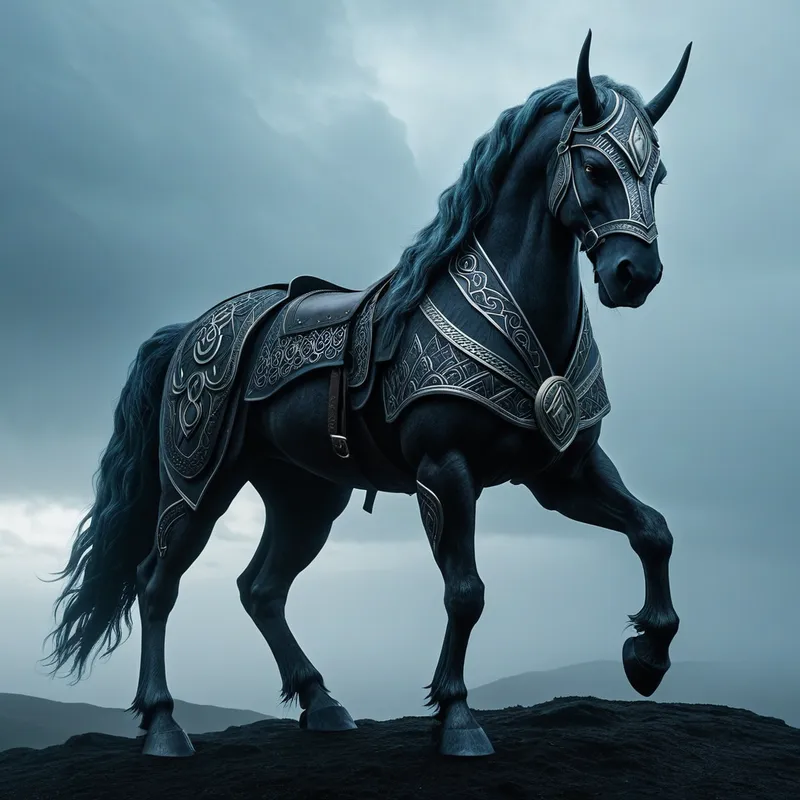
Sleipnir Myth Meaning & Symbolism
A horse of shadow and light, born from a god's cunning and a giant's strength, to carry the Allfather across all worlds.
The Tale of Sleipnir
Hear now a tale not of glorious battle, but of cunning, necessity, and a birth that shook the roots of the world-tree itself. In the dawn of the gods' reign, the walls of Asgard stood unfinished, a fortress vulnerable to the giants of Jotunheim. A master builder came from the mountains, a giant in disguise, and made an offer that reeked of both promise and peril. He would build an impregnable wall in one winter’s span. His price? The sun, the moon, and the goddess Freyja as his bride.
The Æsir laughed, deeming the task impossible. But Loki, silver-tongued and ever-confident, urged them to accept. “What have we to lose? He cannot succeed.” So the pact was sworn, a terrible oath sealed in the presence of all. The builder set to work, and the gods’ mirth turned to ash in their mouths. By day, he labored with impossible strength, and by night, his stallion, Svadilfari, hauled stones so massive the earth groaned. The wall rose with terrifying speed.
As the final days of winter loomed, the wall neared completion. Dread settled over Asgard. They would lose the lights of the sky and their beloved Freyja. A council of fury was held, and all eyes, burning with accusation, turned to Loki. “You made this bargain,” they thundered. “You undo it.”
Loki’s mind, a nest of serpents and schemes, coiled tight. That night, as Svadilfari hauled the last great stones toward the nearly finished gate, a strange mare appeared from the shadow of the forest. She was of a beauty to stir the heart of any beast, her coat like polished jet, her eyes deep pools. She whinnied, a song of pure, wild longing. Svadilfari snorted, his harness straining. The giant builder cursed and pulled, but the stallion’s blood was aflame. He broke free, crashing through his traces, and galloped after the phantom mare into the deep, dark woods. The builder raged through the night, but his great work was halted, his tool lost.
Time passed. Loki, too, was absent. And then, one grey morning, he returned to the fields of Asgard. He was not alone. Beside him trotted a foal, but like no foal ever seen. Its legs were not four, but eight, each step a complex, mesmerizing dance of potential motion. Its coat was grey as mist and shadow, and its eyes held not the innocence of youth, but a deep, knowing silence. It was a creature of two natures—born of a god’s deceit and a giant’s strength, born of necessity and wild passion.
Odin saw the creature and understood. He named it Sleipnir, “The Sliding One.” This was no mere steed. This was a being who could not just run, but traverse; not just gallop, but glide between the worlds themselves. Odin claimed him, and from that day, the eight-legged horse carried the Allfather down the road to Hel, across the bridge Bifrost, and through the air over Midgard. The price of Asgard’s security was a child of trickery, and that child became the key to all journeys.
Cultural Origins & Context
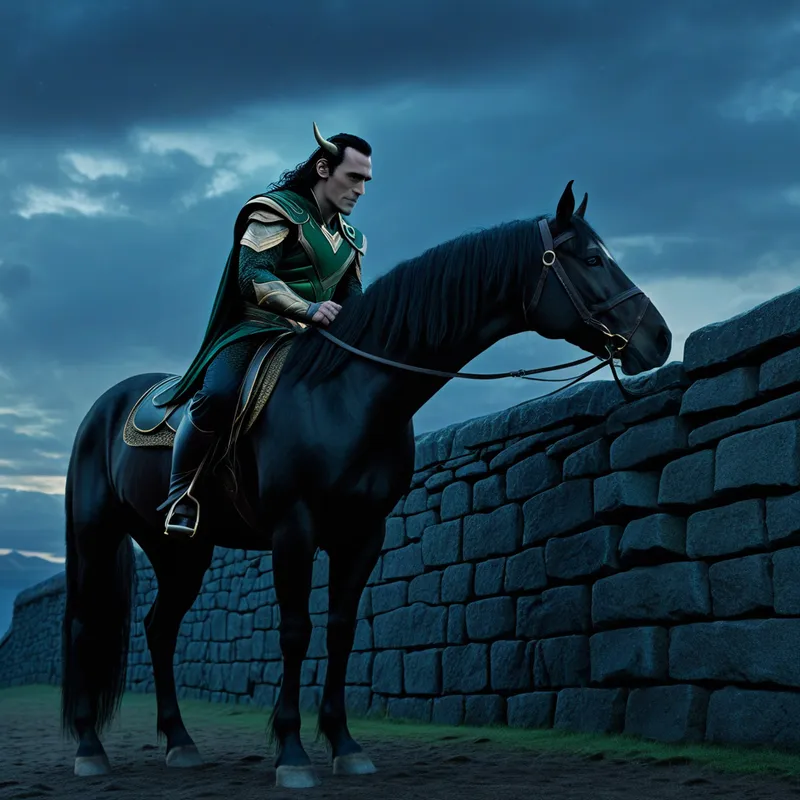
The myth of Sleipnir is preserved primarily in the Prose Edda by Snorri Sturluson, a scholar writing in Christianized Iceland centuries after the height of Norse pagan belief. Snorri’s sources were the older poetic traditions, the skaldic verses and eddic poems that were the lifeblood of Norse oral culture. This story was not a children’s fable but a foundational narrative explaining the origin of a key divine attribute—Odin’s unmatched mobility—and reinforcing core cultural values.
It functioned on multiple levels. For a society of explorers, traders, and raiders, the concept of a steed that could overcome any boundary was powerfully resonant. It also served as a mythic charter for the complex Norse relationship with the Jotnar. The gods are not purely “good” and the giants purely “evil”; they are intertwined, and power often flows between them through cunning, marriage, or, as here, procreation. Loki, the ambiguous insider/outsider, is the essential catalyst in this exchange. The tale would have been told in halls, a gripping story of a narrow escape that also carried a subtle warning: even the gods’ security comes at a cost, and that cost often births something new and unpredictable.
Symbolic Architecture
Sleipnir is the ultimate symbol of the liminal—the entity that exists between. His eight legs are not merely for speed but for stability across unstable realities. He is the psychopomp, the guide of souls, but also the vehicle of consciousness seeking knowledge in forbidden places.
The bridge between worlds is not a structure, but a state of being—a creature born of a broken oath and a wild chase.
His parentage is his deepest cipher. He is the offspring of Loki (shapeshifting intelligence, chaotic fire) and Svadilfari (pure instinctual, physical power). This union represents the necessary, often uncomfortable, marriage of cunning and brute force, of mind and body, to achieve an impossible task. Sleipnir is the embodied result of a shadow negotiation. The gods could not defeat the giant through direct force once the oath was sworn; they had to use indirect, “shadowy” means (Loki’s transformation). The product of this shadow-work is not a weapon, but a means of transit.
His eight legs symbolize omnidirectional movement. He can travel up, down, sideways, through time, and into the psyche. He is the capacity to hold multiple perspectives simultaneously and move between them with grace. He is not the journey’s end but the faculty of journeying itself.
The Dreamer's Resonance
To dream of an eight-legged creature, or a horse that moves in impossible ways, is to feel the stirring of Sleipnir within the personal psyche. This is not a dream of simple travel, but of necessary traversal. The dreamer is likely at a threshold, facing a barrier that seems as immovable as the wall of Asgard—a career impasse, a relational deadlock, a spiritual stagnation.
The somatic feeling is one of potent, coiled kinetic energy. There may be a sense of anxiety (the giant’s nearing victory) coupled with a strange, intuitive knowing that the solution lies not in a direct assault, but in a fundamental shift in one’s own nature. The dream is prompting a shape-shift. It asks: What part of you, like Loki, must transform and engage with the raw, instinctual power (the Svadilfari) of the situation in a new way? The birth of the eight-legged steed in the dream signals that the psyche is forging a new inner capacity, a vehicle born from integrating cunning and strength, from engaging with what you initially sought to avoid.
Alchemical Translation
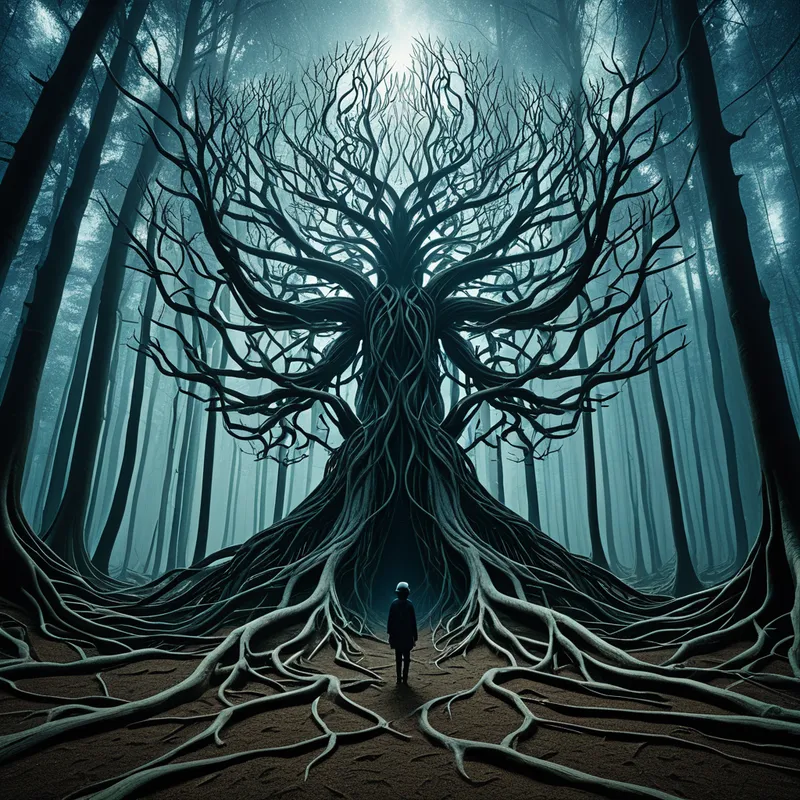
The myth of Sleipnir is a perfect allegory for the alchemical process of individuation. The “wall” is the hardened persona or the conscious ego’s defensive structure. It feels necessary for security, but its completion—its rigidity—would cost us our inner light (the sun, moon, and Freyja as symbols of life, consciousness, and love).
The psyche’s greatest defenses, once completed, become its prison. Freedom is found in the seemingly illicit child of their sabotage.
The giant builder is the relentless, one-sided drive of a singular goal, often born of trauma or inflation. Loki, the trickster, is the disruptive, intelligent unconscious that forces a crisis to prevent a catastrophic “success.” His transformation into the mare is the nigredo, the descent into the dark, instinctual realm. Engaging with the powerful, primal force (Svadilfari) is the coniunctio, the sacred and often scandalous union of opposites.
Sleipnir is the lapis philosophorum, the philosopher’s stone—not a static object, but a dynamic function. He is the transcendent function born from this conflict. For the modern individual, the process looks like this: facing an impossible problem born of an old oath (a life promise, a rigid self-concept), allowing the cunning inner voice (not the rational one) to engineer a creative betrayal of that old pattern, engaging deeply with the raw energy of the situation, and ultimately giving birth to a new inner faculty. This faculty is not the solution to the original problem, but something far greater: the ability to traverse all subsequent problems, to move between realms of thought, feeling, and reality with newfound agility. You secure your citadel not by finishing the wall, but by acquiring the horse that can leave it behind.
Associated Symbols
Explore related symbols from the CaleaDream lexicon: