
Slash-and-Burn Cultivation Myth Meaning & Symbolism
A myth of sacred fire and fertile ash, where the clearing of the old forest is a divine act of sacrifice to birth new life from the soil.
The Tale of Slash-and-Burn Cultivation
Listen. Before the straight rows and the measured fields, there was the wild. The forest was a living, breathing beast, a tangle of green so deep and old it whispered with the voices of the first days. Its roots were the bones of [the earth](/myths/the-earth “Myth from Hindu culture.”/); its canopy, a roof against the sun. The people lived in its clearings, small and grateful, eating what the forest gave, which was never quite enough.
Then came the hunger. A cold that settled in the belly, a thinning of the game, a silence where the fruit should have been. The people looked to Grandmother Ash, whose eyes were the color of a long-extinguished hearth. She did not speak with words, but with a gesture. She took a stone blade, its edge singing a thin, sharp song, and she walked to the oldest, thickest wall of the forest.
She did not plead. She began to cut. Not to destroy, but to speak. Each slash of the blade against bark was a question. Each vine severed was a plea. The forest groaned in its sleep. For days, the only sounds were the thock of stone on wood and the heavy fall of greenery. A wound opened in the green flesh of [the world](/myths/the-world “Myth from Tarot culture.”/), a clearing of fallen giants and weeping sap.
Then, on the seventh dusk, when the pile of the slain was a mountain of shadows, Grandmother Ash stood at its heart. From a pouch at her side, she took a sliver of wood, blackened from a lightning-struck tree. She knelt. She breathed upon it, not with air from her lungs, but with the story of the people’s hunger, their fear, their hope. A spark, tiny and desperate as a newborn star, flickered to life.
She placed it in the heart of the cut greenery. For a moment, nothing. Then, a sigh. Then, a roar. Fire, the Red Jaguar, awoke. It did not rage; it consumed. It flowed over the fallen forest like a liquid sunset, crackling with the voices of all that was being unmade. The heat was a physical wall, the light a second, terrible sun. The people wept, for they saw the death of their old world.
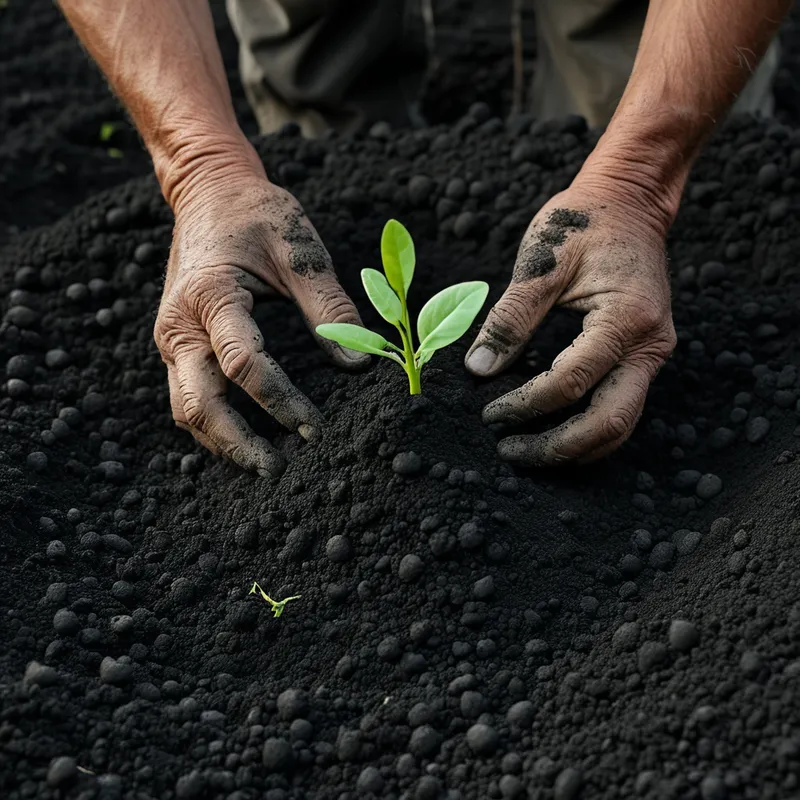
They wept until dawn. When the Red Jaguar had eaten its fill and vanished with the night, all that remained was a field of absolute black. A desolation. A silence of ash. Grandmother Ash, her face smudged with soot, walked into the center. She knelt again, and with her bare hands, she pushed them deep into the warm, soft powder. She brought forth not ash, but soil—black, rich, and humming with a latent heat. It smelled not of death, but of potential.
Into this warm, dark womb, she cast the seeds—the hard, tiny hearts of the last season’s grain. She covered them with the blanket of ash. The people waited. And from that absolute blackness, from that holy void, came a green more vibrant than any forest green. It was a green that sang. It was a green that fed. The first field was born, not from peace, but from a sacred, terrifying conversation between blade, fire, and faith.
Cultural Origins & Context
This is not a myth of conquest, but of negotiation. It emerged from the shifting cultivation societies of the tropical forests, where the relationship with the land was intimate, cyclical, and deeply reciprocal. The story was not written but performed—told by firelight during the dry season, just before the actual cutting would begin. The teller was often the eldest cultivator, a person who held the memory of the last cycle in their bones.
Its function was threefold. First, it was a practical allegory, encoding the necessary, dangerous steps of the agricultural cycle into a sacred narrative, ensuring the technique was remembered with the gravity it deserved. Second, it was a psychological preparation. The act of cutting and burning a patch of forest, one’s home and provider, would have provoked profound anxiety and grief. The myth provided a container for these emotions, framing the destruction not as an act of violence, but as a necessary step in a divine dialogue. Third, it established a cosmology of reciprocity. The bounty of the harvest was not merely a product of labor, but a gift from the forest spirit, given in exchange for its own sacrificed body.
Symbolic Architecture
At its core, the myth maps the archetypal cycle of [death](/symbols/death “Symbol: Symbolizes transformation, endings, and new beginnings; often associated with fear of the unknown.”/) and [rebirth](/symbols/rebirth “Symbol: A profound transformation where old aspects of self or life die, making way for new beginnings, growth, and renewal.”/) onto the [landscape](/symbols/landscape “Symbol: Landscapes in dreams are powerful symbols representing the dreamer’s emotional state, personal journey, and the broader context of life situations.”/) itself. The Primordial [Forest](/symbols/forest “Symbol: The forest symbolizes a complex domain of the unconscious mind, representing both mystery and potential for personal growth.”/) represents the unconscious in its lush, tangled, and unmanaged state. It is fertile but impenetrable; it provides, but on its own terms. It is the [psyche](/myths/psyche “Myth from Greek culture.”/) before conscious work.
The blade that cuts is the incisive power of consciousness. It is the painful, necessary act of discrimination—separating what must be released from what can remain.
The [Sacred Fire](/myths/sacred-fire “Myth from Various culture.”/) is the catalyst of alchemical change. It is the emotional heat of sacrifice, the burning away of old complexes, identities, and growths that have become obstructive. It transforms solid, rigid forms (trees) into a fine, receptive medium (ash).
The Field of Ash is the critical, liminal state. It is the psychic fallow [period](/symbols/period “Symbol: Periods in dreams can symbolize cyclical patterns, renewal, and the associated emotions of loss or change throughout life.”/) after a great [loss](/symbols/loss “Symbol: Loss often symbolizes change, grief, and transformation in dreams, representing the emotional or psychological detachment from something or someone significant.”/) or [dissolution](/symbols/dissolution “Symbol: The process of breaking down, dispersing, or losing form, often representing transformation, release, or the end of a state of being.”/). It feels barren, but it is charged with all the nutrients of the burned-away past. It is the [tabula rasa](/myths/tabula-rasa “Myth from Alchemical culture.”/), the clean slate prepared for a new [pattern](/symbols/pattern “Symbol: A ‘Pattern’ in dreams often signifies the underlying structure of experiences and thoughts, representing both order and the repetitiveness of life’s situations.”/).
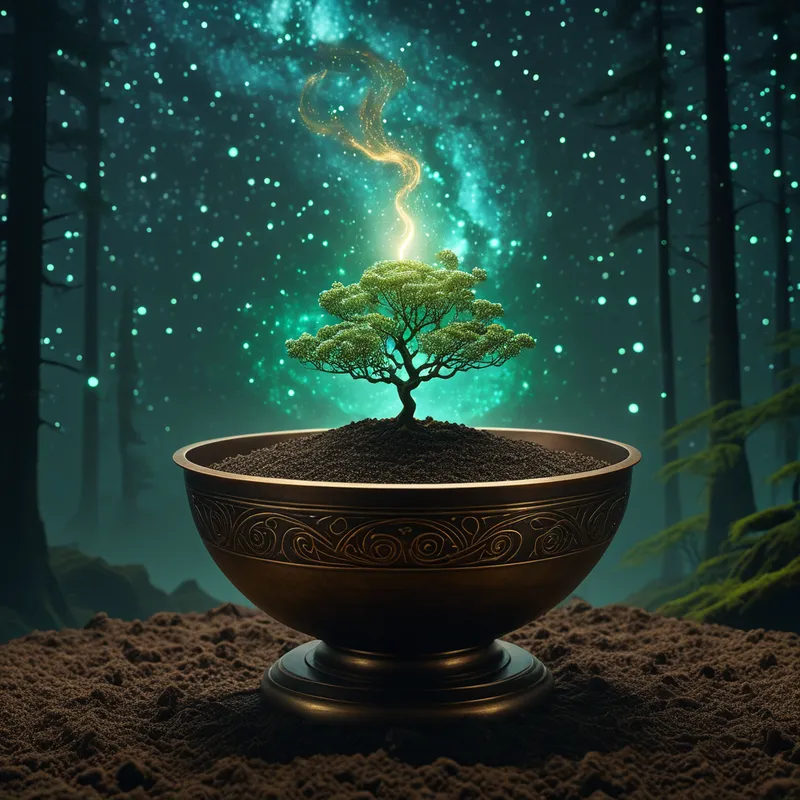
Finally, the New Green Shoot symbolizes the emergent [life](/symbols/life “Symbol: The symbol of ‘Life’ represents a journey of growth, interconnectedness, and existential meaning, encompassing both the joys and challenges that define human experience.”/) that could not have existed without the clearing. It represents [insight](/symbols/insight “Symbol: A sudden, deep understanding of a complex situation or truth, often arriving unexpectedly and illuminating hidden connections.”/), new habits, or creative works that are nourished directly by the decomposed matter of our former selves.
The Dreamer’s Resonance
When this myth stirs in the modern dreamer, it often manifests as dreams of controlled burning, clearing clutter, or paradoxical growth from destruction. You may dream of setting fire to your own childhood home and watching calm gardens sprout from the foundations. You may dream of hacking through dense, suffocating undergrowth with a machete to find a sunlit clearing.
Somatically, this points to a psychological process of active dissolution. The psyche is signaling that a period of held growth—a job, a relationship, a self-concept, a pile of unresolved memories—has become a thicket. It is now more imprisoning than nourishing. The anxiety in the dream (the fire’s threat) mirrors the real fear of letting go of a known structure, even a painful one. The relief and hope upon seeing the new shoots correspond to the deep, often unconscious knowledge that this clearing is not an end, but a preparation. The dream is the psyche performing its own slash-and-burn ritual, making space in the inner world for a crop that the old soil could no longer support.

Alchemical Translation
For the individual on the path of individuation, the myth of slash-and-burn cultivation is a master metaphor for the process of psychic transmutation. We all cultivate an inner landscape. Over years, we grow forests of habit, thickets of trauma, and beautiful but now-shadowing groves of old identity.
The alchemical work begins with the Blade of Discrimination. This is the hard, introspective work of therapy, journaling, or honest reflection. We must “slash”—identify and consciously decide to release patterns of thought, emotional reactions, and stories we tell ourselves that no longer serve life.
The fire is endured, not controlled. It is the period of grieving, rage, or profound disorientation that follows the release. It is the feeling of being burned by the consequences of your own choice for growth.
This fiery phase reduces the rigid, woody structures of the old self into ash—a state of fertile humility. One is left in the [nigredo](/myths/nigredo “Myth from Alchemical culture.”/), the alchemical blackening, feeling empty, void, and rich with potential all at once. This is the essential, fallow period. To rush to plant a new self in this ash is to risk a weak crop. One must wait, contained in the darkness, until the inner heat settles.
Then, and only then, can the Seed of the New be sown. This seed was always there, but it could not germinate in the deep shade of the old forest. It requires the light and nutrients unlocked by the fire. The new growth—a more integrated personality, a creative vocation, a capacity for deeper relationship—is not a rejection of the past, but its literal transmutation. The individual becomes the cultivator of their own soul, understanding that life proceeds in sacred, necessary cycles of clearing, burning, resting, and sprouting anew.
Associated Symbols
Explore related symbols from the CaleaDream lexicon: