Sól Myth Meaning & Symbolism
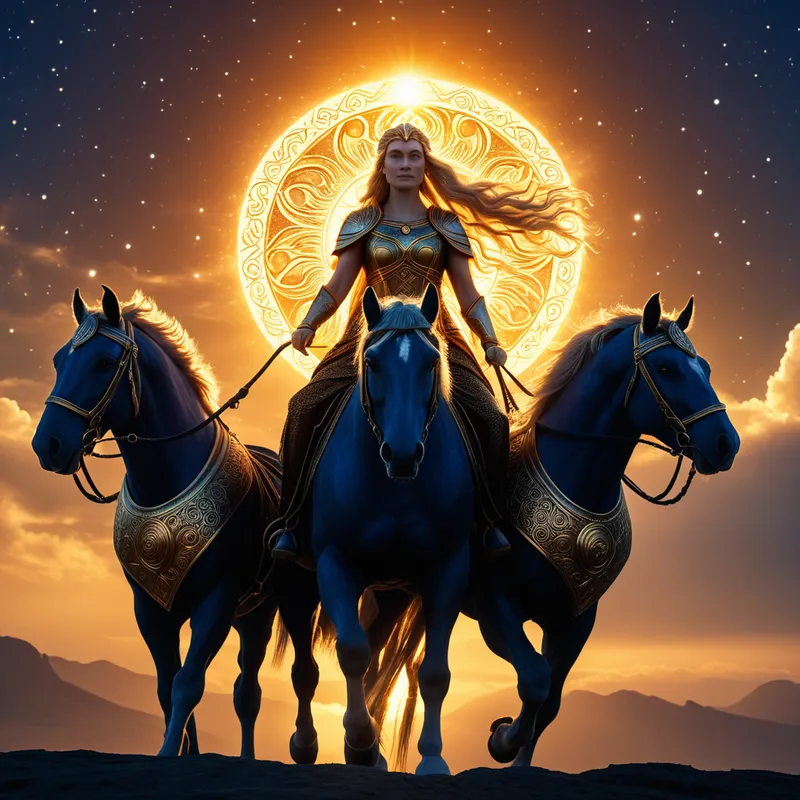
The goddess Sól drives the sun's chariot across the sky, eternally fleeing the wolf Sköll, in a myth of radiant duty and inevitable transformation.
The Tale of Sól
Hear now the tale of the wheel of days, the story written in fire across the vault of [the world](/myths/the-world “Myth from Tarot culture.”/). Before time was counted, the gods looked upon the formless dark and saw a need. From the southern realms of [Muspelheim](/myths/muspelheim “Myth from Norse culture.”/), they took two great sparks, essence of that primordial flame. These sparks they shaped not into weapons or treasures, but into beings of luminous duty.
They became a sister and a brother: Sól</abtitle=“The personification of the sun, a goddess”>ól, whose hair was spun sunlight, and Máni, whose face held the cool glow of a winter’s night. To them was given the heaviest of gifts: the stewardship of the heavens. The gods forged a chariot of such brilliance that few could look upon it, and harnessed to it two horses, Arvakr and Alsvidr, whose names mean “Early Awake” and “All-Swift.”
Each dawn, Sól dons her armor of light, mounts her chariot, and takes the reins. With a crack that stirs the world from sleep, she begins her ascent from the east. [The dew](/myths/the-dew “Myth from Alchemical culture.”/) is her tears, shaken loose by the urgency of her passage. She drives her blazing course across the dome of Ymir’s skull, and all below—the mountains, the seas, the clinging roots of [Yggdrasil](/myths/yggdrasil “Myth from Global/Universal culture.”/)—are bathed in her life-giving gaze.
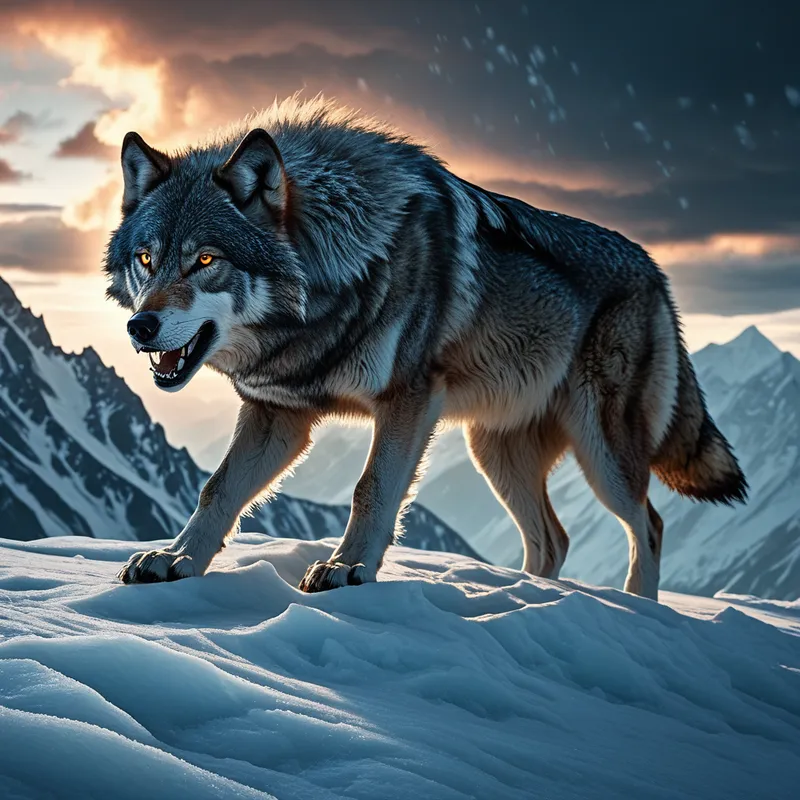
But her path is not one of peace. For in the deep shadows of the world, in the iron woods of the east, a horror was born. The wolf Sköll, a creature of gaping hunger and fathomless shadow, was set upon her trail. His howl is [the wind](/myths/the-wind “Myth from Various culture.”/) that bites before a storm; his breath is the creeping frost. He pursues her not for malice alone, but because it is his nature, written in [the runes](/myths/the-runes “Myth from Norse culture.”/) of fate. Sól does not look back. She hears the panting of the beast, feels the chill of his proximity at the edge of day. She whips the reins, and her horses strain, their hooves striking sparks that become the stars of twilight.
This is the eternal rhythm: the glorious, desperate flight, the relentless pursuit. It is a race where the finish line is the western gate, where Sól plunges into the twilight sea, only to be borne in secret through [the underworld](/myths/the-underworld “Myth from Greek culture.”/) to begin again. The old tellers whisper the prophecy: a day will come when the wolf’s jaws finally close. [The sky](/myths/the-sky “Myth from Persian culture.”/) will darken with his victory, and the stars will vanish from the heavens. But that is a tale for the last day. For now, and for all the nows that have been, Sól drives on, and the world lives in the space between her light and the wolf’s teeth.
Cultural Origins & Context
This myth of the celestial chase was not scripture, but a story woven into the very fabric of daily life for the Norse and wider Germanic peoples. It was told around hearth fires in longhouses, the flickering flames a tiny echo of Sól’s chariot, while the winter wind outside sounded like Sköll’s howl. These narratives were preserved primarily in the Poetic Edda, compiled in the 13th century from much older oral traditions, and referenced in the later Prose Edda.
The function of the myth was profoundly practical and cosmological. It explained the most fundamental observable phenomena: the rising and setting of the sun, the passage of days and seasons. But more than an ancient scientific model, it framed human existence within a grand, dramatic, and ultimately tragic cycle. The sun was not an impersonal ball of gas, but a divine being performing a sacred, perilous duty. Her daily journey mirrored the human struggle—a life spent in productive effort (ørlög) while being pursued by inevitable endings. The myth taught resilience, acceptance of cyclical time, and a deep respect for the forces that sustain life, knowing they operate under constant threat.
Symbolic Architecture
At its [heart](/symbols/heart “Symbol: The heart symbolizes love, emotion, and the core of one’s existence, representing deep connections with others and self.”/), the myth of Sól is a masterful symbolic map of [consciousness](/symbols/consciousness “Symbol: Consciousness represents the state of awareness and perception, encompassing thoughts, feelings, and experiences.”/), time, and the [nature](/symbols/nature “Symbol: Nature symbolizes growth, connectivity, and the primal forces of existence.”/) of existence.
The sun is not merely an object in the sky, but the principle of conscious awareness itself—the light we cast upon the world to know it and to live within it.
Sól represents the focused, sustaining [energy](/symbols/energy “Symbol: Energy symbolizes vitality, motivation, and the drive that fuels actions and ambitions.”/) of [the ego](/myths/the-ego “Myth from Jungian culture.”/) and the [life](/symbols/life “Symbol: The symbol of ‘Life’ represents a journey of growth, interconnectedness, and existential meaning, encompassing both the joys and challenges that define human experience.”/) force. She is the directed will, the daily discipline, the radiant [identity](/symbols/identity “Symbol: Identity represents the sense of self, encompassing personal beliefs, cultural background, and social roles.”/) that moves through the world, creating order, warmth, and growth. Her [chariot](/symbols/chariot “Symbol: The chariot signifies control, direction, and power in one’s journey through life.”/) is the [vehicle](/symbols/vehicle “Symbol: Vehicles in dreams often symbolize the direction in life and the control one has over their journey, reflecting personal agency and decision-making.”/) of the [psyche](/myths/psyche “Myth from Greek culture.”/), and her horses are the vital energies that pull it forward.
Sköll, her pursuer, is the ultimate [symbol](/symbols/symbol “Symbol: A symbol can represent an idea, concept, or belief, serving as a powerful tool for communication and understanding.”/) of [entropy](/symbols/entropy “Symbol: In arts and music, entropy represents the inevitable decay of order into chaos, often symbolizing creative destruction, impermanence, and the natural progression toward disorder.”/), [dissolution](/symbols/dissolution “Symbol: The process of breaking down, dispersing, or losing form, often representing transformation, release, or the end of a state of being.”/), and the unconscious. He is not “evil,” but the necessary [shadow](/symbols/shadow “Symbol: The ‘shadow’ embodies the unconscious, repressed aspects of the self and often represents fears or hidden emotions.”/) to her light—the pull of oblivion, the decay of all forms, the return to undifferentiated darkness. He represents time as a devourer, the inevitable end that gives meaning to the [journey](/symbols/journey “Symbol: A journey in dreams typically signifies adventure, growth, or a significant life transition.”/). The [chase](/symbols/chase “Symbol: Dreaming of a chase often symbolizes avoidance of anxiety or confrontation, manifesting as fleeing from something threatening or overwhelming in one’s waking life.”/) is not a flaw in the [system](/symbols/system “Symbol: A system represents structure, organization, and interrelated components functioning together, often reflecting personal or social order.”/); it is the system. The [tension](/symbols/tension “Symbol: A state of mental or emotional strain, often manifesting physically as tightness, pressure, or unease, signaling unresolved conflict or anticipation.”/) between them creates the arc of the day, the span of a life, and the very possibility of narrative.
The myth presents a [universe](/symbols/universe “Symbol: The universe symbolizes vastness, interconnectedness, and the mysteries of existence beyond the individual self.”/) where transcendence is impossible. There is no final victory over the [wolf](/symbols/wolf “Symbol: Wolves in dreams symbolize instinct, intelligence, freedom, and a deep connection to the wilderness and primal instincts.”/), only a temporary, daily outrunning. This imbues existence with a poignant, heroic [beauty](/symbols/beauty “Symbol: This symbol embodies aesthetics, harmony, and the appreciation of life’s finer qualities.”/). The value is in the running, in the faithful driving of [the chariot](/myths/the-chariot “Myth from Tarot culture.”/), in the light shed for others along [the way](/myths/the-way “Myth from Taoist culture.”/).
The Dreamer’s Resonance
When this mythic pattern stirs in the modern unconscious, it often manifests in dreams of pursuit. The dreamer may be running from a vague but terrifying presence, driving a vehicle that is losing control, or trying to keep a fragile source of light alive in an encroaching darkness. The pursuer is rarely a literal wolf; it may be a shadow, a flood, a silent crowd, or a feeling of immense, impersonal dread.
Somatically, these dreams correlate with states of anxiety, burnout, or a profound fear of time slipping away—the sensation of being “chased” by deadlines, responsibilities, or mortality itself. Psychologically, this is the ego feeling the pressure of the unconscious, the approach of repressed material, or the threat to a cherished self-image. The dream is not necessarily a warning of doom, but an illustration of the psyche’s natural, cyclical rhythm. The “wolf” at our heels is often the part of ourselves or our reality we have been outrunning, the truth that demands integration. The dream asks: What are you so tirelessly driving forward? And what are you refusing to let catch up?
Alchemical Translation
The individuation process, the alchemy of the soul, is perfectly modeled in Sól’s eternal journey. It is not about defeating [the shadow](/myths/the-shadow “Myth from Jungian culture.”/), but about learning to drive the chariot with full knowledge of the wolf.
The goal of psychic wholeness is not to stop being chased, but to incorporate the chase into the meaning of the journey.
The initial stage is identification with Sól alone—the conscious ego, striving, achieving, and illuminating. We believe our task is to outrun all darkness indefinitely. The first alchemical shock is the realization of Sköll, the acknowledgment of our limits, our flaws, our mortality, and the unconscious forces that shape us. This feels like a crisis, a terrifying pursuit.
The transmutation occurs when we understand that the wolf and the sun are two aspects of a single system. The relentless chase is what gives the sun’s path its purpose and beauty. In psychological terms, accepting the “wolf”—our shadow, our finitude, our destructive potentials—does not extinguish our light; it contextualizes it. It moves us from a state of anxious flight to one of conscious, purposeful motion. We begin to drive the chariot not in blind fear, but as a sacred duty performed within the bounds of a great and tragic story.
The modern individual undergoing this alchemy learns to honor their daily “drive”—their work, their relationships, their creativity—not as a naive escape from darkness, but as a luminous act performed because the darkness exists. The light we cast becomes more precious, more compassionate, and more authentic when we know it is, and has always been, temporary. We become the caregiver of our own consciousness, tending its flame faithfully across the sky, until, at the end of our personal day, we make our own destined plunge, having completed the course set before us.
Associated Symbols
Explore related symbols from the CaleaDream lexicon: