Sin/Nanna Myth Meaning & Symbolism
The story of the Moon God Sin, whose cyclical journey through darkness and light embodies the soul's need for withdrawal, reflection, and inevitable return.
The Tale of Sin/Nanna
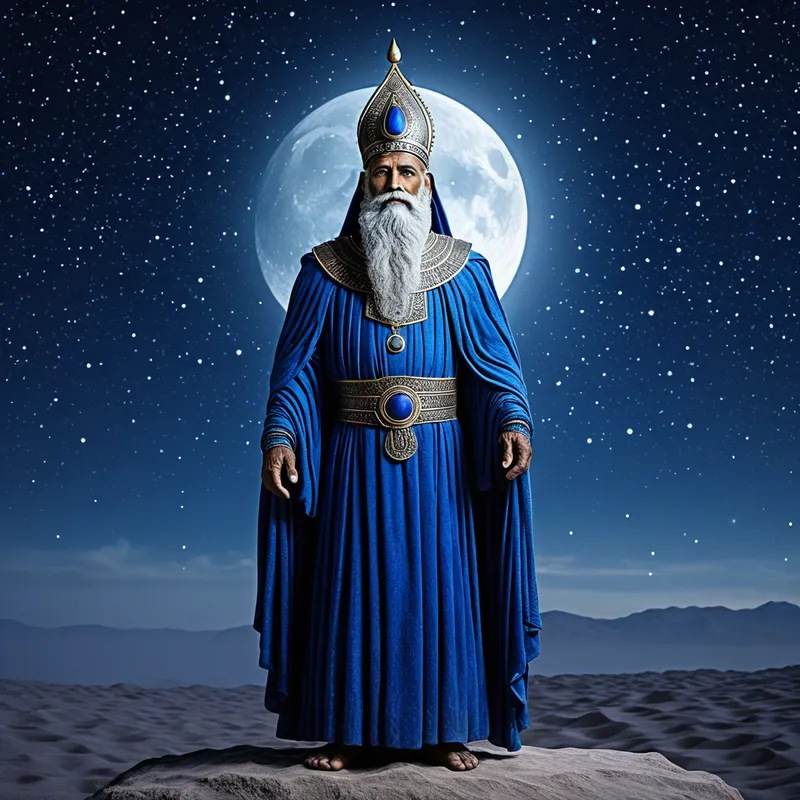
Listen, and let the silence of the night sky speak. Before the clamor of cities, beneath the eternal wheel of stars, there sailed a vessel of quiet light. This was the Barge of Heaven, and its master was Sin, the Lord of Wisdom, whose beard was the flow of time and whose crown was a sliver of pearl in the velvet dark.
Each month, Sin embarked on his solemn voyage. For twenty-nine nights, he would grow, a fattening disk of silver light, bathing the sleeping world of Ki in a cool, watchful glow. He was the measurer, the counter of days, the silent witness to the prayers whispered from ziggurats and the secrets confessed in reed beds. His light was not the harsh judgment of the sun, but a gentle revealer of contours and shadows.
But the fullness could not last. As the days dwindled, a great melancholy would settle upon the god. The light would wane, thinning to a fragile crescent, then to a mere ghost of curve against the black. This was the time of descent. Guiding his barge from the high vault of the heavens, Sin would sail down the hidden rivers of the sky, toward the dread Kur. The world above would plunge into the darkest night, a night of held breath and uncertainty. Where was the measurer? Where was the witness?
Into the mountain of the dead he went, his light extinguished. Here, in the dust-choked silence where the Gidim flitted like moths, Sin was not a lord, but a sojourner. For three days, the world knew true darkness. But this was not an end. It was a hidden renewal, a necessary dissolution in the belly of the mountain.
And then, on the western horizon, a miracle. A thin, impossible sliver of new light. With immense, silent effort, Sin had navigated the labyrinth of Kur. He had been cleansed in the darkness, made new. His barge emerged, bearing the first crescent—a bow, a boat, a promise. He began his climb anew, a fresh cycle of waxing light, greeted with relief and offerings from below. The measurer had returned. Time itself had been rescued from chaos, and the soul of the world could breathe again.

Cultural Origins & Context
This myth was not merely a story but the foundational clock of Mesopotamian civilization. It emerged from the Sumerian world, where the god was called Nanna, and was later syncretized with the Akkadian Sin. His primary cult center was the great Ekišnugal ziggurat at Ur</ab title=“A major Sumerian city-state, the cult center of Nanna/Sin”>Ur, where his priesthood meticulously observed and recorded the lunar phases.
The myth was societal software. It explained the most reliable natural rhythm in an unpredictable world of floods and droughts. The lunar cycle dictated the administrative month, the schedule of festivals, and the timing of religious rites. The three days of the moon’s disappearance were often seen as ill-omened, a time when the protective, ordering principle of the cosmos was absent, and chaos lurked closer. The new crescent’s appearance was thus a monthly triumph of order, celebrated with offerings and the sounding of horns. The myth was passed down through temple liturgies, hymns, and cylinder seal iconography, reinforcing a worldview where cosmic order (Me) was perpetually maintained through divine cycles of presence and withdrawal.
Symbolic Architecture
At its heart, the myth of Sin/Nanna is a master symbol of cyclical time and the necessity of periodic dissolution for renewal. He is not a static, omnipotent god, but a dynamic, processional deity. His journey models a fundamental psychic and cosmic law.
The light must consent to its own extinction to be reborn. Wisdom is not accumulated, but periodically shed and renewed in the silent dark.
Sin represents the luminous intellect and the organizing principle of consciousness. He brings light to the dark, measures the immeasurable (time), and offers a reflective, non-burning illumination. His monthly descent into Kur is the symbolic enactment of the ego’s necessary submission to the unconscious. The fullness of light (conscious achievement, clarity, public identity) inevitably leads to a state of depletion, a psychic “waning,” where one must retreat from the world.
The Kur is not a place of punishment, but of psychic digestion and recalibration. It is the realm of the forgotten, the shadow, and the ancestral. Sin’s journey through it signifies a vital reconnection with the root of being, a stripping away of accrued identities in the “dust” of the underworld. The new crescent is the nascent, fragile emergence of a renewed self, informed by the depths but not consumed by them.
The Dreamer’s Resonance
When this mythic pattern stirs in the modern dreamer, it often manifests as profound cycles of engagement and retreat. One may dream of a glowing object (a lamp, a phone screen, a pearl) that slowly dims and must be taken into a cave or basement to be repaired. There are dreams of calendars where the final pages are blank, of boats sinking into dark water only to resurface elsewhere, or of a beloved, wise figure who disappears for a time, causing great anxiety, before returning changed.
Somatically, this resonates with the natural rhythms of energy depletion and recovery, the introverted pull following periods of intense extroversion. Psychologically, it signals a process of necessary disintegration. The conscious attitude has become rigid, inflated, or exhausted. The psyche is enforcing a “lunar descent”—a depression, a loss of motivation, a creative drought—not as a failure, but as an imperative phase of the cycle. The dreamer is in the Kur, whether they wish to be or not. The task is not to fight the darkness, but to learn to be a sojourner within it, to wait for the intrinsic rhythm of renewal to complete its arc.

Alchemical Translation
For the individual on the path of individuation, Sin/Nanna offers a non-heroic, sage-like model of psychic transmutation. The alchemical work here is Lunaria—the work of the moon. It contradicts the solar, heroic ideal of constant progress and conquest.
The first operation is Observation and Measurement (the waxing moon): developing conscious awareness, structuring one’s life, building ego strength. But the crucial, often resisted operation is the Descent (the waning moon): the voluntary or enforced withdrawal of libido from external projects and personas. This is the negredo, the darkening, where all that was certain seems lost.
The alchemy of the soul requires a vessel that can both hold the light and brave the journey into the mountain of night.
The third operation is the Hidden Conjunction (in Kur): in the silence and darkness, the conscious mind (Sin) encounters the forgotten contents of the personal and collective unconscious (the Gidim, the dust of Kur). This is not an active battle, but a slow, passive permeation, a marination in the shadow. The final operation is the New Crescent: the emergence of a subtle, re-oriented consciousness. It is not the brilliant, full ego of before, but a wiser, humbler light that knows its own dependency on the dark. The individual learns to live in cycle, not in line, understanding that wisdom is born from the rhythmic consent to be unmade and remade, month after month, season after season of the soul.
Associated Symbols
Explore related symbols from the CaleaDream lexicon: