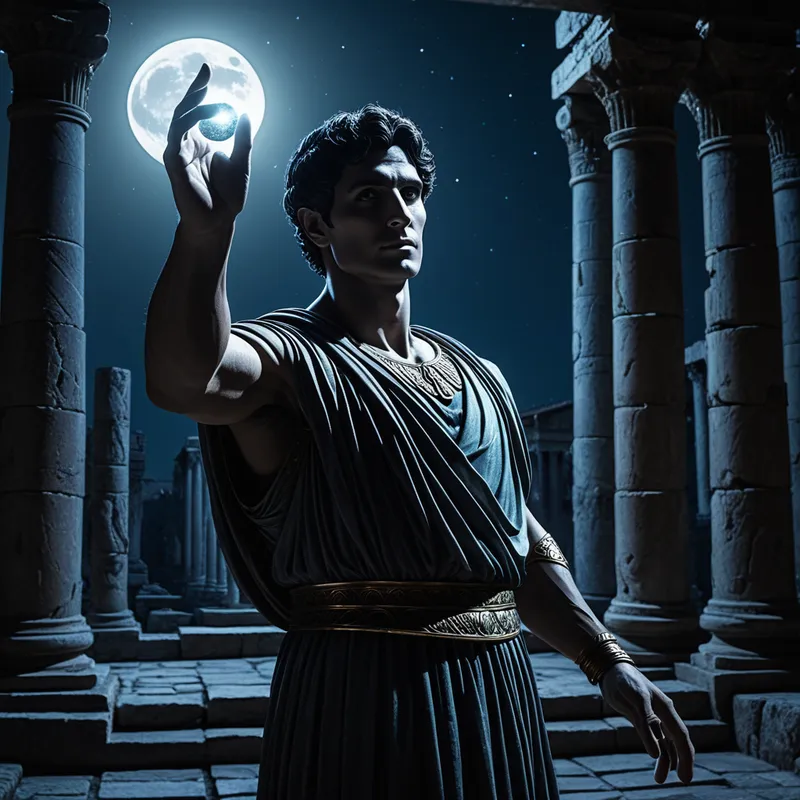
Sinister Myth Meaning & Symbolism
The Roman spirit of the left side, a paradoxical guardian of ill-omen and hidden fortune, challenging the conscious order to reveal deeper truths.
The Tale of Sinister
Listen, and hear the whisper from the side you seldom heed. Before the Di Consentes held absolute sway, the world was read in the trembling of a leaf, the flight of a bird, the very lay of the land. And of these primal whispers, none was more potent, more chilling, or more strangely hopeful than the omen from the left.
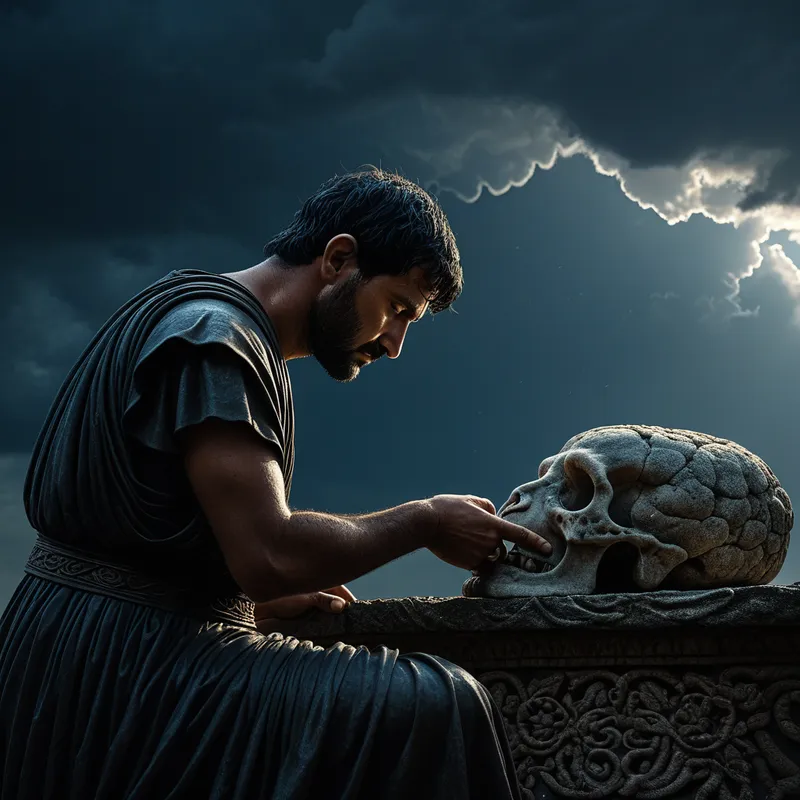
In the sacred space of the templum, under a sky heavy with the breath of the gods, the haruspex would begin his work. The air was thick with incense and the metallic scent of blood. With a blade consecrated to the task, he would open the offering. Steam would rise from the visceral mystery within—a liver, a heart, a set of lungs, a map of the future written in flesh.
All eyes were on his right hand, the dexter, the hand of skill and conscious action. It would trace the familiar lobes, the known markings. But the tension in the gathered crowd, from the lowest soldier to the most seasoned general, came from watching the left. For it was to the left side, the sinister side, that the unseen forces spoke.
If a flaw appeared on the left lobe of the liver, a dark spot, an unusual texture, a cold dread would settle over the assembly. A mutter would pass: “Sinister…” It was an ill-portent, a warning from the realm of chaos that the orderly plans of men were built on shaky ground. A general might delay a march, a consul postpone a law. The left was the realm of the awkward, the unlucky, the inauspicious. It was the stumble, the dropped offering, the bird that flew against the sun from the wrong quarter.
Yet, in the hushed stories told by old Etruscan seers to their Roman apprentices by firelight, there was another layer. They spoke not of a mere direction, but of a presence. Sinister was not just a side; it was a spirit, a numinous force that inhabited that space. He was the guardian of the threshold that conscious reason feared to cross. His warning was not mere malice, but a corrective—a painful truth from the shadowed depths that, if heeded, could avert a greater catastrophe. To receive a sinister omen was to be granted a terrible, precious gift: a glimpse of the hidden currents upon which your ship of state truly sailed. It was the whisper of fate’s left hand, cold and unsettling, but holding a truth the right hand dared not grasp.
Cultural Origins & Context
The concept of sinister is a profound relic of the Roman world-view, deeply rooted in the earlier Etruscan tradition of divination. For the Romans, order (cosmos) was paramount, and it was mirrored in their rituals, their cities, and their very bodies. The right side (dexter) was associated with skill, favor, and the blessings of the gods—the source of our word “dexterity.” The left was its necessary, but feared, counterpart.
This duality was institutionalized in the practice of <abbr title=""Augury"; divination by observing the flight patterns of birds">auspicia. A priest, or augur, would divide the sky into templated regions. Birds appearing in the eastern, right-hand sectors brought favorable signs (auspicia impetrativa). Those from the western, left-hand sectors brought unfavorable, sinister signs. This was not superstition, but a state science; no major public action—from declaring war to holding an election—could proceed without ensuring the signs from the right prevailed.
The myth of Sinister, therefore, functioned as a societal coping mechanism and a profound philosophical concept. It gave a name and a shape to the inevitable intrusion of chaos into order, of bad luck into well-laid plans. It taught that the universe was not uniformly benevolent, but dialogic. One had to listen to both voices: the affirming voice of dexter and the critical, cautioning voice of sinister. To ignore the left was the height of hubris.
Symbolic Architecture
Psychologically, Sinister represents the entire constellation of the Shadow, as articulated by Carl Jung. It is the repository of all that the conscious ego—aligned with the “right-handed” values of order, light, and approved social conduct—rejects, denies, or simply cannot see.
The left hand does not know what the right hand is doing, but it feels the weight of all it has refused to carry.
Sinister is not “evil” in a simplistic sense. It is the inauspicious, the awkward, the unlucky, the repressed, and the instinctual. It is the intuitive flash you dismiss, the gut feeling that contradicts logic, the creative idea that seems too strange, and the personal flaw you desperately hide. In the mythic reading of the entrails, the sinister flaw on the liver is a direct manifestation of a hidden flaw in the plan, the leader, or the collective psyche. It is the unconscious presenting its bill.
The power of Sinister lies in its duality. It brings warning (omen) that can lead to disaster if ignored, but also contains the seed of necessary correction. It is the “bad luck” that forces a detour onto a more authentic path. To acknowledge the sinister is to begin a dialogue with the totality of the self, not just its presentable half.
The Dreamer's Resonance
When the archetype of Sinister stirs in the modern dreamer, it rarely appears as a Roman spirit. Its presence is felt in the texture of the dream itself. It is the dream where you are constantly stumbling, where your left hand is clumsy and won’t obey. It is the path you are “supposed” to take that is blocked, forcing you down the neglected, overgrown lane. It is the important meeting where you are naked from the waist down—a profound social awkwardness emanating from the lower, “sinister” half of the body.
Somatically, this can manifest as a feeling of dread or coldness on the left side of the body upon waking, or a preoccupation with left-handed objects or actions. Psychologically, the dream signals that the conscious attitude is out of balance, overly identified with “right-handed” achievements and persona. The unconscious is sending up a sinister omen—a warning that you are ignoring a vital part of your own nature, and that continued progress on your current path will lead to a symbolic (or literal) shipwreck. The dream is the haruspex, and the odd, uncomfortable image is the flaw on the liver of your psyche.

Alchemical Translation
The alchemical process mirrored in the myth of Sinister is the Nigredo, the blackening. This is the necessary first step of dissolution, where the pristine, ordered matter of the ego is confronted with its own shadow, its sinister counterpart. It feels like bad luck, depression, confusion, and the collapse of plans.
The inauspicious sign is the prima materia of transformation. It is the blackened lump of coal that must endure pressure before it can become a diamond.
The modern individuation journey requires us to become our own augur. We must learn to observe the “left-hand” signs in our own lives: the recurring failures that point to a hidden weakness, the relationships that bring “bad luck” because they mirror our disowned parts, the creative endeavors that feel awkward and inauspicious but hold a strange pull. To integrate Sinister is to stop fleeing these signs and instead, like the haruspex, examine them with sacred attention.
This is the transmutation. The “ill-omen” (sinister) is not banished; it is understood. The repressed instinct becomes grounded intuition. The awkward trait is recognized as a unique gift. The “bad luck” is re-framed as a redirection. The left hand is no longer clumsy, but becomes the hand that receives the hidden, the intuitive, the numinous. In achieving this, the individual moves from a state of one-sided, “right-handed” consciousness to a more complete, ambidextrous psyche. They have heeded the whisper of Sinister and, in doing so, have not avoided fate, but aligned with a deeper, more authentic version of it. The inauspicious becomes the cornerstone of a truer fortune.
Associated Symbols
Explore related symbols from the CaleaDream lexicon: