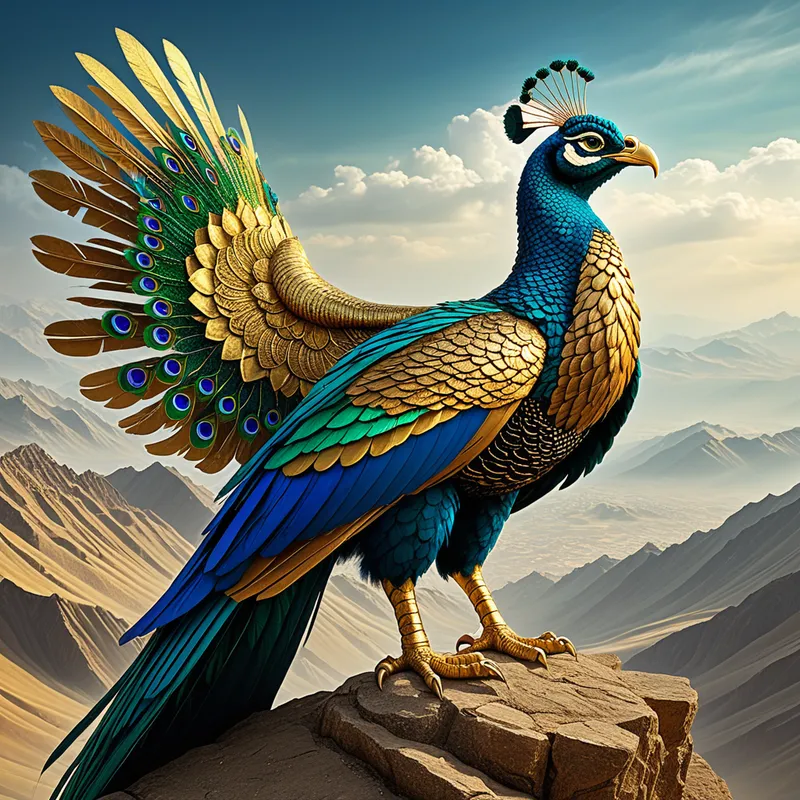
Simurgh's Song Myth Meaning & Symbolism
A wounded king is healed only by hearing the song of the Simurgh, the cosmic bird of wisdom, in a myth of psychic integration and wholeness.
The Tale of Simurgh’s Song
Listen, and let the veil of time grow thin. In the age when legends walked the earth and the scent of sandalwood hung heavy in the air, there ruled a king named Kay Kāvus. His realm was vast, his armies formidable, his palaces adorned with lapis lazuli and carnelian. Yet, a shadow fell upon the Sun-Throne. A strange malady seized the Shah. It was not a fever of the body, but a sickness of the soul—a profound melancholy that turned wine to ash on his tongue and made the song of the nightingale sound like a dirge. The light of his spirit guttered, leaving him listless upon his cushions, his eyes fixed on a horizon only he could see, one of fractured meaning and hollow splendor.
Physicians from the seven climes came with their elixirs and incantations. Sorcerers whispered spells into bowls of mercury. Priests burned sacred woods and read the patterns in the smoke. All failed. The king’s essence was leaking away, drop by invisible drop, into a well of despair. The court grew silent, the gardens untended. The kingdom itself began to mirror its ruler’s affliction, growing still and waiting.
Then, into this stagnant silence, came the whisper of a remedy so impossible it seemed a cruelty. The oldest sage, a man whose beard was white as the snows on Mount Qaf, spoke with a voice like dry leaves. “There is one cure, O King of Kings. It is not found in any herb or gem. It is the Song of the Simurgh.”
A murmur swept the hall. The Simurgh! The bird of a thousand years, who nested in the Gaokerena and whose wings could blot out the sun. To seek it was madness. Its home was beyond the Alborz, in the land of Hûvar, accessible only to the purest of heart or the most desperate of souls. Yet, in the king’s dim eyes, a single spark flickered—the spark of a final, wild hope.
The greatest heroes of the realm set out. They crossed deserts where the sun was a hammer, scaled peaks that pierced the belly of the sky, and navigated valleys where shadows had weight. Many fell to despair, or turned back, their courage spent. Only one, a prince whose name is lost to the wind of ages, driven by a filial love as fierce as it was futile, persevered. After trials that stripped him of everything—his armor, his pride, even his memory of the quest’s purpose—he stumbled into a valley of impossible light.
There, upon a peak of crystal, sat the Simurgh. It was vaster than a palace, its feathers a tapestry of all colors and none, eyes holding the patience of the cosmos. It did not speak, but in its presence, the prince’s fragmented mind became still. He remembered his king, his father in spirit, wasting away. He prostrated himself and made his plea, not with words, but with the raw, silent offering of his journey’s anguish.
The Simurgh regarded the mortal. Then, it inclined its head, parted its beak, and sang.
It was not a sound heard with ears alone. It was the vibration of roots growing deep, the harmony of stars in their orbits, the whisper of creation and the sigh of dissolution woven into one seamless tapestry. It was the song of the whole. The prince felt it mend his own unseen fractures. And then, with a beat of its wings that stirred the clouds, the Simurgh granted not its presence, but its essence—a single, radiant feather, humming with the echo of its song.
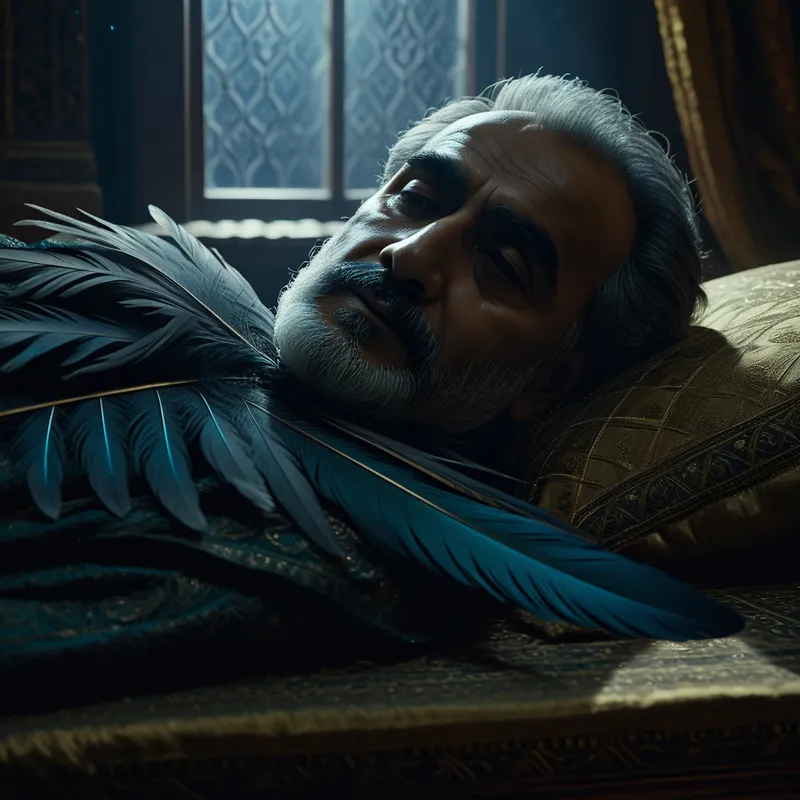
The return journey was a blur. The prince, clutching the feather, found the world had shifted; paths opened where there were none. He arrived at the darkened palace, approached the Shah’s bedside, and held aloft the feather. As the king’s clouded gaze fell upon it, the feather resonated. The Simurgh’s Song, captured in its form, unfolded silently in the chamber’s air.
And Shah Kay Kāvus heard it. He heard the song of the all-encompassing, the note that binds the fragment to the whole. The melancholy, which was the loneliness of a part severed from its source, shattered like ice in a spring thaw. Color returned to his face. Light to his eyes. He rose, not just healed, but transformed—having heard the music of his own deepest, forgotten completeness.
Cultural Origins & Context
The myth of the Simurgh and its healing song is woven deeply into the Persian literary and mystical tradition, most famously immortalized in Ferdowsi’s epic Shahnameh (The Book of Kings) and later, in a profoundly allegorical form, in Farid ud-Din Attar’s Mantiq al-Tayr. In the Shahnameh, the story is a royal epic, a tale of a king’s affliction and the heroic quest for a cure, reinforcing the ideal of the just and healthy ruler as the axis of a healthy world. It was told by storytellers (naqqāls) in coffeehouses and courts, serving as both entertainment and a mirror for statecraft.
In Attar’s Sufi masterpiece, the Simurgh becomes the ultimate symbol of the Divine, and the quest is an inward journey of thirty birds (the si murgh) who discover that the Simurgh (which also means “thirty birds”) is their own collective, transcendent essence. The “song” here transforms into the silent, ultimate realization of unity. This dual transmission—through the national epic and the mystical poem—allowed the myth to function on multiple levels: as a civic lesson on leadership and dependency on wisdom, and as an esoteric map for the soul’s journey toward God. It was never merely a fantasy, but a cultural vessel for carrying profound psychological and spiritual truths.
Symbolic Architecture
At its core, this myth is a profound allegory for the crisis of fragmentation and the healing power of integrative wholeness. Shah Kay Kāvus represents the conscious ego in a state of alienation. He has all the outer trappings of success (the kingdom) but is afflicted with a “sickness of the soul”—a modern analogue to depression, existential dread, or the feeling of meaninglessness that can plague even the most accomplished life.
The wound of the king is the wound of the part that has forgotten it belongs to a whole.
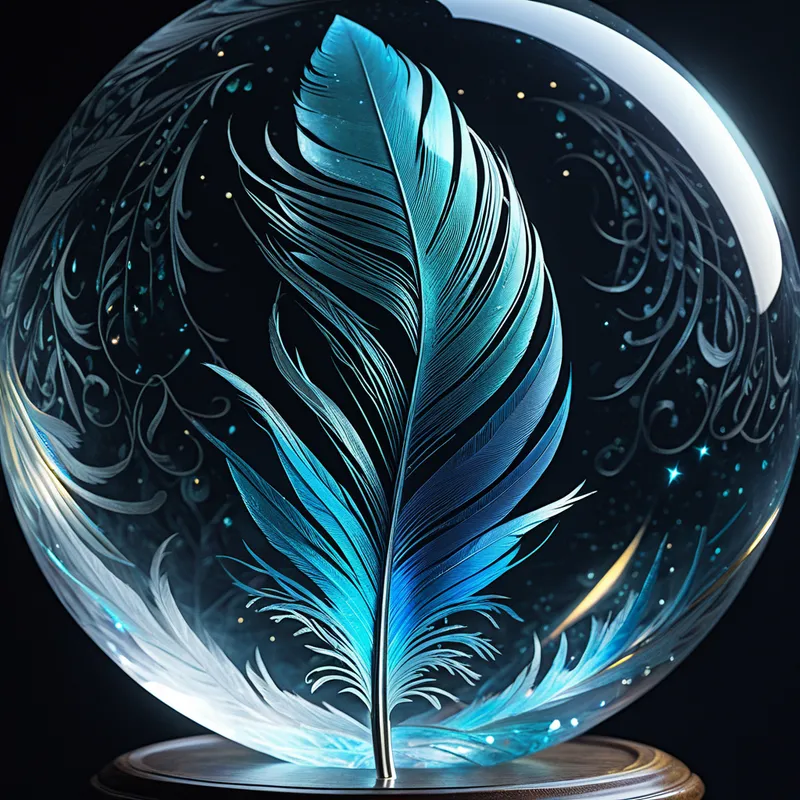
The Simurgh is the symbol of the complete Self, in the Jungian sense. It is not just an external savior but the psychic totality—the union of conscious and unconscious, human and divine, temporal and eternal. Its home on Mount Qaf, the world-encircling mountain, signifies that this wholeness exists at the periphery of our known world, in the transcendent dimension of the psyche. The feather is a synecdoche: a part that contains and transmits the essence of the whole. It is the tangible symbol, the dream image, or the moment of insight that bridges the gap between our fractured state and our latent completeness.
The quest, undertaken by the heroes and completed by the self-forgetting prince, is the necessary ordeal of the ego. One must be stripped of preconceptions and personal ambition (the prince forgets his purpose) to become a vessel pure enough to receive the symbol of wholeness. The healing occurs not through an action, but through a resonance. The king is cured by hearing the song—by allowing the symbolic representation of wholeness to vibrate within his own being, re-attuning his fragmented psyche to its innate, harmonious pattern.
The Dreamer’s Resonance
When this mythic pattern stirs in the modern dreamer, it often manifests during a period of profound psychological or life transition—a “dark night of the soul.” One might dream of a cherished place (the kingdom) that feels decaying or abandoned. The dream ego may be paralyzed, ill with a mysterious condition, or searching desperately for a lost, vital object.
The appearance of a magnificent, often impossibly large or radiant bird is a key signal. It may be silent, or its call may produce a feeling of awe or deep peace. Alternatively, the dream may focus on the quest: an arduous, confusing journey through labyrinthine landscapes, perhaps in search of a specific sound, a medicine, or a wise figure. Somatic sensations in the dream are crucial: a feeling of weightlessness upon hearing a certain tone, a warmth spreading from the chest, or the mending of a cracked or hollow feeling inside.
Psychologically, this dream pattern indicates that the conscious mind is exhausted from maintaining a fragmented identity. The psyche is mobilizing its deepest resources, symbolised by the Simurgh, to initiate a process of integration. The dream is not just a reflection of illness, but the first note of the healing song itself, emerging from the Self to begin the re-attunement of the personality.
Alchemical Translation
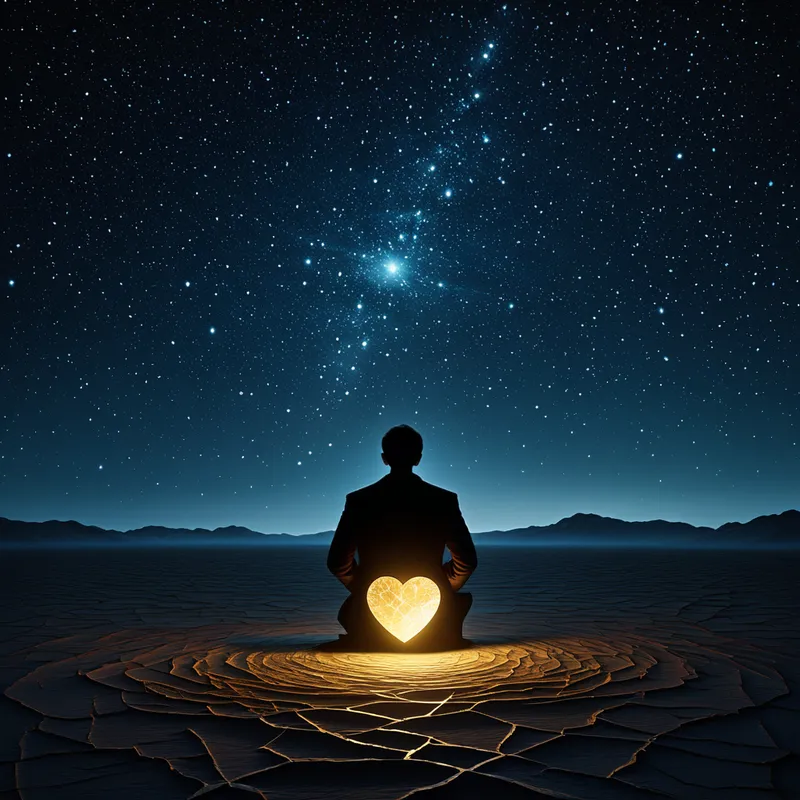
The myth of Simurgh’s Song provides a flawless model for the alchemical process of individuation—the psychic transmutation of leaden fragmentation into golden wholeness. The initial stage, nigredo, is the king’s melancholy: the darkening, the putrefaction of the old, outworn mode of being. His worldly power (the persona) is useless; the ego must confront its own poverty.
The quest represents the stages of albedo and citrinitas—the purification and illumination. The hero’s journey is the ego’s labor to serve a goal beyond itself. Being stripped bare on the journey is the necessary dissolution of ego-attachments. Arriving empty-handed before the Simurgh is the moment of surrender, where the ego relinquishes control and opens to the non-ego, the Self.
The feather is the lapis philosophorum, the Philosopher’s Stone—not a stone, but the transformative symbol that mediates between the finite and the infinite.
The final act is the rubedo, the reddening or culmination. This is not an explosive event, but a resonant healing. The king does nothing but listen. The alchemical transmutation is completed through a receptive, embodied integration. The song-vibration is the new, harmonious frequency of the integrated personality. The healed king is the individuated individual, who rules his inner kingdom not through force of will, but through alignment with the symphonic wisdom of the Self. He has internalized the Simurgh’s Song, and thus, in the most profound sense, has become it. His sovereignty is now authentic, flowing from the unity of the part with the cosmic whole.
Associated Symbols
Explore related symbols from the CaleaDream lexicon: