Simurgh Myth Meaning & Symbolism
A cosmic bird of wisdom, the Simurgh guides heroes and heals the world, embodying the ultimate union of all beings and the soul's ascent.
The Tale of Simurgh
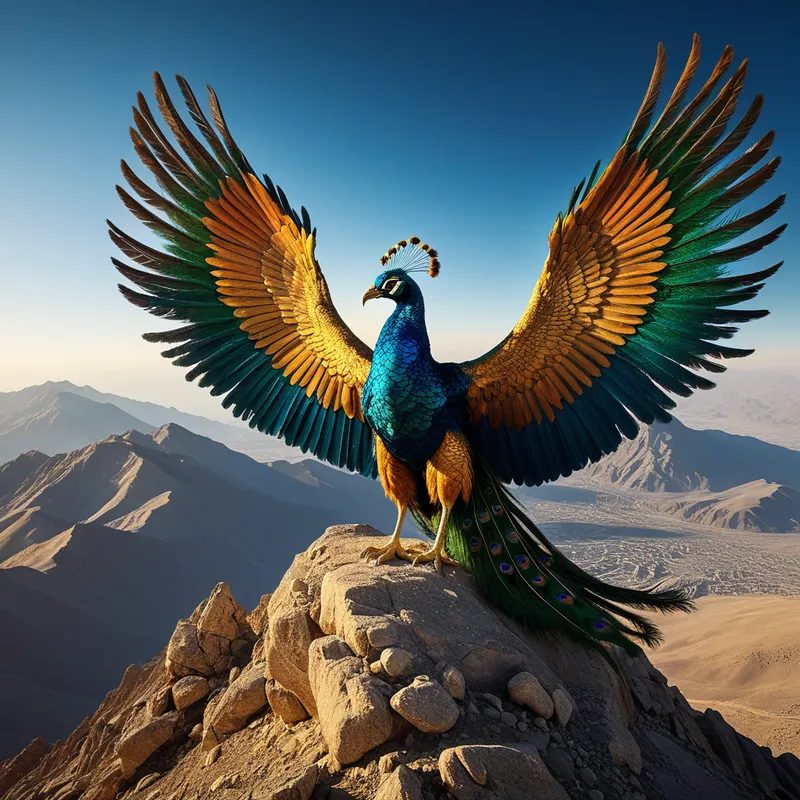
Listen, and let the winds of the Alborz carry you to a time before time, to the slopes of the mythic Mount Qaf. It is a realm of emerald stone and whispering cedars, where the air is thin with eternity. Here dwells the Simurgh, a creature so vast its wings blot out the sun, its feathers holding the hues of sunrise and deep ocean, of copper and lapis lazuli. Its eyes hold the patience of the ages, and its nest is woven from branches of the Tree of All Seeds.
Our tale turns to the world of men, to a king’s despair. The warrior-king Sam is blessed with a son, but the babe is born with hair as white as moonlight and skin like alabaster. The court gasps. They see an omen, a demon’s mark. Fear, cold and sharp, pierces Sam’s heart. In a moment of tragic weakness, he orders the infant carried to the wild, desolate foothills of Mount Qaf and left to the mercy of beasts and elements. The child, named Zal, wails into the uncaring wind.
But the Simurgh, from its high perch, hears not a demon’s cry, but the pure sound of innocent life. Moved by a compassion deeper than human understanding, it swoops down, its great wings beating a rhythm of salvation. It gathers the fragile child in its talons, gentle as a mother’s hand, and carries him to its celestial aerie. There, amidst the scent of ancient spices and the rustle of cosmic feathers, the Simurgh raises Zal. It feeds him on the marrow of wisdom and the fruit of the Tree of All Seeds. It teaches him the languages of beasts and stars, the art of healing, and the virtue of boundless compassion. Zal grows strong and wise, a prince of two worlds.
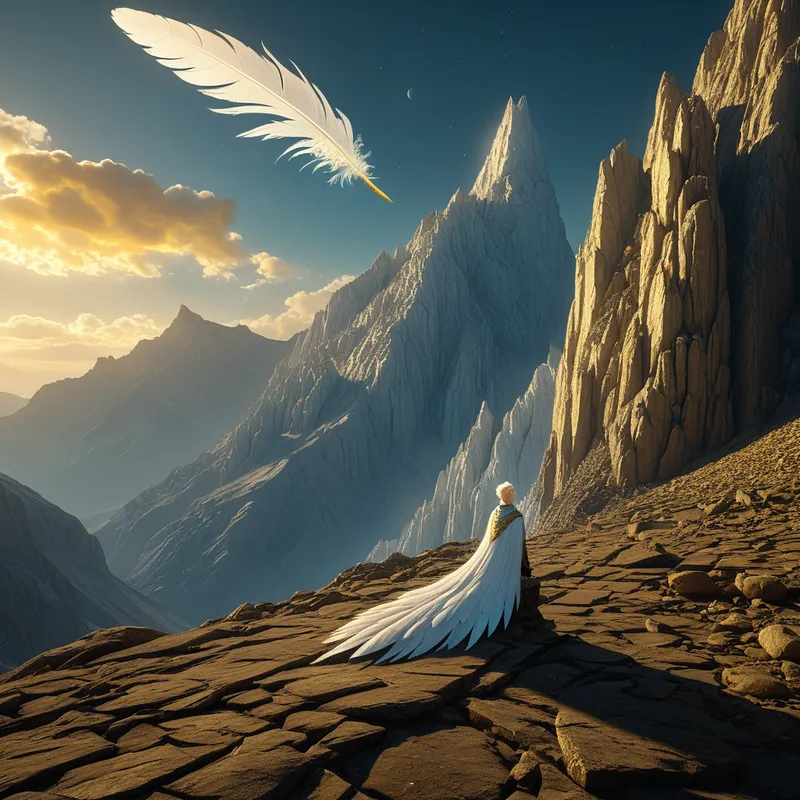
Yet, a human heart yearns for its own kind. Seeing his foster-son’s quiet longing, the Simurgh, though its own heart aches, knows its duty is complete. Before Zal descends to reclaim his birthright, the great bird plucks a single, glowing feather from its breast. “Take this,” it whispers with a voice like shifting continents. “When you are in dire need, burn this feather, and I will come.” Zal, tears mingling with the mountain mist, takes the feather—a piece of the sky made solid—and returns to the world of men, forever marked by the grace of the divine.
Years flow like rivers. Zal becomes a great king and a father. His son, the mighty hero Rostam, is born in agony, a child so large he threatens the life of his mother, Rudabeh. Desperate, remembering the ancient promise, Zal takes the sacred feather to a brazier. As the smoke curls upward, carrying his plea, the sky darkens. The Simurgh arrives in a storm of grace. It instructs Zal in a miraculous surgery, guides his hand to save Rudabeh, and heals the newborn Rostam with a touch of its beak. Once more, it offers a feather for future peril, then ascends, leaving behind the scent of rain and the echo of a promise that binds heaven to earth.
Cultural Origins & Context
The Simurgh is not merely a story; it is a cultural pillar, its roots sunk deep into the Zoroastrian soil of pre-Islamic Persia. It soars through the pages of the Shahnameh, Ferdowsi’s monumental 10th-century epic that preserved Iran’s mythic history. Here, the Simurgh is a tangible force, a Farr-bearing entity that intervenes in the lineage of heroes.
Its transmission was the sacred duty of storytellers and naqqāls, who would recite the Shahnameh in coffeehouses and courts, their voices weaving the Simurgh’s benevolence into the national psyche. The myth functioned as a societal anchor, teaching lessons of wisdom over brute force, of compassionate nurture over fearful prejudice, and of the sacred covenant between the sovereign and the divine. It affirmed that even the most forsaken—like the abandoned Zal—could be chosen for a destiny intertwined with the cosmic order.
Symbolic Architecture
The Simurgh is an emblem of ultimate wholeness. Its very name suggests “thirty birds” (si morgh), a hint at its most profound secret: it is the unity of the multitude. It is not a distant god, but an immanent, nurturing consciousness that bridges heaven and earth, the divine and the human, the abandoned and the royal.
The Simurgh does not rescue from afar; it nests in the world, making the cosmic mountain a cradle and its feathers a tangible link to grace.
Psychologically, it represents the Self, the central, organizing principle of the psyche that guides the ego toward integration. Zal’s abandonment is the ego’s initial state—alienated, rejected by the conventional order (King Sam). His rearing by the Simurgh is the nurturing of the latent Self, acquiring wisdom not from human society but from the deep, instinctual, and transpersonal source. The gift of the feather symbolizes the enduring connection to this inner compass, a tool for summoning profound inner resources during life’s crises, much as Zal and Rostam do.
The Dreamer's Resonance
To dream of the Simurgh is to encounter a moment of profound psychic intervention. You may dream of being lost in a mountainous, isolating landscape (a life crisis, depression, feeling “abandoned” by your own history or family patterns). The appearance of the great bird—perhaps first only as a shadow, a sound of immense wings, or a single feather found in a barren place—signals the activation of the Self.
Somatically, this can feel like a sudden, deep inhalation after being submerged, a warmth in the chest, or a release of tension in the shoulders. Psychologically, you are in the process of being “fostered” by a deeper part of your own psyche. The dream is an assurance that you are not alone in your struggle; a wiser, more compassionate intelligence within you is attending to your plight, offering not a quick rescue, but the tools for healing and the promise of eventual return to your life, transformed and empowered.

Alchemical Translation
The myth of the Simurgh is a perfect map for the alchemical process of individuation—the journey toward becoming an integrated, whole individual. The nigredo, or initial blackening, is Zal’s abandonment: the ego’s painful separation and confrontation with its own “otherness” (his albinism). The albedo, the whitening, occurs on Mount Qaf: the purifying, instructive period of being raised by the Self, where one learns the language of the unconscious (beasts, stars).
The descent from the mountain is not an end, but the beginning of the great work: to bring the wisdom of the mountain into the marketplace of ordinary life.
The gift and eventual burning of the feather represent the rubedo, the reddening or final stage. It is the conscious, willful invocation of the Self’s power in a moment of extreme earthly crisis (childbirth, a creative block, a moral dilemma). You must “burn” your most sacred connection—act with faith, surrender the symbol—to manifest its power. The healing of Rostam and Rudabeh symbolizes the fruit of this work: the birth of the heroic potential within (Rostam) and the salvation of one’s relatedness to life and love (Rudabeh). The final lesson is that the Self is not a one-time rescuer but a perpetual, abiding presence. The journey to the Simurgh is, in the end, the journey to discover that you are, and always have been, a part of its thirty-fold, glorious being.
Associated Symbols
Explore related symbols from the CaleaDream lexicon: