Sim Cheong Myth Meaning & Symbolism
A blind man's devoted daughter sacrifices herself to the sea, is reborn as an empress, and returns to restore her father's sight and the world's order.
The Tale of Sim Cheong
Hear now the tale woven from sorrow and salt, from the darkness behind the eyes and the light at the bottom of the sea. In a time when the mountains were young and the rivers sang clearer, there lived a man named Sim Hak-gyu, whose world was a perpetual midnight. Blinded by grief, he wandered a landscape of sound and touch, his only compass the voice of his daughter, Sim Cheong. She was his dawn, his guiding star, the hands that led him through the unending dusk.
Their life was one of poignant simplicity, a fragile boat on a river of need. Yet, the world’s cruelty is a tide that finds every shore. In his devotion to Buddha, Sim Hak-gyu learned that a donation of three hundred sacks of rice could rebuild a temple and, perhaps, move the heavens to restore his sight. A promise born of desperation, a debt impossible for a blind beggar and his daughter to repay. Sim Cheong, whose love was as deep and unwavering as the ancient East Sea, heard of merchant sailors seeking a sinseon—a living offering to placate the Dragon King and calm his furious waters. The price for this sacrifice? Three hundred sacks of rice.
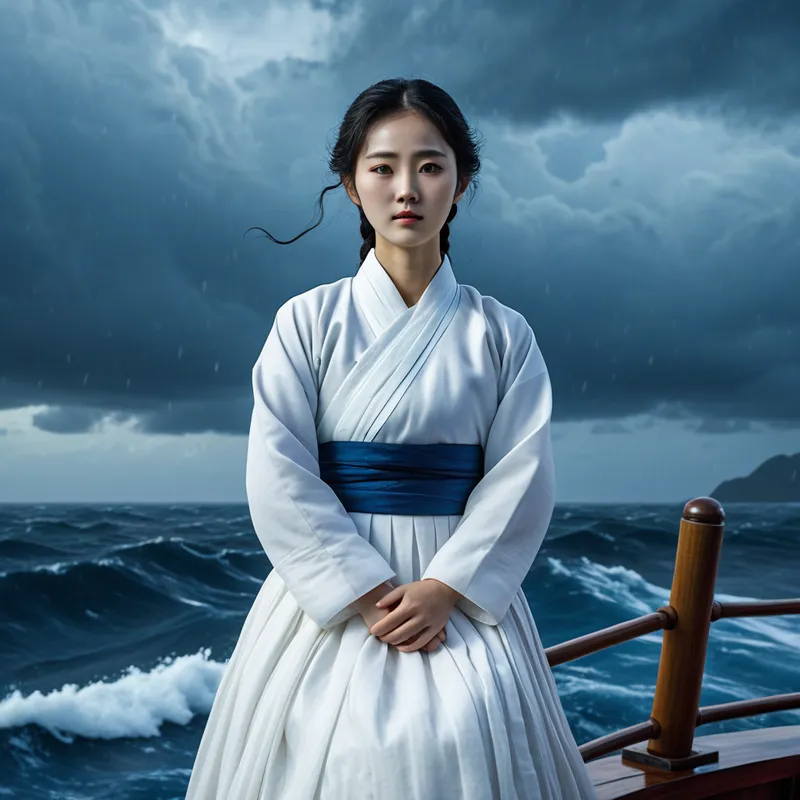
Without a whisper of hesitation, she traded her life for her father’s dream. They dressed her in bridal white, not for a husband, but for the abyss. On the appointed day, the sea was a roiling beast of grey and green. As the sailors chanted and the drums beat a funeral rhythm, Sim Cheong stepped to the ship’s rail. She did not look back at the land of the living, but forward into the maw of the deep. With a prayer for her father on her lips, she surrendered to the cold embrace of the waves.
But the story does not end in the crushing dark. The Dragon King was not a monster of mindless hunger, but a sovereign of profound order. Moved by her purity and sacrifice, he could not consume such a soul. Instead, he cradled her in a palace of coral and pearl, placing her within a colossal, radiant lotus bud. This bud, a vessel of potential, was carried by the currents of fate to the surface, where it drifted into the garden pond of the Emperor himself.
When the lotus bloomed under the imperial moon, revealing Sim Cheong, alive and more luminous than before, the world turned on its axis. She became the Empress, her past a secret jewel. Yet, even in the silken splendor of the palace, her heart beat only for the sound of a blind man’s cane tapping in the distance. She ordered a great feast for all the blind men of the kingdom, and among the throng, she found him—her father, more broken than ever, believing his daughter forever lost. At the sound of her true voice, a miracle woven from love and loss unfolded: the scales fell from his eyes. Light, color, and the face of his daughter flooded into his world, healing the original wound. The circle closed, not merely restored, but sanctified.
Cultural Origins & Context
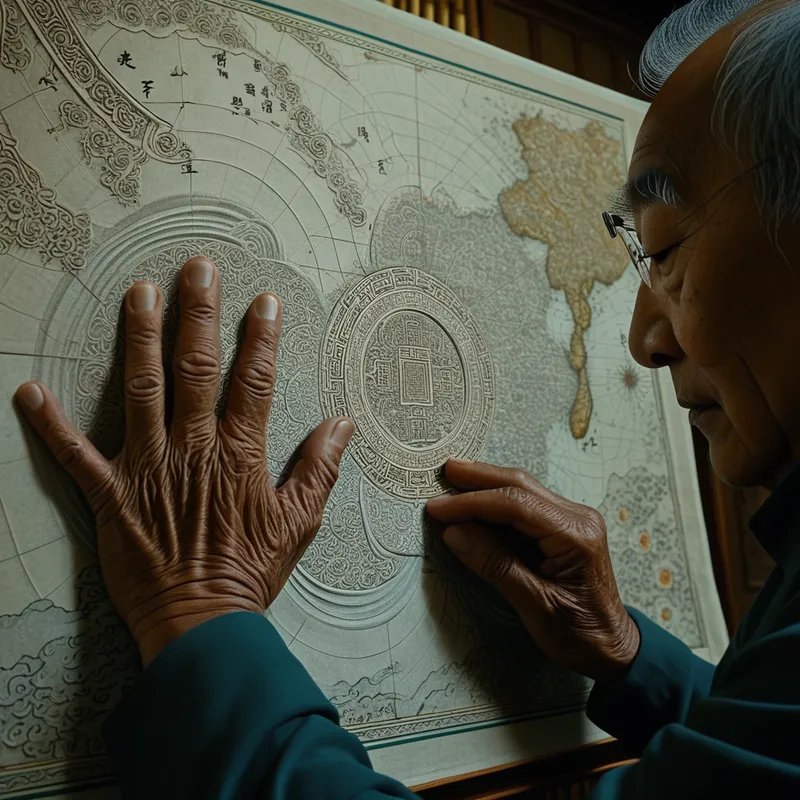
The myth of Sim Cheong, known as Simcheong-ga, is a cornerstone of Korean narrative heritage, classified as one of the five great Pansori epics. For centuries, it was not read, but performed—brought to life by a lone singer (sorikkun) and a single drummer, whose rhythms guided the emotional journey from despair to transcendence. This oral tradition, thriving particularly during the Joseon period, carried the tale from royal courts to rural village squares.
Its societal function was multifaceted. On one level, it was a powerful didactic tool, reinforcing the Confucian virtue of hyo (filial piety) to an extreme, almost unimaginable degree. Sim Cheong was the ultimate model of the self-sacrificing daughter. Simultaneously, the story served as a profound folk-theodicy, offering a narrative framework for the common human experiences of unbearable suffering, unjust fate, and the fragile hope for miraculous reversal. It provided a psychic container for the collective grief and resilience of a people often subject to the harsh whims of nature and hierarchy, promising that ultimate fidelity and purity could, in the most mysterious ways, reorder the cosmos itself.
Symbolic Architecture
At its heart, Sim Cheong is not merely a folktale of duty, but a profound map of the soul’s descent and return. Sim Cheong herself represents the Caregiver archetype in its most absolute form—the part of the psyche willing to journey into the deepest unconscious (the sea) to heal a foundational wound (her father’s blindness).
The ultimate sacrifice is not a negation of the self, but a sowing of the self into the dark earth of the unknown, from which a more complete identity must grow.
Her plunge into the sea is the classic nekyia, a voluntary descent into the underworld of the unconscious. The Dragon King is not a devil, but the sovereign of this deep, psychic realm—the keeper of primal patterns, emotions, and life force. He does not destroy her because her motive is pure; she is not fleeing life, but serving a love greater than her individual survival. The lotus bud is the symbol of her transformed state—protected, latent, containing her potential for rebirth. Her emergence as Empress signifies the integration of this deep, self-sacrificing love with conscious power and authority. She returns not as the same daughter, but as a woman who has unified the depths and the heights.

The Dreamer’s Resonance
When this myth stirs in the modern dreamer, it signals a profound process of shadow-work and psychic obligation. To dream of sacrificing oneself for a blind parent, or of falling willingly into a deep, dark body of water, often points to a feeling of being unconsciously compelled to give up one’s own vision, one’s own life path, to care for an internalized “parental complex”—a set of old wounds, obligations, or inherited blindnesses that demand constant tending.
The somatic experience might be one of weight, of being pulled downward by a deep, sad loyalty. Psychologically, it is the process of confronting the inner caregiver who has over-identified with its role. The dream asks: What part of me have I thrown overboard to calm a storm that was not mine? What vision have I sacrificed to pay a debt I did not incur? The healing comes not in refusing the descent, but in understanding its purpose. The dream may progress to images of being safely held in strange, beautiful depths (the coral palace) or enclosed in a protective shell (the lotus), indicating the psyche’s innate capacity to hold and transform us through the sacrifice.

Alchemical Translation
The alchemical journey of Sim Cheong is a perfect model for the process of individuation, where the base metal of compulsive, self-abnegating duty is transmuted into the gold of conscious, compassionate wholeness.
The first stage, nigredo, is her sacrifice—the conscious acceptance of a necessary “death” of the old identity (the devoted village daughter). The sea represents the prima materia of the soul, where dissolution occurs. The Dragon King’s realm is the albedo stage—a period of purification and reflection in the unconscious, where she is recognized for her essential purity, not her functional role.
The psyche’s deepest waters do not drown the true self; they baptize it in the mystery of its own origin.
Her enclosure in the lotus is the citrinitas, the incubation of a new form. Finally, her emergence as Empress and the restoration of her father’s sight is the rubedo—the culmination. Here, the archetypal energies are fully integrated. The Caregiver is now married to the Ruler. The healed “father” (the internalized complex, the old wound) now sees the world—and her—anew. She has not abandoned her love, but has expanded it from a personal duty into a universal principle of restorative grace. The modern individual undergoing this alchemy learns that true healing of ancestral or personal wounds requires not just sacrifice, but a journey through the sacrifice to a place where one can return, empowered, to bestow the gift of sight—consciousness—upon the very source of the old blindness.
Associated Symbols
Explore related symbols from the CaleaDream lexicon:
- Sacrifice — The central, voluntary act of Sim Cheong, representing the conscious surrender of the ego’s demands to serve a deeper, soul-level obligation or love.
- Water — The primordial element of the unconscious, the sea into which Sim Cheong descends, symbolizing dissolution, emotion, the unknown, and the source of rebirth.
- Blindness — The literal condition of Sim Hak-gyu and the symbolic state of the psyche cut off from insight, trapped in old patterns, and dependent on external guidance.
- Vision — The ultimate gift restored, representing not just physical sight but psychic illumination, consciousness, and the ability to see the true nature of reality and relationship.
- Lotus — The vessel of rebirth and transformation, protecting Sim Cheong in the deep; it symbolizes purity rising from murky depths, spiritual awakening, and the enlightened self.
- Father — Represents the internalized ancestral complex, tradition, old wounds, and the part of the psyche that requires healing through a descendant’s journey.
- Daughter — The aspect of the soul devoted to service, connection, and the healing of the past, willing to journey into the depths to restore order.
- Ocean — The vast, sovereign realm of the Dragon King, representing the collective unconscious, fate, and the mysterious, ordering power that recognizes true virtue.
- Rebirth — The core transformative process of the myth, the emergence from a symbolic death (the sea) into a new, more integrated and powerful state of being (Empress).
- Dancheong Patterns — The intricate, colorful patterns on the temple Sim Hak-gyu longs to fund; they symbolize cosmic order, harmony, beauty, and the sacred structure that devotion seeks to restore.
- Grief — The foundational emotion that blinds Sim Hak-gyu and motivates the entire narrative, representing the unprocessed pain that must be journeyed through for healing to occur.
- Love — The unwavering, filial love that drives the sacrifice and ultimately becomes the transformative force that heals blindness and restores wholeness.