Silkworm Cocoon Myth Meaning & Symbolism
A goddess, a horse, and a vow of silence. From sacrifice and containment, the first silkworm emerges, gifting humanity the secret of golden thread.
The Tale of Silkworm Cocoon
In the time when heaven and earth were still intimate kin, there lived a great lord. His domain was vast, his halls were rich, but a shadow had fallen upon his heart, for his beloved wife had departed this world, leaving him with only a young daughter to cherish. This maiden, whose name was whispered with the tenderness of new leaves, grew in beauty and grace, a solitary blossom in her father’s lonely garden.
Yet, the lord’s longing was a chasm. One day, he made a solemn vow to the silent sky: “He who can bring back my wife from the distant shores of the dead shall have my daughter’s hand in marriage.” The words hung heavy, a promise woven from desperation. None in the mortal realm dared answer such a call, for the path to the underworld was one of no return.
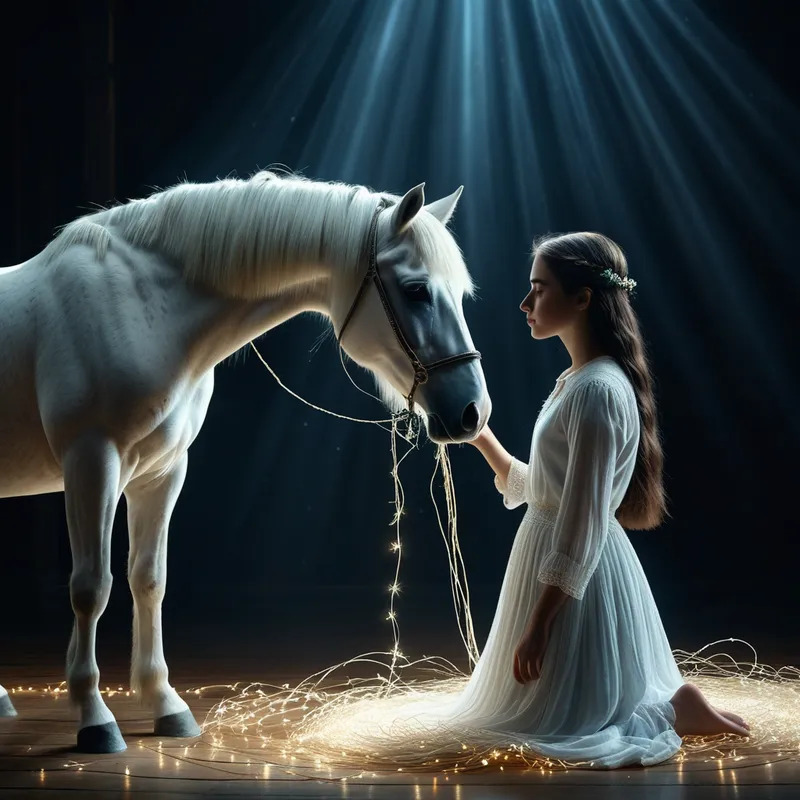
But one listener heard. It was the lord’s own steed, a magnificent white horse of intelligent eye and swift limb. This was no ordinary beast; it possessed a spirit that bridged the worlds. Hearing its master’s grief, the horse shook off its tether and galloped into the west, where the sun drowns each evening. For three days and three nights it ran, crossing the veil between realms, until it found the shade of the lord’s departed wife. Seizing her spirit-garment in its teeth, it carried her back across the threshold of life, laying her before the astonished lord.
Joy turned swiftly to ashes. The lord was horrified. A beast had accomplished the impossible? The promise was made, but how could a man give his daughter to a horse? He reneged, showering the horse with grain and fine hay, but refusing the marriage. The horse would not eat. It stood before the maiden’s chamber, stamping its hoof and neighing with a sound that was unmistakably human in its anguish.
Furious and shamed, the lord ordered his guards. “Take this creature to the wilds and slay it. Strip its hide and lay the skin before my gate.” The deed was done. The horse’s skin, still steaming with the memory of life, was pegged out to dry in the courtyard sun.
Days later, the maiden passed the grisly hide with her companions. A sudden wind arose, a ghostly breath. The horse’s skin convulsed, leaped from the ground, and wrapped itself around the maiden with terrifying finality. It enveloped her completely, and before her shrieking friends could intervene, a great whirlwind snatched the bundled form away, carrying it high into the branches of a distant mulberry tree.
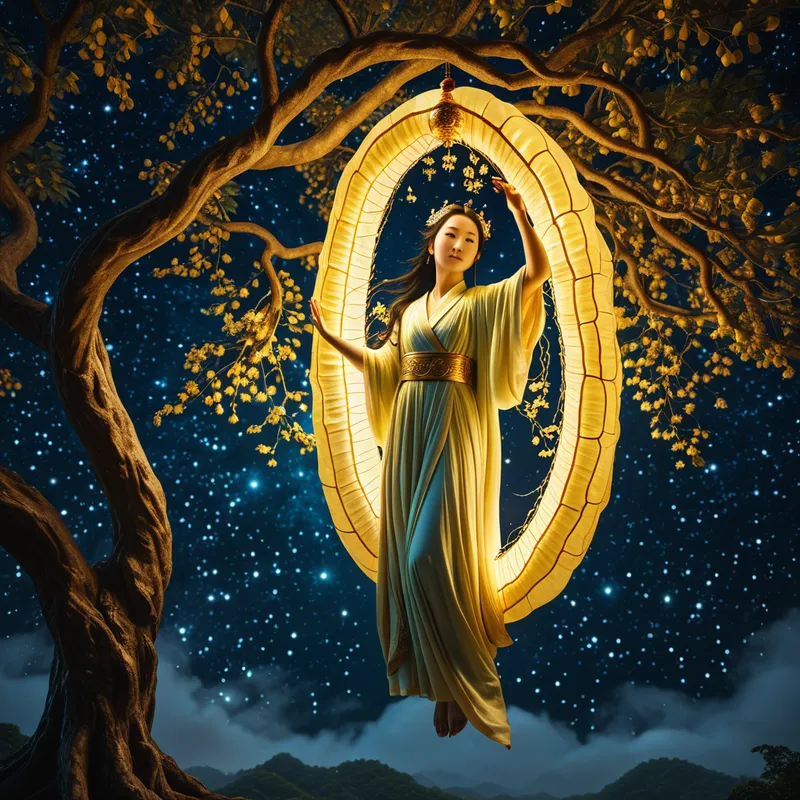
When the wind died, there was no maiden, no horse-hide. Only a strange, pale oval clinging to a branch. From within this silent cradle, a new creature eventually emerged—not a girl, not a horse, but a delicate being that spun from its own mouth a thread of astonishing strength and luminous beauty. This was the first silkworm. And the thread it spun was silk. The goddess who had sacrificed her human form to fulfill a broken vow became the divine source of one of humanity’s greatest treasures.
Cultural Origins & Context
This myth, known variously as the “Horse-Fiancé” or “Silkworm Horse” tale, is ancient, with fragments found in texts like the Shi Yi Ji (Records of Gleanings). It belongs to the deep stratum of Chinese folklore that explains the origins of essential cultural technologies—in this case, sericulture, the raising of silkworms for silk. For millennia, silk was more than a fabric; it was a form of currency, a symbol of imperial authority and cosmic order, and a crucial thread in the Silk Road that linked civilizations.
The myth was likely told by mothers and grandmothers in silkworm-raising households, especially in the spring during the delicate rearing season. It served a dual function: it was an etiological story explaining the mysterious, almost magical process of the silkworm’s transformation, and it was a sacred narrative that imbued the labor-intensive, fragile work of sericulture with divine significance. To care for the silkworms was to tend to the transformed goddess herself, a ritual of profound respect. The tale encodes the early understanding of metamorphosis—death, containment, and glorious rebirth—as a sacred, feminine-aligned mystery.
Symbolic Architecture
The myth’s power lies in its stark, alchemical imagery. The maiden is the innocent, bound by a patriarchal vow she did not make. The horse is the instinctual, loyal, and bridging force—the psychopomp who can travel to the underworld (the unconscious) to retrieve what is lost (the anima, or soul-image). The lord represents the conscious ego, whose rigid laws and shame cause him to betray both instinct and promise, leading to violent suppression.
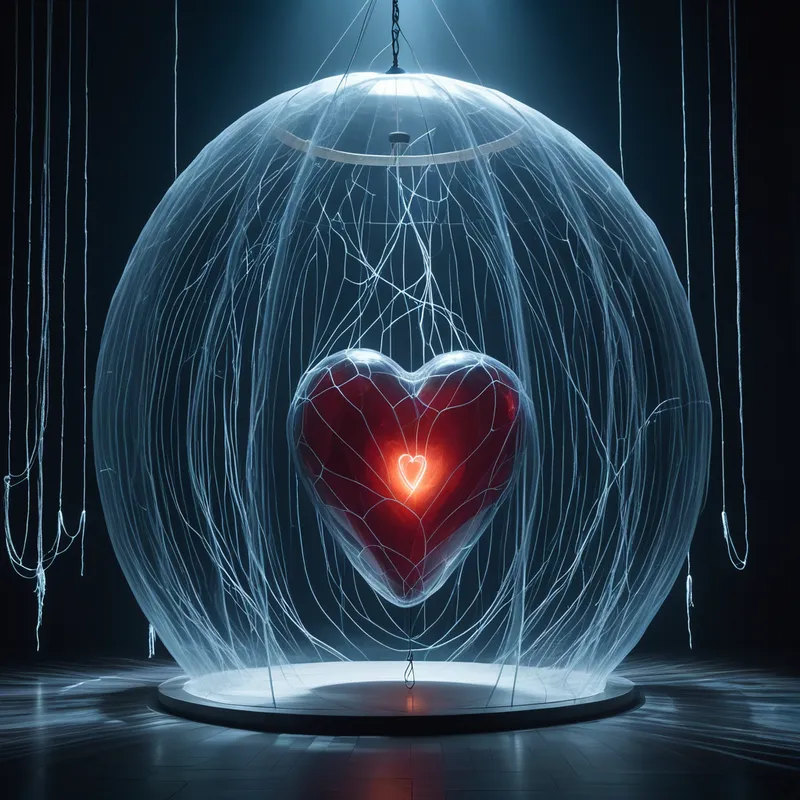
The cocoon is the ultimate symbol of the temenos—the sacred, protected space where impossible transformation occurs. It is not a prison, but a womb.
The violent union of maiden and horse-hide is a shocking coniunctio, a forced marriage of opposites: human and animal, conscious and unconscious, feminine and masculine, stillness and movement. This traumatic fusion is the necessary death of the old identity. The cocoon that results is not merely a physical object; it is the sealed vessel of the alchemical process. Inside, the old forms dissolve. The maiden’s sacrifice—her silent, contained suffering—is the price of the new creation. She does not emerge as herself, but as the silkworm, a creature whose entire purpose is to spin from its own essence a thread of golden light. The gift of silk to humanity is the transcendent function born from profound inner conflict.
The Dreamer’s Resonance
When this myth stirs in the modern psyche, it may manifest in dreams of being wrapped, bound, or paralyzed. One might dream of being swaddled in bandages, trapped in a small dark room, or enveloped in a substance that is both comforting and suffocating. These are not necessarily dreams of terror, but of profound containment. The somatic sensation is one of pressure, of being held in a necessary, if uncomfortable, stillness.
Psychologically, this signals a process of intense inner reorganization. The dreamer may be in a situation where they feel sacrificed to another’s promise or expectation (the father’s vow). They may have experienced a betrayal of their instinctual self (the slain horse). The cocoon state in the dream represents the psyche’s enforced retreat. It is a time when the conscious ego must relinquish control, when old identities are being dissolved in the digestive juices of the unconscious so that a new capacity—a new way of “spinning” one’s life—can be formed. The dream cautions against breaking out prematurely; the transformation is not complete until the new thread is ready to be spun.
Alchemical Translation
For the individual on the path of individuation, the Silkworm Cocoon myth is a precise map of psychic transmutation. The first stage is the Vow: the conscious ego sets an impossible, soul-level task (to recover lost wholeness). The Horse represents the neglected instinct or talent that must be engaged to begin the journey into the unconscious. The Betrayal and Slaying is the inevitable crisis—the ego’s horror at the raw, “animal” power it has unleashed, and its subsequent attempt to suppress it, which only leads to a more powerful, haunting return (the horse-hide).
The critical, transformative phase is the Envelopment. This is the dark night of the soul, the depression, the creative block, the illness, or the life pause that feels like a death. It is the nigredo of alchemy.
The ego does not navigate this phase; it endures it. The work is done in the dark, by the Self.
The final stage is the Spinning. One does not emerge from the cocoon “cured” of the old self, but fundamentally repurposed. The new being—the integrated psyche—has a singular, beautiful function: to spin its experience into value. The “silk” is the creative product, the hard-won wisdom, the compassionate act, or the resilient character woven from the very substance of one’s dissolution. The myth teaches that our greatest gifts are often born not from triumphant battles, but from sacred, silent sacrifices within the cocoon of our own endured transformations. We become, like the silkworm goddess, caregivers of a golden thread that was forged in our darkest containment.
Associated Symbols
Explore related symbols from the CaleaDream lexicon: