
Silenus Myth Meaning & Symbolism
The myth of the drunken, wise old satyr who holds the secret of life's greatest good, revealing truth through paradox and ecstatic dissolution.
The Tale of Silenus
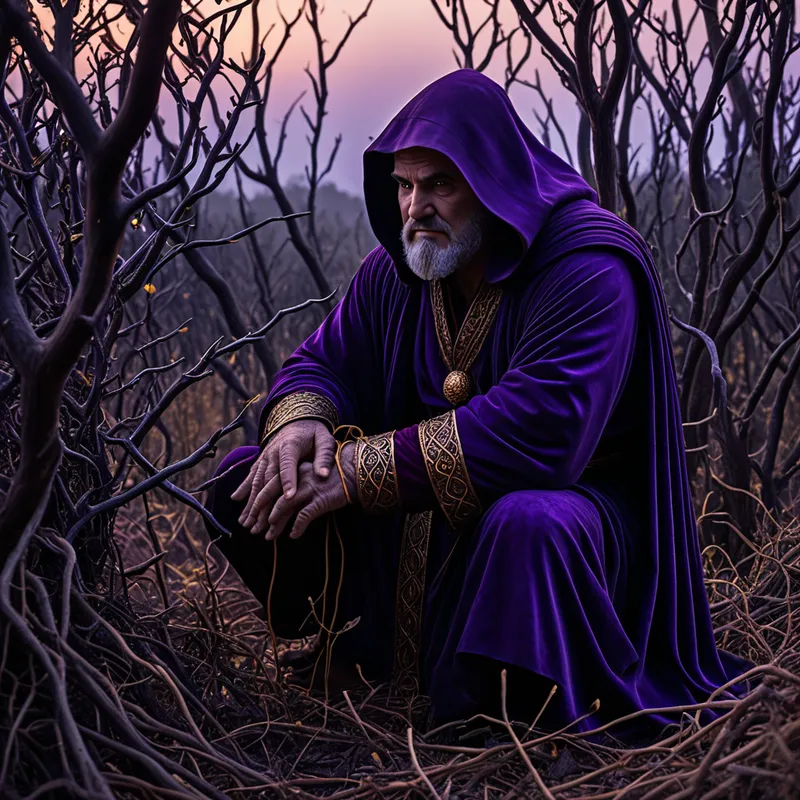
Listen, and let the scent of pine resin and spilled wine carry you to a time when the world was younger, and the gods walked closer to the earth. In the wild, untamed mountains of Boeotia and Phrygia, where sunlight dappled through leaves like coins of gold, there wandered a being of profound contradiction. This was Silenus—old, fat, bald, eternally drunk, stumbling on his donkey, yet holding in his wine-addled heart the secret to all things.
He was the chief of the satyrs, the foster-father and most devoted companion to the god Dionysus himself. Where the ivy-crowned god went, leading his thiasos of ecstatic maenads and riotous satyrs, Silenus would follow, or more often, be carried, snoring and wine-sodden, a living emblem of sacred excess.
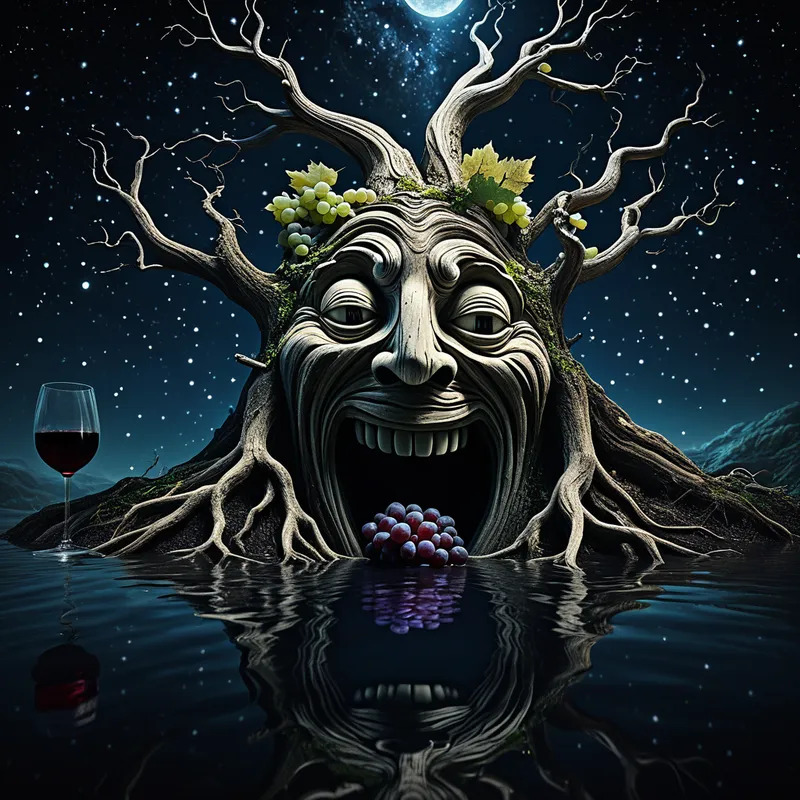
But kings, in their gilded halls, dream of more than gold. King Midas, he of the cursed golden touch, longed for a wisdom that could not be weighed. He had heard the whispers on the wind: to capture Silenus was to capture the oracle of the vine, the one being who could answer the question that haunts every mortal soul. So Midas laid a trap. He mixed wine with the spring water of a mountain source, creating a pool of irresistible fragrance. Into this glade stumbled the old satyr, parched from his revels. He drank deeply, and the world spun into a deeper, more profound slumber.
When Silenus awoke, he found himself bound not with chains, but with garlands, in the palace of the king. Midas approached not as a jailer, but as a supplicant. “O wise Silenus,” he implored, “you who have nursed a god at your breast and seen the turning of the ages, tell me: What is the greatest good, the most desirable thing, for humankind?”
The old satyr, his eyes clearing for a moment of terrifying sobriety, fixed the king with a gaze that saw through palace walls and mortal pretensions. He did not speak of power, or wealth, or even love. His voice, rough as bark and clear as a mountain stream, delivered a verdict that froze the blood.
“Oh, ephemeral offspring of a toilsome genius, creatures of a day,” he began, his words echoing in the silent hall. “Why do you force me to speak what it is better for you not to know? The best of all things is utterly beyond your reach: not to have been born, not to be, to be nothing. But the second-best thing for you—and the first available to the living—is to die soon.”
The words hung in the air, a cold, clear truth that stripped away all illusion. Midas, seeking a blessing, had received a curse far heavier than his golden touch. He had asked for the secret of life, and had been given the secret of death as its only worthy companion. Stunned, humbled, and perhaps truly wise for the first time, Midas released the old sage. Some say he returned Silenus to Dionysus, who rewarded the king by teaching him the rites that could wash away such grievous knowledge. Others say Silenus simply stumbled back into the woods, his laughter—now heard as both mirth and mourning—echoing among the trees, a permanent riddle in the heart of the wild.
Cultural Origins & Context
The figure of Silenus emerges from the rich, chthonic soil of Greek rustic religion, a world far removed from the polished marble of the Parthenon. He belongs to the entourage of Dionysus, a god whose cult represented the necessary, terrifying, and ecstatic dissolution of the civilized order. Silenus was not a god to be worshipped in grand temples, but a spirit encountered in the liminal spaces: the forest edge, the vineyard at harvest, the chaotic climax of the ritual.
His stories were passed down not in epic hexameter, but in the satyr plays that followed tragic trilogies at the City Dionysia. These plays, performed by choruses dressed as satyrs, blended crude humor with profound philosophical themes, with Silenus often as their bawdy, yet strangely sagacious, leader. He appears in the fragments of poets like Pindar and the dialogues of Plato, where his wisdom is cited with sober respect. His myth functioned as a societal pressure valve and a mirror. For a culture that prized reason (logos) and form, Silenus embodied its opposite: unreason, formlessness, and the raw, unvarnished truth that civilization works tirelessly to forget.
Symbolic Architecture
Silenus is the archetype of the drunken sage, the ultimate paradox. He is the embodied union of opposites: divine wisdom and animalistic appetite, eternal truth and ephemeral stupor, the nurturing father and the chaotic reveler. He represents the shadow of Apollo, god of light and clarity. Where Apollo offers prophecy from a clean, sunlit temple, Silenus offers his oracle from the mud and the vine.
The most profound truths are not found in sober clarity, but in the ecstatic dissolution of the ego, where the boundary between self and world, wisdom and folly, life and death, becomes porous.
His famous answer to Midas is not nihilism, but a devastating form of existential honesty. It confronts the individual with the fundamental suffering (pathei mathos, learning through suffering) of existence. Silenus does not offer comfort; he offers the brutal prerequisite for any authentic life: the acknowledgment of its tragic frame. He is the psychological embodiment of the shadow—not the personal shadow of repressed desires, but the collective, existential shadow: the knowledge of our finitude, our insignificance in the cosmic order, and the inherent pain of consciousness. To confront Silenus is to confront this bedrock reality.
The Dreamer’s Resonance
When the pattern of Silenus stirs in the modern dreamer, it often manifests not as a literal old satyr, but as an atmosphere or a paradoxical figure. One might dream of a beloved but dissolute grandfather figure who speaks shocking truths during a family feast. Or of finding a sacred, ancient text that is stained with wine and illegible except for one devastating sentence. The setting is frequently a party that turns ominous, a forest that is both inviting and deeply frightening, or a classroom where the teacher is foolish yet all-knowing.
Somatically, this dream process correlates with a confrontation with one’s own avoidance of life’s fundamental terms. It is the psyche’s attempt to sober up from the intoxicants of perpetual optimism, productivity, or spiritual bypassing. The dreamer may experience a sense of grounding dread, a collapse of naïve meaning, followed—if the dream is worked with—by a strange, weightless relief. The psychological process is the ego’s reluctant encounter with the Self in its most terrifying aspect: the Self that encompasses not just growth and purpose, but also decay, meaninglessness, and the void. It is the necessary “dark night” that precedes any genuine transformation.
Alchemical Translation
The alchemical journey modeled by the Silenus myth is the Nigredo—the blackening, the putrefaction, the descent into the prime matter. King Midas, representing the conscious ego in search of a prized wisdom (the philosopher’s stone), attempts to capture the transcendent principle (Silenus) through cunning and worldly means (the spiked spring). His success leads not to enlightenment, but to the mortificatio, the symbolic death delivered by Silenus’s oracle.
The first and most necessary operation is not the pursuit of gold, but the willing ingestion of the poison that kills the illusion of the separate, special self.
Midas’s subsequent release of Silenus is the critical step. He does not kill the bearer of bad news; he lets the truth go, allowing it to return to the unconscious (the wild, Dionysian realm). This is the alchemical solutio—dissolution in the waters of truth, however bitter. The ego is not fortified by the secret; it is humbled and dissolved by it. The reward from Dionysus—often the teaching of secret rites—symbolizes the next stage: having faced the Nigredo, one can now learn the sacred practices (the conscious attitudes and rituals) that allow one to live with that knowledge, not in despair, but in a deeper, more ironic, and truly authentic engagement with life. The individual is no longer seeking a “greatest good” in the future, but is initiated into the paradoxical sacredness of the flawed, suffering, and ecstatic present moment. The gold Midas sought was always the fool’s gold; the true treasure was the capacity to hold the devastating and liberating truth without being destroyed by it.
Associated Symbols
Explore related symbols from the CaleaDream lexicon: