Sika Deer Myth Meaning & Symbolism
A sacred deer, a divine arrow, and a journey to the mountain. A myth of sacrifice, transformation, and the soul's covenant with the numinous.
The Tale of the Sika Deer
In the age when gods walked just behind [the veil](/myths/the-veil “Myth from Various culture.”/) of [the world](/myths/the-world “Myth from Tarot culture.”/), in the deep mountains of Yamato, there lived a hunter. His name is lost to [the wind](/myths/the-wind “Myth from Various culture.”/), but his story is etched in the stone of memory. He was a man of the bow, his life bound to the rhythm of the chase, the flight of the arrow, the grateful taking of life to sustain life.
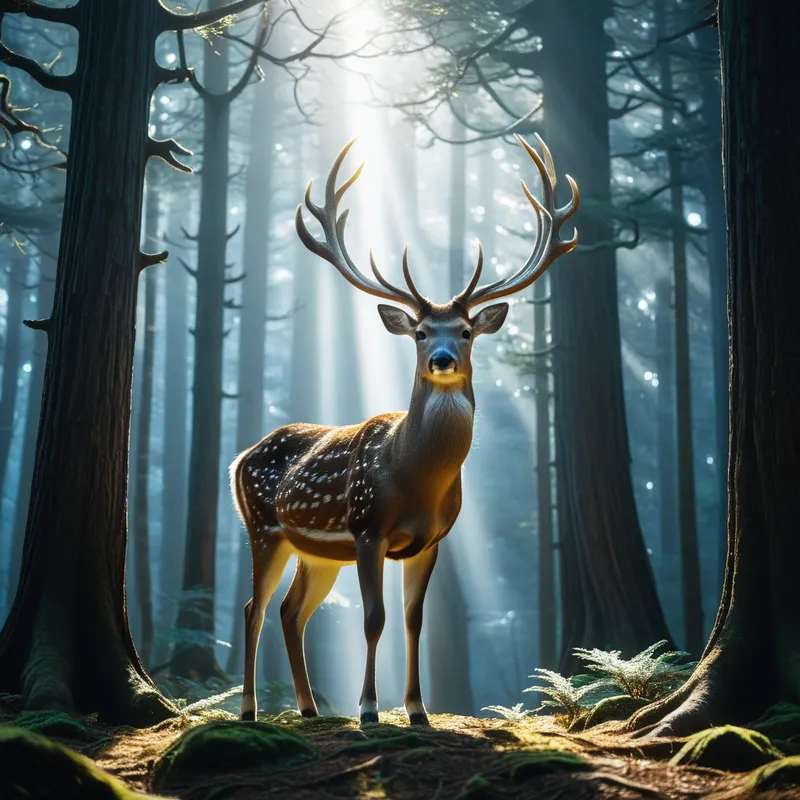
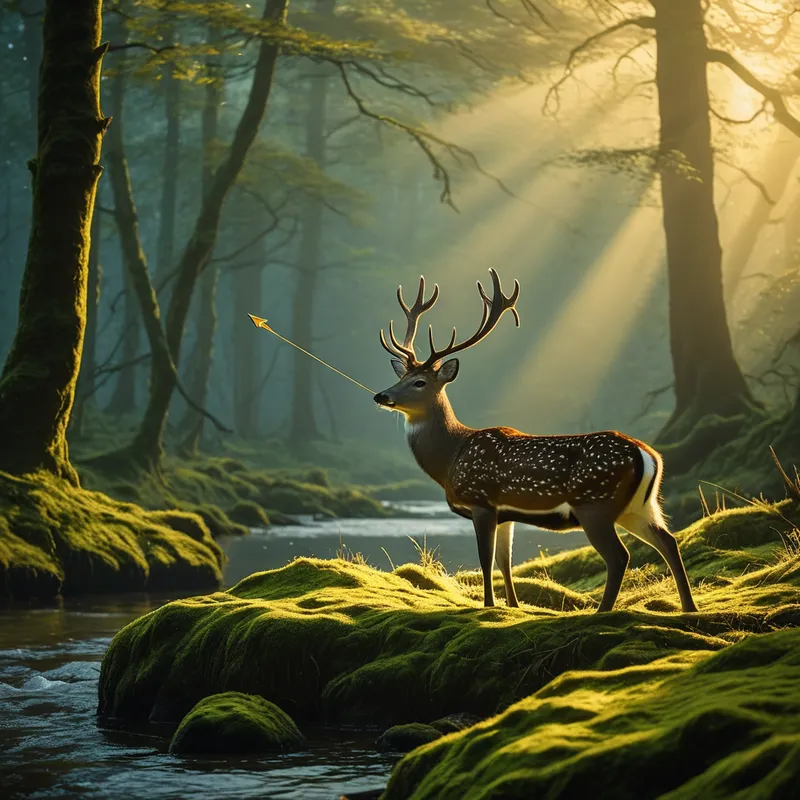
One morning, as mist clung to the cedars like ghostly silk, he followed the tracks of a deer beside a river singing over smooth stones. The air was cold and clear. Then, he saw it. Not a mere deer, but a creature of impossible grace—a Sika stag, its coat the color of polished chestnut and snow, its antlers a proud crown of bone that seemed to catch the first light of the sun and hold it. [The hunter](/myths/the-hunter “Myth from African culture.”/)’s breath stilled. This was no ordinary prey; this was a being of the mountain’s soul.
He nocked an arrow, his movements honed by instinct. The bowstring sang. The arrow flew true, striking the great stag in its flank. But instead of a cry of pain or a frantic flight, the deer turned its noble head. It looked at the hunter, and in its deep, dark eyes was not fear, but a profound and ancient knowing. Then, without panic, it began to walk. It did not run. It walked, with deliberate, sacred steps, deeper into the forest, the arrow still lodged in its side.
Awe-struck and compelled by a force greater than curiosity, the hunter followed. He followed the trail of occasional blood drops, like crimson jewels on moss, and the quiet, unwavering path of the wounded king. For hours he walked, through sun-dappled groves and shadowed ravines, until they came to a place where the very air hummed. A hidden clearing, where a pure spring bubbled from the roots of an ancient, gnarled tree.
There, the great stag lay down beside the [water](/myths/water “Myth from Chinese culture.”/). It breathed once, deeply, and then its spirit departed—not in struggle, but in offering. As the hunter approached, trembling, he saw not just a slain animal, but a messenger who had completed its journey. From the body of the deer, a radiant light began to emanate, and its form seemed to blur between beast and something divine. The hunter understood, in a flash of wordless knowledge, that he had not taken a life, but had been led. The arrow was not his weapon, but a key. The deer was not his prey, but his guide. He had been used by the mountain itself to bring a sacred offering home.
Cultural Origins & Context
This poignant tale is woven into the foundational spiritual fabric of Japan, emerging from the indigenous Shinto worldview. It is not a single, codified myth from a text like the Kojiki, but a pervasive folk narrative and symbolic motif found in regional legends, particularly those associated with mountain worship (sangaku shinkō) and the veneration of divine messengers.
In Shinto, the natural world is alive with kami. Mountains are often seen as especially potent dwelling places of kami, and animals like the deer are considered their tsukai or shinkei. The most famous real-world manifestation is in Nara, where Sika deer have been protected as divine messengers of the Kasuga kami for over a thousand years. The myth encodes a pre-Buddhist ethic of sacred reciprocity: the hunt is not mere exploitation, but a solemn, ritual engagement with the spirit of the land. The deer’s deliberate journey transforms a act of killing into a rite of conduction, guiding a sacrificial offering to a sanctified place.
Symbolic Architecture
At its [heart](/symbols/heart “Symbol: The heart symbolizes love, emotion, and the core of one’s existence, representing deep connections with others and self.”/), this myth is a profound map of an unexpected, guided transformation. The Sika [Deer](/symbols/deer “Symbol: The deer symbolizes gentleness, intuition, and a connection to nature.”/) represents the numinous—the wholly other, the divine—choosing to intersect with the [human](/symbols/human “Symbol: The symbol of a human represents individuality, complexity of emotions, and social relationships.”/) [realm](/symbols/realm “Symbol: The symbol of ‘Realm’ often signifies the boundaries of one’s consciousness, experiences, or emotional states, suggesting aspects of reality that are either explored or ignored.”/) through the [vehicle](/symbols/vehicle “Symbol: Vehicles in dreams often symbolize the direction in life and the control one has over their journey, reflecting personal agency and decision-making.”/) of [nature](/symbols/nature “Symbol: Nature symbolizes growth, connectivity, and the primal forces of existence.”/). It is the embodied [spirit](/symbols/spirit “Symbol: Spirit symbolizes the essence of life, vitality, and the spiritual journey of the individual.”/) of the wild, conscious and consenting to its [role](/symbols/role “Symbol: The concept of ‘role’ in dreams often reflects one’s identity or how individuals perceive their place within various social structures.”/).
The sacred does not always appear to save us; sometimes, it appears to be sacrificed by us, so that we may find the path to the altar.
The hunter represents the conscious ego, the part of us that acts in the world with [intention](/symbols/intention “Symbol: Intention represents the clarity of purpose and direction in one’s life and can symbolize motivation and commitment within a dream context.”/) (the hunt) but is largely unaware of the deeper, guiding patterns of the [psyche](/myths/psyche “Myth from Greek culture.”/) (the [mountain](/symbols/mountain “Symbol: Mountains often symbolize challenges, aspirations, and the journey toward self-discovery and enlightenment.”/) kami). His [arrow](/symbols/arrow “Symbol: An arrow often symbolizes direction, purpose, and the pursuit of goals, representing both the journey and the destination.”/) is his focused will, his directed [energy](/symbols/energy “Symbol: Energy symbolizes vitality, motivation, and the drive that fuels actions and ambitions.”/). The critical turn is that his will is co-opted by a larger [purpose](/symbols/purpose “Symbol: Purpose signifies direction, meaning, and intention in life, often reflecting personal ambitions and core values.”/). He believes he is acting on his own desire, but his [action](/symbols/action “Symbol: Action in dreams represents the drive for agency, motivation, and the ability to take control of situations in waking life.”/) becomes the catalyst for a sacred process he does not yet understand.
The wound is central. It is not a tragedy, but an opening—a point of [connection](/symbols/connection “Symbol: Connection symbolizes relationships, communication, and bonds among individuals.”/) between the human and the divine. The deer’s [acceptance](/symbols/acceptance “Symbol: The experience of being welcomed, approved, or integrated into a group or situation, often involving validation of one’s identity or actions.”/) of the wound and its subsequent guided walk symbolize the [soul](/symbols/soul “Symbol: The soul represents the essence of a person, encompassing their spirit, identity, and connection to the universe.”/)’s [capacity](/symbols/capacity “Symbol: A measure of one’s potential, limits, or ability to contain, process, or achieve something, often reflecting self-assessment or external demands.”/) to carry suffering with purpose, to transform pain into a [pilgrimage](/symbols/pilgrimage “Symbol: A spiritual or transformative journey toward a sacred destination, representing personal growth, devotion, and the search for meaning.”/). The clearing with the spring is the [temenos](/myths/temenos “Myth from Greek culture.”/)—the sacred, protected [space](/symbols/space “Symbol: Dreaming of ‘Space’ often symbolizes the vastness of potential, personal freedom, or feelings of isolation and exploration in one’s life.”/) of [the Self](/myths/the-self “Myth from Jungian culture.”/) where the sacrifice is ultimately received and transmuted.
The Dreamer’s Resonance
When this myth stirs in the modern dreamer, it often signals a profound process of psychospiritual orientation. To dream of being the hunter who wounds a majestic, knowing animal suggests [the ego](/myths/the-ego “Myth from Jungian culture.”/) has inadvertently “struck” a deep, sacred aspect of the psyche—perhaps a talent, an intuition, or a connection to the instinctual self—that now demands attention. Guilt and awe mix.
To dream of being the wounded deer, walking steadily through a forest, indicates a somatic experience of carrying a wound with purpose. The dreamer may be enduring a illness, a loss, or a depression, but there is an underlying, almost uncanny sense that this pain is leading them somewhere essential. The body itself becomes the guide.
The dream-deer does not seek a healer; it seeks the holy place where its suffering has meaning.
The imagery of following a trail of light or sacred drops speaks to the necessity of attending to small, often overlooked signs—synchronicities, fleeting insights, bodily sensations—that guide one through a period of disorientation toward a center of meaning.
Alchemical Translation
The alchemy here is the transmutation of a violent, separative act (the hunt) into a unitive, sacred covenant. For the individual on the path of individuation, this myth models the difficult integration of [the shadow](/myths/the-shadow “Myth from Jungian culture.”/) and the acknowledgment of a guiding intelligence beyond the ego.
First, the ego (hunter) must act with its full capacity. We must “fire our arrow”—pursue our goals, exert our will. The myth does not condemn this, but reveals its hidden dimension. The first alchemical stage is the shocking realization that our will is not sovereign; it is part of a larger pattern. The wound we inflict (or perceive we inflict) on our own soul or on the world is often the very opening through which grace enters.
The second stage is the following. This is the conscious submission to the process. The ego must relinquish control and follow the wounded, instinctual/divine guide (the Self). This is the long, patient work of therapy, meditation, or creative exploration—tracking the symptoms, the dreams, the pains, not to eliminate them, but to see where they lead.
The final stage is the arrival at the temenos—the inner sanctuary. The sacrifice is completed. The deer (the instinctual spirit) gives its form to the place. The hunter (the ego) witnesses [the transfiguration](/myths/the-transfiguration “Myth from Christian culture.”/). The two are not merged into one bland identity; rather, the ego is humbled and informed by the Self. The willful act is redeemed as an instrument of a sacred journey.
The gold produced is not the end of suffering, but the realization that one’s suffering has been a sacred passage all along. The arrow remains, but it is no longer a weapon; it is a seal, a proof of the covenant between the human striving and the soul’s mysterious destination.
In this, the myth of the Sika Deer offers a timeless consolation: we are not alone in our wounds. We are, perhaps, being led by them. And the most sacred things may not come to us in protection from all harm, but in the majestic, guiding presence that shows us how to carry the harm home.
Associated Symbols
Explore related symbols from the CaleaDream lexicon: