Siege Perilous Myth Meaning & Symbolism
An enchanted seat at the Round Table, destined for the one pure knight who would achieve the Grail. To sit without being chosen meant death.
The Tale of Siege Perilous
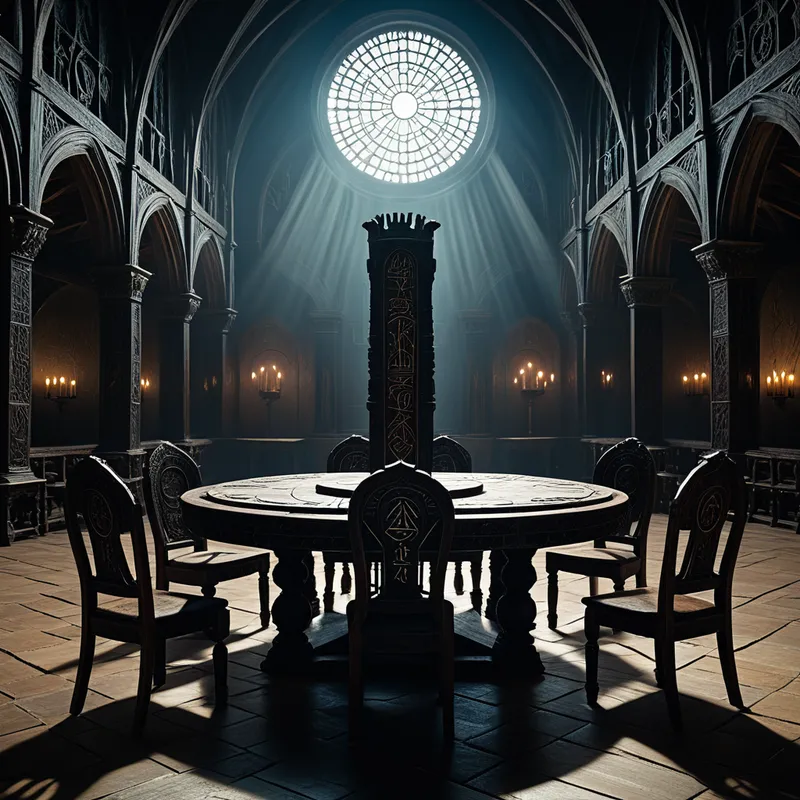
Hear now the tale of the seat that was not a seat, but a question carved in oak and destiny. In the hall of Camelot, where the light of a new order shone, there stood a table of perfect fellowship. A ring of knights, a circle of equals, bound by oaths of [justice](/myths/justice “Myth from Tarot culture.”/) and compassion. Yet, within that perfect circle, one space remained. It was not empty by chance, but by enchantment. The carvers who shaped it did so with trembling hands, for the wood whispered of a future not yet born.
They called it the Siege Perilous. No man, however brave, however noble in lineage, could claim it. To sit without the right was to be swallowed by [the earth](/myths/the-earth “Myth from Hindu culture.”/), consumed by fire from within, or to simply cease to be—a body left hollow, a promise unmade. It was a silent thunder in the hall. During feasts, its vacancy was a palpable presence, a cold draft in the warmth of fellowship. Young knights would glance at it, a flicker of ambition in their eyes, only to look away quickly, chastened by the older warriors’ grave warnings. It was the unspoken test, the ultimate measure that existed beyond all human law and chivalric code.
The years turned. The quest for the [Holy Grail](/myths/holy-grail “Myth from Arthurian culture.”/) was proclaimed, a call that pierced the heart of every knight. It was then that the ancient prophecies stirred. A pure knight, free of sin, would come. He would be the best knight in [the world](/myths/the-world “Myth from Tarot culture.”/), not by strength of arm alone, but by the flawless quality of his soul. His name was [Galahad](/myths/galahad “Myth from Arthurian culture.”/). When he entered the hall of [the Round Table](/myths/the-round-table “Myth from Arthurian culture.”/), clad in red arms that seemed to bleed with sacred purpose, the strange letters upon the Siege Perilous shimmered and changed. They spelled his name, a golden script burning in the dark wood.
Without hesitation, without fear, the young knight approached. The air did not crackle; the earth did not shake. There was only a profound, settling silence, as of a key finding its lock after centuries of searching. He sat. And the seat held him. The peril was not for him, for he was the answer to its ancient riddle. In that moment, the circle was complete. The question mark became a period. The destined one had arrived, and the greatest, most perilous quest could now truly begin.
Cultural Origins & Context
The myth of the Siege Perilous is woven into the later, more spiritually ambitious strands of the Arthurian cycle, particularly those focused on [the Grail Quest](/myths/the-grail-quest “Myth from Arthurian culture.”/). Its most detailed account comes from [Thomas](/myths/thomas “Myth from Christian culture.”/) Malory’s 15th-century compilation, Le Morte d’Arthur, which itself drew from earlier French romances like the Vulgate Cycle. This was not a tale of battlefield heroics, but of spiritual election. It functioned in a culture where chivalry was being consciously reinterpreted from a martial code to a mystical one.
The storytellers who shaped this myth were often clerics or monks, infusing the warrior ethos with Christian mysticism. The Siege served a crucial societal and narrative function: it established a hierarchy of virtue that superseded the hierarchy of blood or battle-prowess. It told the listening knight and courtier that true nobility was internal and divine, not external and feudal. It was a myth of exception, creating a sacred center within the already-sacred circle of the [Round Table](/myths/round-table “Myth from Arthurian culture.”/), reminding all that even in a utopian fellowship, there are destinies singular and untouchable.
Symbolic Architecture
The Siege Perilous is one of the most potent psychological symbols in Western myth. It represents the Vacant Center—the place reserved for the ultimate, integrated Self that cannot be prematurely claimed by [the ego](/myths/the-ego “Myth from Jungian culture.”/).
The empty throne is not an absence, but a potential so potent it annihilates the unready. It is the future Self guarding its own becoming.
The seat is perilous because it symbolizes the ultimate psychic risk: the confrontation with one’s own deepest [destiny](/symbols/destiny “Symbol: A predetermined course of events or ultimate purpose, often linked to spiritual forces or cosmic order, representing life’s inherent direction.”/) and worth. To sit in it unprepared—driven by arrogance, impatience, or a borrowed [identity](/symbols/identity “Symbol: Identity represents the sense of self, encompassing personal beliefs, cultural background, and social roles.”/)—is to be disintegrated by the [magnitude](/symbols/magnitude “Symbol: A measure of scale, intensity, or importance, often reflecting one’s perception of significance, impact, or overwhelming force in life.”/) of what one is not yet. It is the archetypal [danger](/symbols/danger “Symbol: The symbol of ‘Danger’ often indicates a sense of threat or instability, calling for caution and awareness.”/) of [inflation](/symbols/inflation “Symbol: A dream symbol representing feelings of diminishing value, loss of control, or expansion beyond sustainable limits in one’s life or psyche.”/), of the ego identifying with [the Self](/myths/the-self “Myth from Jungian culture.”/) before it has undergone the necessary trials of purification. The seat waits for Galahad, the [knight](/symbols/knight “Symbol: The knight symbolizes honor, chivalry, and the pursuit of noble causes, reflecting the ideal of the noble warrior.”/) of perfect purity, because he represents the part of the [psyche](/myths/psyche “Myth from Greek culture.”/) that has achieved congruence between inner [truth](/symbols/truth “Symbol: Truth represents authenticity, honesty, and the quest for knowledge beyond mere appearances.”/) and outer [action](/symbols/action “Symbol: Action in dreams represents the drive for agency, motivation, and the ability to take control of situations in waking life.”/). He is wholeness personified. The seat does not test him; it recognizes him. It is the symbolic [vessel](/symbols/vessel “Symbol: A container or structure that holds, transports, or protects something essential, representing the self, emotions, or life journey.”/) for an individuated [life](/symbols/life “Symbol: The symbol of ‘Life’ represents a journey of growth, interconnectedness, and existential meaning, encompassing both the joys and challenges that define human experience.”/), which remains lethal to anyone still fractured by [shadow](/symbols/shadow “Symbol: The ‘shadow’ embodies the unconscious, repressed aspects of the self and often represents fears or hidden emotions.”/), [persona](/symbols/persona “Symbol: The social mask or outward identity one presents to the world, often concealing the true self.”/), or unresolved desire.
The Dreamer’s Resonance
When this myth stirs in the modern unconscious, it rarely appears as a medieval chair. Its pattern manifests as a dream of a forbidden or resonant empty space. One might dream of an empty office with one’s name on the door, a vacant seat at a family table that feels magnetically charged, or a silent, waiting vehicle that one is both drawn to and terrified to enter. The somatic experience is one of intense atmospheric pressure—a feeling of being judged by the space itself.
This dream signals a profound crossroads in the individuation process. The psyche is announcing that a central, organizing role or identity—the true vocation, the authentic relationship to Self—is now potentially available. The peril is the dreamer’s own unreadiness. The anxiety in the dream is the friction between the soul’s calling and the ego’s current composition. To dream of approaching but not sitting is to feel the call to growth. To dream of sitting and surviving is a powerful affirmation of recent integration. To dream of sitting and being consumed is a stark warning from the deep self: you are attempting to wear a wholeness you have not yet earned, and the inflation will destroy you.
Alchemical Translation
The alchemical journey modeled by the Siege Perilous is that of mortificatio followed by illuminatio—the necessary death of the false self before the illumination of the true one. The quest for [the Grail](/myths/the-grail “Myth from Arthurian culture.”/) cannot begin in earnest until the seat is filled, meaning the inner quest for wholeness cannot commence until one has confronted the question of ultimate worthiness.
The first and greatest labor is not to find the treasure, but to become the person for whom the treasure is destined.
For the modern individual, this translates to the agonizing, patient work of shedding inauthentic lives. We are all surrounded by empty seats—roles, careers, relationships, identities that society, family, or our own younger egos have prepared for us. The “peril” is the temptation to occupy them before we have been forged by experience, introspection, and moral choice into the person who fits them. The alchemical process demands we let the seat remain empty, let its silent judgment guide us, while we undertake our own lesser but essential quests: integrating our shadow ([Lancelot](/myths/lancelot “Myth from Arthurian culture.”/)‘s struggle), honoring our innocent intuition (Percival’s journey), and cultivating steadfast courage (Gawain’s trials). Only by integrating these aspects do we, piece by piece, build the Galahad-consciousness within. Then, one day, we approach our own inner Siege. The letters of our true name are already written there, waiting for us to grow into the ability to read them. We sit, not in [triumph](/myths/triumph “Myth from Roman culture.”/), but in humble recognition. The circle of the psyche is complete. The peril is past, and the real work—the sacred, [grail](/myths/grail “Myth from Christian culture.”/)-filled work of a life truly one’s own—can finally begin.
Associated Symbols
Explore related symbols from the CaleaDream lexicon: