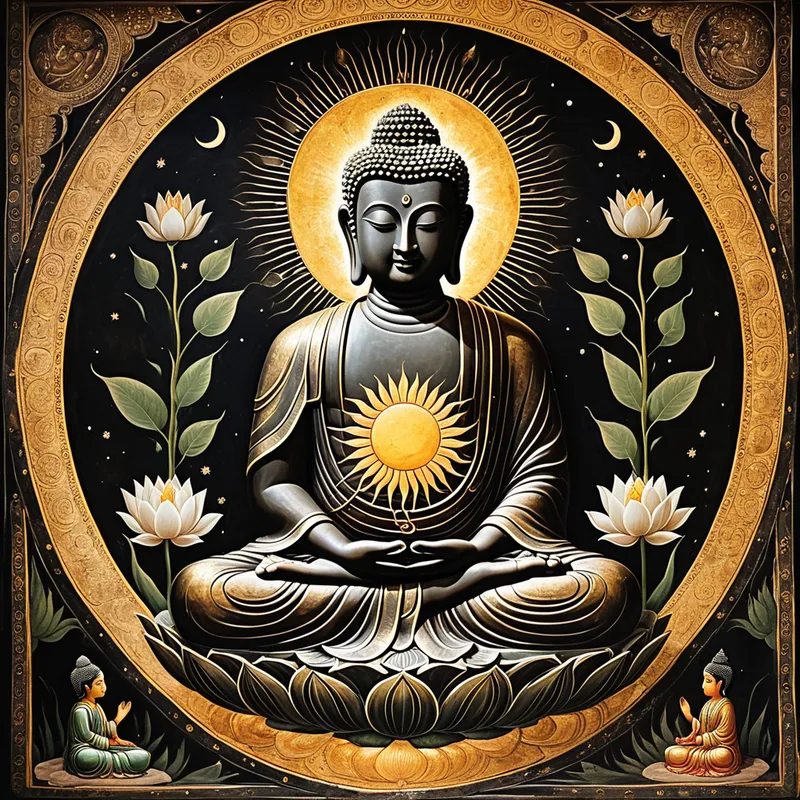
Siddhis Myth Meaning & Symbolism
A mythic warning that the ultimate powers gained on the spiritual path are the final, most seductive obstacles to true awakening.
The Tale of Siddhis
Listen. In the deep silence that follows the storm of becoming, there sits the one who has walked the path. The dust of desire has settled. The fires of aversion have cooled. Through relentless seeing, they have untied the knots of the heart. [The world](/myths/the-world “Myth from Tarot culture.”/), once a deafening chorus of craving, now hums a single, clear note.
And in that profound quiet, the universe begins to offer.
It starts as a whisper in the marrow, a knowing that the fabric of reality is not a wall, but a curtain. The meditator, anchored in unwavering mindfulness, finds the weight of their own body becoming optional. They rise, cross-legged, into the air—not as a feat, but as a simple fact, like a leaf buoyed by [water](/myths/water “Myth from Chinese culture.”/). This is the first gift, or the first test: walking on air.
The offerings grow bolder. Sitting under [the Bodhi tree](/myths/the-bodhi-tree “Myth from Buddhist culture.”/), they perceive the frantic whispers of a distant village, not with ears, but with the mind’s own mirror. They feel the birth-pangs of a deer in a hidden grove and the last sigh of a king in a far-off palace. They witness, simultaneously, the slow erosion of a mountain and the frantic dance of motes in a sunbeam. This is the divine ear, the divine eye—the whole world pouring its secret diary into an open heart.
Then comes the memory. Not of yesterday, or a childhood scar, but of a thousand yesterdays. Lives upon lives unspool: a prince, a beggar, a blade of grass, a god in a perfumed heaven. Each face they have ever worn remembers itself. This is knowledge of past lives, the ultimate biography, granting the terrifying context of endless becoming.
And finally, the pinnacle: the knowledge of the destruction of the asavas, the deep-rooted intoxicants. “It is liberated,” the heart understands with utter, unshakable finality. The work is done. The path is complete.
Here, at this summit, the cosmos presents its most magnificent treasure chest. The siddhis bloom in full array: the power to become many or to vanish into nothing; to pass through rock as if through mist; to touch [the moon](/myths/the-moon “Myth from Tarot culture.”/) with a fingertip; to command the weather with a thought. The very laws of nature soften like clay, awaiting the imprint of this liberated will.
This is the moment of supreme danger. For the ultimate power is not over the external world, but over the internal one. The most seductive maya is not sickness or poverty, but the god-like ability to transcend them. [The ego](/myths/the-ego “Myth from Jungian culture.”/), seemingly dead, can be resurrected in its most glorious form: not as “I am a sinner,” but as “I am a miracle-worker.” The siddhis are the final, golden chain.
The story whispers that the true victor is not the one who accepts these gifts, but the one who, with a gentle, unwavering smile, declines them. They let the powers lap at their feet like a harmless tide, and do not drink. They see the miracle of walking on water, and choose to feel the mud between their toes. They hear the thoughts of all beings, and return to the sacred simplicity of listening to a single human voice. They turn the key on the treasure chest of the universe, not out of fear or weakness, but out of a compassion so vast it has no need to prove itself. The final liberation is liberation from liberation’s powers. The true wonder is to remain, quietly, humanly, free.

Cultural Origins & Context
The lore of the siddhis is woven deeply into the fabric of Buddhist scripture, most notably in the Digha Nikaya and the Visuddhimagga. They were never the goal of the path, but rather signposts—or warning signs—encountered on the journey of [samadhi](/myths/samadhi “Myth from Buddhist culture.”/). Historically, these stories served a critical pedagogical function within the monastic community.
Told by teachers to advanced disciples, the myth of the siddis functioned as a necessary curb against spiritual materialism. In a culture where asceticism and meditation could yield tangible, extraordinary experiences, there was a real danger of practitioners becoming sidetracked by these phenomena, mistaking psychic potency for enlightenment. The myth codified a vital distinction: the difference between puthujjana-iddhi and the true aim of Nibbana. It was a narrative safeguard, ensuring the path remained oriented toward wisdom and compassion, not wonder and power.
Symbolic Architecture
Psychologically, the siddhis represent the full flowering of the [human](/symbols/human “Symbol: The symbol of a human represents individuality, complexity of emotions, and social relationships.”/) potential that occurs when the conscious ego surrenders its tyranny and aligns with the deeper Self. They are the latent capabilities of the unconscious, made manifest. The [ability](/symbols/ability “Symbol: In dreams, ‘ability’ often denotes a recognition of skills or potential that one possesses, whether acknowledged or suppressed.”/) to walk through walls symbolizes the [dissolution](/symbols/dissolution “Symbol: The process of breaking down, dispersing, or losing form, often representing transformation, release, or the end of a state of being.”/) of psychological boundaries and rigid identifications. [Knowledge](/symbols/knowledge “Symbol: Knowledge symbolizes learning, understanding, and wisdom, embodying the acquisition of information and enlightenment.”/) of past lives represents access to the ancestral and archetypal layers of the [psyche](/myths/psyche “Myth from Greek culture.”/). Mind-reading reflects a state of profound [empathy](/symbols/empathy “Symbol: The capacity to understand and share the feelings of others, often manifesting as emotional resonance or intuitive connection in dreams.”/) and intersubjective [connection](/symbols/connection “Symbol: Connection symbolizes relationships, communication, and bonds among individuals.”/).
The greatest magic is not to change the world, but to see the world without the need to change it.
Yet, their symbolic [danger](/symbols/danger “Symbol: The symbol of ‘Danger’ often indicates a sense of threat or instability, calling for caution and awareness.”/) is paramount. They are the ultimate [inflation](/symbols/inflation “Symbol: A dream symbol representing feelings of diminishing value, loss of control, or expansion beyond sustainable limits in one’s life or psyche.”/) of the ego. In [depth](/symbols/depth “Symbol: Represents profound layers of consciousness, hidden truths, or the unknown aspects of existence, often symbolizing introspection and existential exploration.”/) [psychology](/symbols/psychology “Symbol: Psychology in dreams often represents the exploration of the self, the subconscious mind, and emotional conflicts.”/), [inflation](/symbols/inflation “Symbol: A dream symbol representing feelings of diminishing value, loss of control, or expansion beyond sustainable limits in one’s life or psyche.”/) occurs when the conscious [personality](/symbols/personality “Symbol: Personality in dreams often symbolizes the traits and characteristics of the dreamer, reflecting how they perceive themselves and how they believe they are perceived by others.”/) is overwhelmed by contents of the unconscious, leading to a grandiose identification with the [archetype](/symbols/archetype “Symbol: A universal, primordial pattern or prototype in the collective unconscious that shapes human experience, behavior, and creative expression.”/) of the Magician or the Self. The siddhis are the glittering bait of this [inflation](/symbols/inflation “Symbol: A dream symbol representing feelings of diminishing value, loss of control, or expansion beyond sustainable limits in one’s life or psyche.”/). To wield them is to fall back into the dualistic game of subject and object, of a powerful “I” acting upon a malleable world. Thus, they symbolize the final temptation of the spiritual [journey](/symbols/journey “Symbol: A journey in dreams typically signifies adventure, growth, or a significant life transition.”/): to become a god instead of becoming nothing, to choose grandeur over [emptiness](/symbols/emptiness “Symbol: Emptiness signifies a profound sense of void or lack in one’s life, often related to existential fears, loss, or spiritual quest.”/).
The Dreamer’s Resonance
When this mythic pattern stirs in the modern dreamer, it rarely appears as a Buddha under a tree. It manifests as dreams of sudden, unchecked power: discovering you can fly, but becoming lost in the clouds; being able to read minds and becoming paralyzed by the cacophony of others’ judgments; possessing great wealth or influence that isolates you. The somatic experience is often one of exhilarating energy quickly followed by anxiety or dissociation—a feeling of being untethered.
These dreams signal a critical phase in psychological development. The dreamer is likely integrating a significant new capacity—perhaps deep insight from therapy, a hard-won professional skill, or a new level of emotional intelligence. The unconscious is presenting [the shadow](/myths/the-shadow “Myth from Jungian culture.”/) side of this achievement: the temptation to use this new power for control, admiration, or escape, rather than for integration and relatedness. The dream is a warning from the inner sage: “You have gained something precious. Do not let it become your prison.”

Alchemical Translation
The alchemical journey of individuation mirrors the myth of the siddhis precisely. The [prima materia](/myths/prima-materia “Myth from Alchemical culture.”/) of our neuroses and complexes is subjected to the fire of conscious attention (meditation, self-reflection, therapy). Through this [nigredo](/myths/nigredo “Myth from Alchemical culture.”/), we break down. Then, in the albedo, new capacities emerge: psychological insight, emotional resilience, creative flow. These are our personal siddhis.
The crucial alchemical stage is [rubedo](/myths/rubedo “Myth from Alchemical culture.”/), which corresponds to the myth’s climax. Here, the newly formed “gold” of the personality must be sacrificed. The ego, now healthier and more capable, faces its greatest test: will it identify with its new powers (the psychologist who must fix everyone, the artist who demands reverence, the healed person who looks down on the suffering), or will it humble itself?
Individuation is not about building a perfect, powerful self. It is about building a vessel strong enough to hold the self, and then letting the vessel dissolve.
The alchemical translation of the myth is the practice of non-identification. It is to develop profound skill and then hold it lightly. It is to gain deep understanding and wear it as ordinary clothes. The final transmutation is from the [Lapis Philosophorum](/myths/lapis-philosophorum “Myth from Alchemical culture.”/)—a stone that can transform base metal into gold—into simple, clear water: essential, life-giving, and without any shape of its own. The true siddhi is the power to be powerless, the strength to be soft, the wisdom to be a beginner in every moment. This is the psychic transmutation from a person who has powers, to a presence that is peace.
Associated Symbols
Explore related symbols from the CaleaDream lexicon: