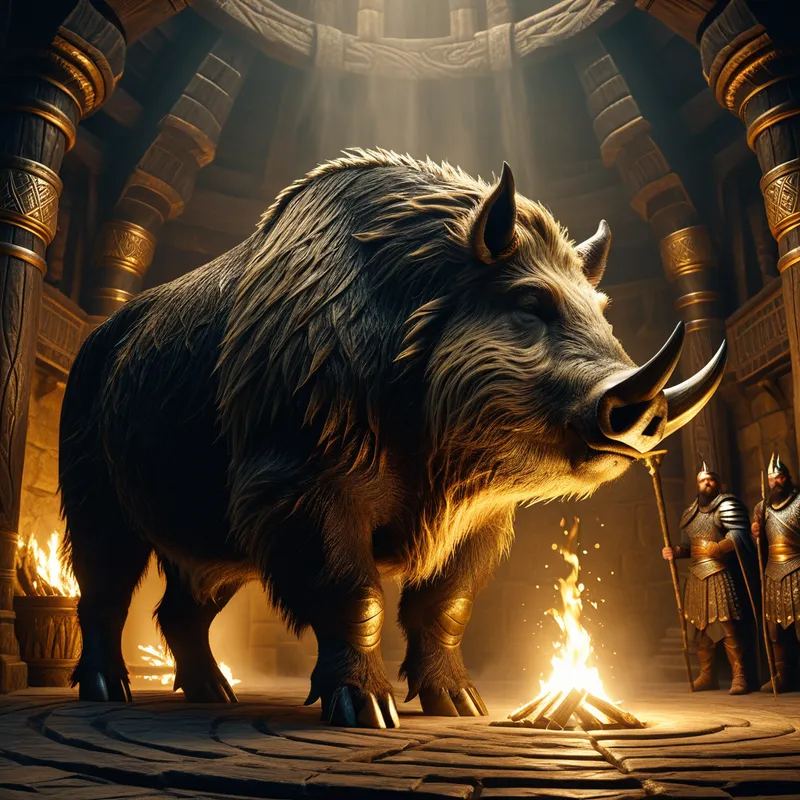
Sæhrímnir Myth Meaning & Symbolism
The magical boar slain and reborn each day to feed the warriors of Valhalla, embodying the eternal cycle of sacrifice and regeneration.
The Tale of Sæhrímnir
Hear now of the feast that never ends, in the hall where the roof is made of shields and the rafters are spears. In Valhalla, the air does not grow stale with time, for time itself is measured not in days, but in the gathering roar of heroes. Each dawn, the Einherjar rise from their benches, their sleep-death broken. The sound is like a mountain cracking: the clatter of ancient mail, the deep breaths of five hundred and forty doors swinging wide.
But before the clash of practice blades, before the boasting and the tales of glorious death, there is a deeper magic. It begins not with a shout, but with a soft rustle in the golden grove Glasir. From beneath the trees of red-gold leaves steps Sæhrímnir. Not a beast of fear, but of profound offering. His hide is the color of a stormy twilight, his bristles like polished iron, and his eyes hold the quiet knowing of the earth itself. He walks, without rope or prod, to the heart of the hall, where the great cauldron, Eldhrímnir, steams and bubbles over a fire that never dies.
There stands Andhrímnir, his face lined not with age, but with the solemnity of his eternal task. No words are exchanged. The boar lowers its great head. The knife, honed on the whetstone of necessity, finds its place. It is not a death of violence, but one of profound and willing surrender. The sound is a sigh that fills the hall, a release, not a cry. The immense form settles onto the stones, life flowing into the waiting vessel.
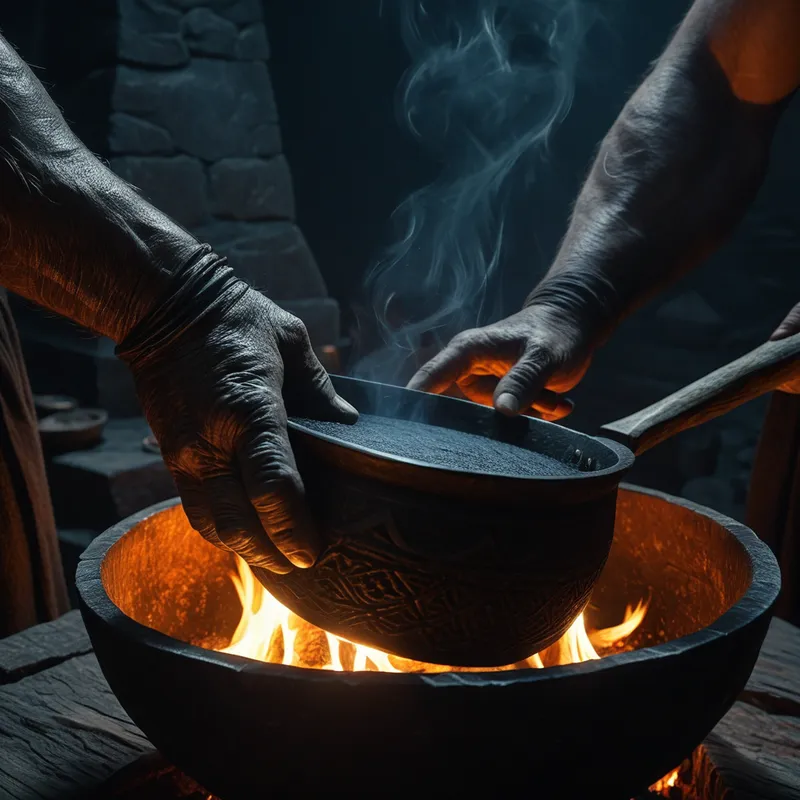
Then, the alchemy of the cauldron. The flesh, rich and dark, simmers in Eldhrímnir’s belly, and a scent rises—a scent of hearth, of deep forest loam, of promise fulfilled. It is a smell that reaches into the very soul of a warrior, mending the ghost-wounds of a thousand battles. The Einherjar gather, their eternal hunger awakened anew. They eat their fill, and the boar’s substance becomes their strength, their laughter, their readiness for the evening’s combat.
And as the last bone is cleaned, as the last drop of broth is savored, a whisper moves through Glasir’s grove. On the cool earth where the boar first stood, the air shimmers. From nothing, and from everything—from the memory of the feast and the promise of the dawn—the form gathers. Muscle weaves itself from mist, hide darkens from shadow, and the quiet, knowing eyes open once more. Sæhrímnir is whole. He shakes his great head, the iron bristles catching the first light of the next day, and waits, complete, for the cycle to begin again. The feast never ends because the gift is never exhausted.
Cultural Origins & Context
This myth is preserved primarily in the Poetic Edda, specifically in the Grímnismál, and is reiterated in the later Prose Edda. It was not a standalone epic, but a vital piece of cosmological description, recited by skalds and storytellers to paint a complete picture of Valhalla’s paradoxical nature. Its function was multifaceted. On one level, it answered a practical, almost homely question in a culture familiar with scarcity: what do the glorious dead eat? The answer affirmed a divine economy of limitless abundance, a powerful consolation and aspiration.
On a deeper level, it reinforced the core Norse ethos of cyclicity and purpose. The universe was not a linear march to an end, but a series of cycles—day and night, season and season, life and death—all upheld by sacred, often sacrificial, labor. Sæhrímnir’s daily death and rebirth mirrored the daily battle-dying of the Einherjar themselves, and presaged the great cycles of the world, from creation to Ragnarök and beyond. The myth was a narrative anchor, assuring listeners that within the great, often brutal wheel of existence, there was a place of guaranteed renewal, sustained by a willing, sacred victim.
Symbolic Architecture
Sæhrímnir is the archetype of the self-replenishing source. It is not merely a magical food supply; it is the embodied principle of regenerative sacrifice. The boar itself is a potent symbol in Norse and wider Indo-European culture, representing fertility, strength, and untamed nature. Here, that raw, earthly power is perfectly harnessed and perpetually offered.
The deepest nourishment requires a willing dissolution. The self that is clung to cannot feed the future.
The key figures form a sacred triad: The Boar (Sæhrímnir) is the substance, the raw material of life and strength. The Cook (Andhrímnir) is the agent of transformation, the one who applies the "fire" of process to translate potential into actual nourishment. The Cauldron (Eldhrímnir) is the vessel, the sacred container where the transformation occurs, a womb of culinary rebirth. This process—substance, transformative action, containing vessel—is a universal template for any act of creation or sustenance, from cooking a meal to forging a community.
Psychologically, Sæhrímnir represents the part of the psyche that can be "spent" for growth without being depleted. It is the well of creative energy, emotional resilience, or psychic resource that seems to refill after we have given our all. Its death is not an annihilation, but a necessary surrender of form so that essence can be distributed and assimilated.
The Dreamer's Resonance
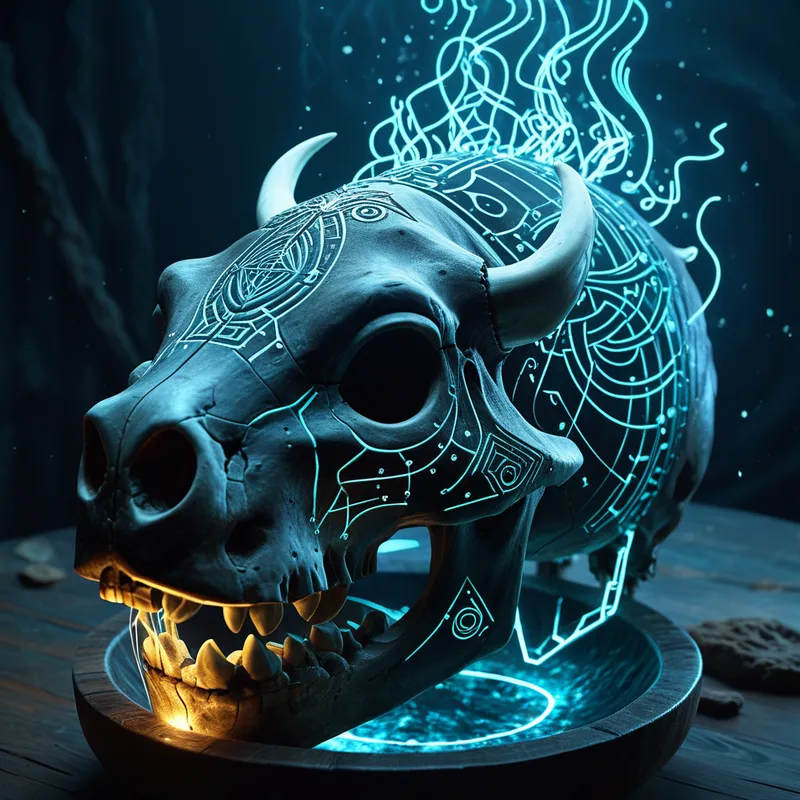
When this myth stirs in the modern unconscious, it often manifests in dreams of recurring feasts, endless meals, or magical animals that return after being lost or harmed. One might dream of cooking a magnificent, abundant meal for a vast, anonymous crowd, or of discovering a source of food that never runs out in a barren landscape.
Somatically, this can correlate with a profound process of replenishment after expenditure. The dreamer may be in a life phase where they are constantly giving—as a caregiver, a creator, a leader—and feeling the deep anxiety of depletion. The myth-dream is the psyche’s reassurance. It signals that a cycle is at work: the act of giving itself is part of a larger metabolic process that will regenerate the source, provided there is a willingness to surrender the current form. The anxiety of "running out" meets the deep, somatic truth of cyclical renewal. The dream is an invitation to trust in the Eldhrímnir within—the containing, transformative process—and to play the role of Andhrímnir with purposeful care, rather than desperate scarcity.
Alchemical Translation
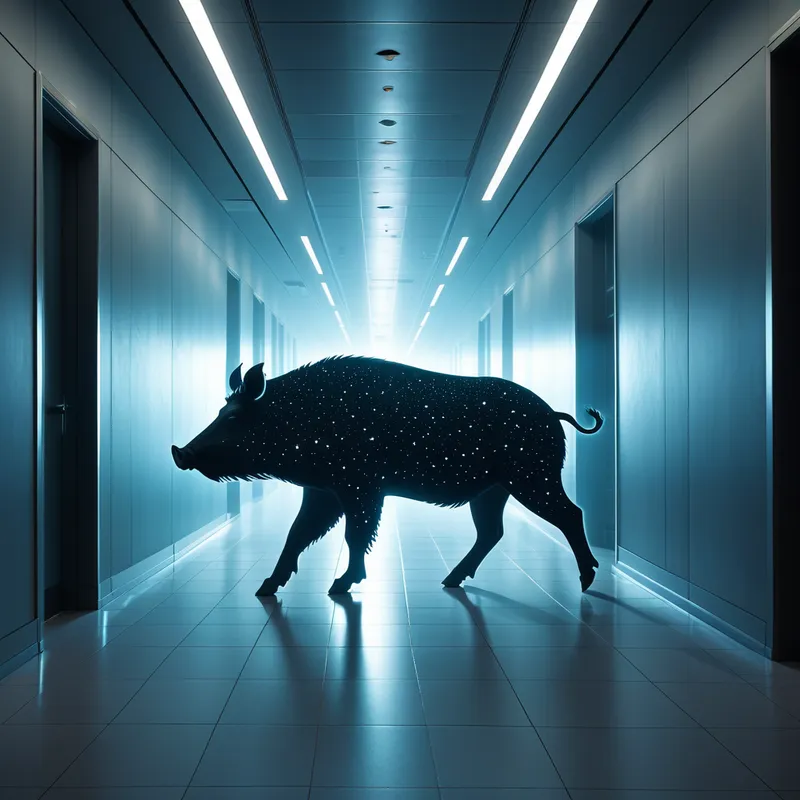
The alchemical journey modeled by Sæhrímnir is the Opus Contra Naturam—the work against nature—but here, it is the work against the nature of linear depletion. For the modern individual pursuing individuation, the myth maps the process of building a sustainable psyche.
The first step is Nigredo, the blackening: identifying what in us plays the role of Sæhrímnir. What is that core resource—our creativity, our compassion, our vitality—that we fear to spend lest it vanish? We must, like the boar, acknowledge it and bring it consciously to the cauldron of transformation.
The second is Albedo, the whitening: the sacrificial act itself, performed by the Andhrímnir-consciousness. This is the disciplined, daily "cooking"—the act of applying our skills (the knife) and our transformative fire (our attention and effort) to that resource. We write the poem, offer the comfort, complete the project. We allow the form of our potential to be "slain" and translated into tangible nourishment for our life and relationships.
Individuation is fed not by hoarding the self, but by a daily, sacred slaughter of the ego's claim to permanence, so the soul's substance may be shared and renewed.
Finally, Rubedo, the reddening: the feast and the rebirth. This is the integration, where the spent resource returns not as it was, but renewed. The writer finds deeper inspiration after finishing the book. The caregiver discovers a fuller well of patience after a day of exhaustion. The cauldron Eldhrímnir is the vas hermeticum of the individuating psyche—the sealed container of the conscious life where this death-and-rebirth cycle safely occurs. The ultimate alchemical translation is understanding that our deepest strength is not in being an imperishable monument, but in being a perpetual, willing source—dying to our old form each day to be reborn, nourishing the life we are here to live, again and again, until the final twilight.
Associated Symbols
Explore related symbols from the CaleaDream lexicon: