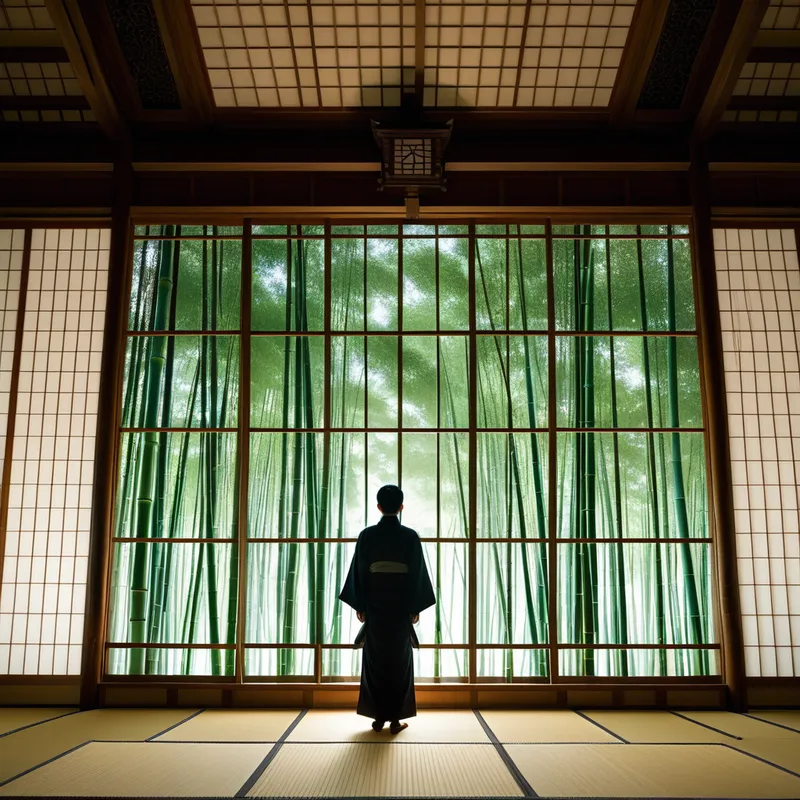
Shoji Screens Myth Meaning & Symbolism
A mythic tale of the first Shoji, born from a kami's breath to hold the tension between the seen world and the luminous mystery beyond.
The Tale of Shoji Screens
Listen, and let the silence between the words speak. In the time when [the world](/myths/the-world “Myth from Tarot culture.”/) was still wet with creation, the kami walked with a lighter step. Among them was Takumi-no-Kami, the spirit of the artisan’s breath. He watched the humans huddle in their wooden homes, their lives a stark division: the solid, known world within, and the vast, terrifying mystery of the night without. Walls were barriers, and doors were breaches.
Takumi-no-Kami felt a sorrow for this severance. One evening, as the sun bled into the western sea and the first star, Hoshi-no-Kon, trembled into being, he descended to a small house at the forest’s edge. Inside, a poet sat, paralyzed by the darkness pressing against his shutters. He longed not to banish the night, but to converse with it—to hear its whispers without being consumed.
The kami, unseen, gathered the sigh of the cypress tree, the patience of [the bamboo](/myths/the-bamboo “Myth from Taoist culture.”/), and the first, pure light of [the moon](/myths/the-moon “Myth from Tarot culture.”/). He breathed upon a frame of slender wood, and where his breath touched, a substance emerged—neither wall nor void. It was a skin of moonlight made solid, a parchment woven from cloud: the first [shoji](/myths/shoji “Myth from Japanese culture.”/).
He placed it in the poet’s window. The man started, for the impenetrable black was gone. In its place was a gentle, pearlescent glow. The fierce wind became a soft rustle; the shapeless night resolved into the elegant, dancing silhouettes of pine boughs. The terror retreated, replaced by a profound curiosity. He saw not the darkness itself, but the forms within it, outlined by the light from his own hearth. The outside was not shut out; it was invited in, translated into a language of shadow and silhouette. The screen held the tension—a sacred boundary that was also a bridge. That night, the poet did not write of fear, but of the beauty of the hidden world, now made intimate. And Takumi-no-Kami smiled, for he had not given a wall, but a lens for the soul.
Cultural Origins & Context
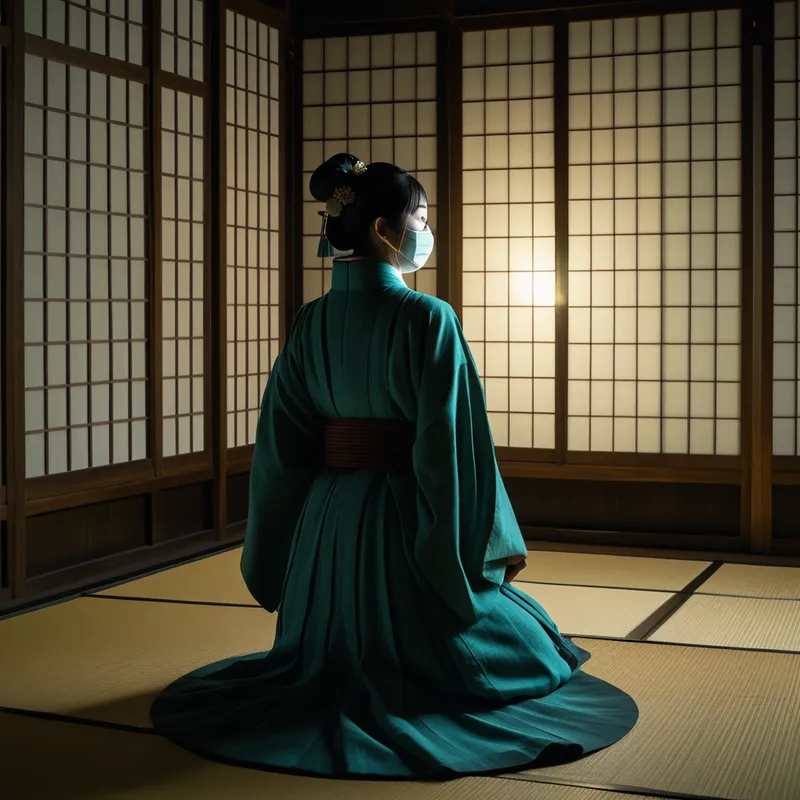
This myth, woven into the oral traditions of master carpenters (tōryō) and paper-makers, is less a formal Kiki narrative and more a foundational koto-dama—the spirit of [the thing](/myths/the-thing “Myth from Norse culture.”/). It emerges from the core principles of Shinto and later, Zen Buddhist aesthetics, which perceive the sacred not in distant heavens, but in the interstices of the natural world. The shoji screen is a physical manifestation of [wabi-sabi](/myths/wabi-sabi “Myth from Japanese culture.”/) and [yūgen](/myths/ygen “Myth from Japanese culture.”/).
Passed down not as a sacred text but as a story told by craftsmen to apprentices, its societal function was pedagogical. It taught that a barrier’s purpose is not merely to separate, but to define a relationship. The shoji regulates the flow of light, air, sound, and attention. It creates shakkei, making the garden part of the room. The myth thus encodes an entire philosophy of space and perception: the world is a dialogue between omote (the surface) and ura (the reverse), and the shoji is the mediating membrane.
Symbolic Architecture
Psychologically, the myth of the Shoji Screen maps the [architecture](/symbols/architecture “Symbol: Architecture in dreams often signifies structure, stability, and the framing of personal identity or life’s journey.”/) of [consciousness](/symbols/consciousness “Symbol: Consciousness represents the state of awareness and perception, encompassing thoughts, feelings, and experiences.”/) itself. The solid wooden frame represents the defining [structure](/symbols/structure “Symbol: Structure in dreams often symbolizes stability, organization, and the framework of one’s life, reflecting how one perceives their environment and personal life.”/) of [the ego](/myths/the-ego “Myth from Jungian culture.”/)—our [identity](/symbols/identity “Symbol: Identity represents the sense of self, encompassing personal beliefs, cultural background, and social roles.”/), our personal [history](/symbols/history “Symbol: History in dreams often represents the dreamer’s past experiences, lessons learned, or unresolved issues that continue to influence their present.”/), the “house” of [the self](/myths/the-self “Myth from Jungian culture.”/). The translucent paper, however, symbolizes the permeable [boundary](/symbols/boundary “Symbol: A conceptual or physical limit defining separation, protection, or identity between entities, spaces, or states of being.”/) of the [psyche](/myths/psyche “Myth from Greek culture.”/).
The ego is not a fortress wall, but a shoji screen: it must be sturdy enough to provide shape, yet translucent enough to allow the light of the unconscious to illuminate its inner chambers with the silhouettes of outer truth.
The outside [night](/symbols/night “Symbol: Night often symbolizes the unconscious, mystery, and the unknown, representing the realm of dreams and intuition.”/) represents the unconscious—vast, unknown, and potentially frightening. The [interior](/symbols/interior “Symbol: The interior symbolizes one’s inner self, thoughts, and emotions, often reflecting personal growth, vulnerabilities, and secrets.”/) hearth-light is the light of conscious [awareness](/symbols/awareness “Symbol: Conscious perception of self, surroundings, or internal states. Often signifies awakening, insight, or heightened sensitivity.”/). The miracle of the shoji is that it allows these two to interact without collapse. The shadows cast upon it are the archetypes and contents of the unconscious, projected and given form by the light of our own [attention](/symbols/attention “Symbol: Attention in dreams signifies focus, awareness, and the priorities in one’s life, often indicating where the dreamer’s energy is invested.”/). We do not see the “[thing](/myths/thing “Myth from Norse culture.”/)-in-itself” of the unconscious directly (that would be psychosis), but we see its shape, its influence, its beautiful and terrifying patterns. The screen protects us from being overwhelmed, while allowing a constant, nourishing exchange.
The Dreamer’s Resonance
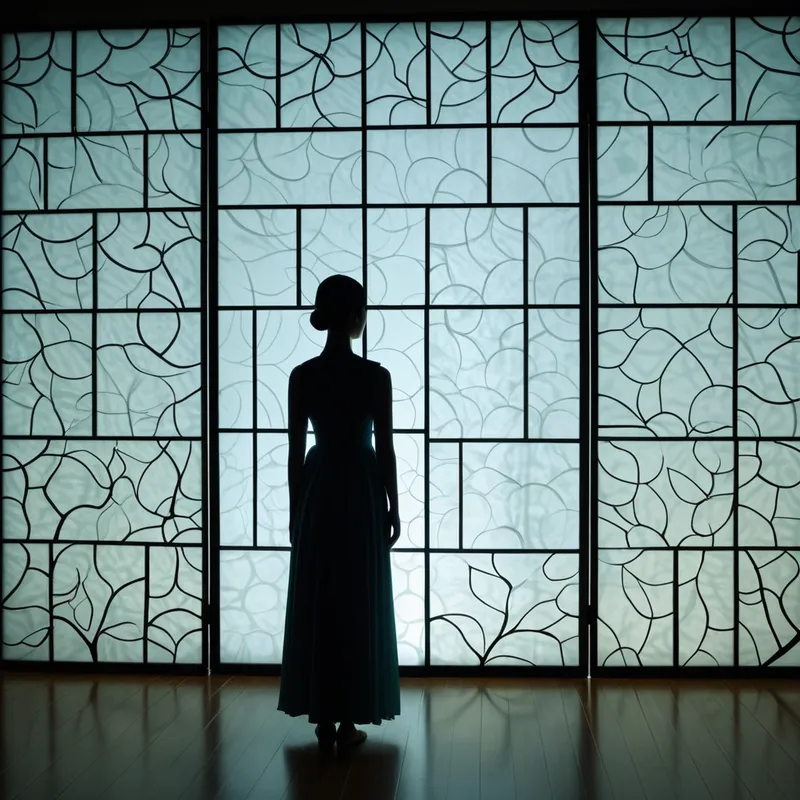
When a modern dreamer encounters a shoji screen, it often signifies a somatic and psychological process of threshold management. The dream ego is negotiating a boundary. Perhaps the screen is torn, indicating porous personal boundaries and a feeling of being invaded. Perhaps it is brilliantly lit from the other side, suggesting an imminent revelation from the unconscious—a new insight, intuition, or a repressed memory seeking to be integrated.
Somatically, one might feel the tension of that threshold in the body: a tightness in the chest (the heart behind the screen), a hesitation in the hand before sliding the panel open, or a chill from the draft passing through the paper. The dream is staging the delicate operation of the psyche’s immune system. It asks: What are you allowing in? What are you keeping out? Is your current structure—your ego—flexible enough to translate the shadowy movements of your inner or outer world into recognizable forms, or is it a solid wall causing isolation and fear?
Alchemical Translation
The myth models the alchemical process of [solutio](/myths/solutio “Myth from Alchemical culture.”/) followed by coagulatio. The initial state is the [nigredo](/myths/nigredo “Myth from Alchemical culture.”/) of the poet’s fear—the black, undifferentiated night of the unconscious, which paralyzes because it has no relationship to consciousness. Takumi-no-Kami’s act is the intervention of the transcendent function.
Individuation is not the demolition of the ego, but the transformation of its walls into shoji screens—increasing its transparency to the Self.
The breath of the kami is the aqua permanens, the dissolving [water](/myths/water “Myth from Chinese culture.”/) that transforms the solid wall (rigid ego-defenses) into a translucent membrane. The new structure—the shoji—is the coagulatio, the newly formed, more sophisticated boundary of the individuating psyche. It holds the tension of the opposites: inside/outside, known/unknown, self/other, light/dark. The [triumph](/myths/triumph “Myth from Roman culture.”/) is not conquest, but the establishment of a conscious, permeable relationship with all that is not-self. For the modern individual, this translates to the practice of holding one’s convictions (the frame) with humility and openness (the paper), allowing the world to impress upon us, change us, and cast its instructive shadows on the screen of our awareness, without losing our essential form. We become, like the poet, translators of the mysterious night, finding intimacy with the vastness rather than fear.
Associated Symbols
Explore related symbols from the CaleaDream lexicon: