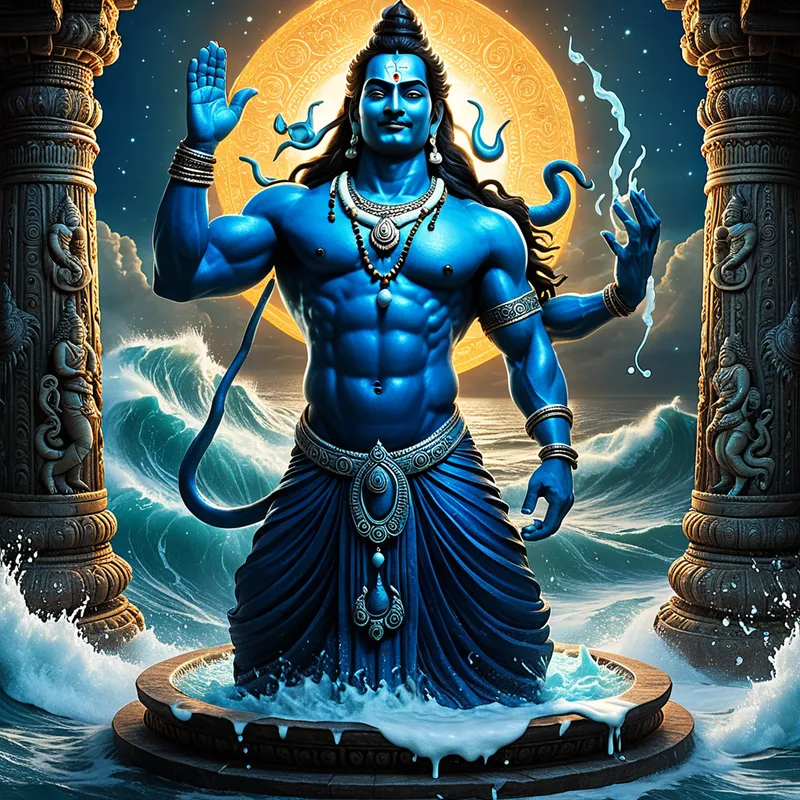
Shiva's Poison Myth Meaning & Symbolism
When the gods churned the ocean for nectar, they first released a deadly poison. Only Shiva, the great ascetic, could contain it, swallowing it to save all creation.
The Tale of Shiva’s Poison
Listen. Before the world was as it is, the gods and the demons, locked in their eternal dance, sought the nectar of immortality. They gathered on the shores of the primordial ocean of milk, Mount Mandara. With the king of serpents, Vasuki, coiled around the mountain as a rope, they began to pull. The gods at the tail, the demons at the head. Back and forth. The mountain groaned, churning the milky depths.
The ocean heaved. First, it gave forth a deadly vapor, a smoke that choked the sky. Then, from its tortured depths, it vomited forth a substance of such absolute malignancy that the very air curdled around it. This was Halahala. It was not mere venom; it was the concentrated essence of entropy, the primal toxin of existence itself, born from the friction of opposing forces. It spread, a black, viscous tide, threatening to dissolve all creation back into void. The celestial Apsaras fled. The sky grew dark. The gods and demons, their great project unraveling, stood paralyzed in terror. Their ambition had birthed an apocalypse.
In that moment of cosmic despair, a figure emerged from the silence of the high mountains. It was Shiva, the great ascetic, the lord of yogis. He had been seated in profound meditation, but the distress of the world stirred him. He saw the spreading darkness, heard the silent scream of the universe. Without a word, without consulting the council of gods, he moved. With the compassion of one who understands that poison and nectar are two sides of the same coin, he cupped his hands. He gathered the rising, world-killing poison—every drop, every fume—and, before any could protest, he raised it to his lips and drank.
The universe held its breath. The poison, a fire that could burn worlds, coursed down his throat. His consort, the goddess Parvati, in a flash of protective terror, reached out and clasped his neck. Her touch, the power of conscious containment, arrested the descent. The poison, trapped in his throat, could neither ascend to his head and destroy his consciousness, nor descend to his stomach and destroy his form. It burned there, a contained inferno, turning his throat a permanent, radiant blue. Thus, he became Neelakantha, the blue-throated one. The crisis was averted. The churning could continue, because one consciousness had agreed to hold the darkness so that all else could seek the light.

Cultural Origins & Context
This myth, known as the Samudra Manthan, is a cornerstone narrative within the Puranic tradition, most elaborately detailed in texts like the Vishnu Purana and the Shiva Purana. It was not a story confined to temples or priestly classes; it was a living cosmology told by bards, enacted in village plays, and sculpted onto the walls of mighty temples from Angkor Wat to Ellora. Its function was multifaceted: it was an etiological myth explaining Shiva’s form, a cosmological map of creation and destruction, and a profound societal allegory.
The story served as a cultural container for the paradox of existence. In a society structured by the concept of Dharma, it acknowledged that the pursuit of order (the nectar of immortality for the gods) inevitably unleashes disorder (the poison). It taught that transcendence is not about avoiding this shadow, but about finding the divine capacity to hold it without being destroyed. Shiva, as the archetypal outsider-yogi, models the role of the one who takes on the collective toxicity—be it societal sin, karmic debt, or primal fear—so that the community may survive and evolve.
Symbolic Architecture
At its heart, the myth is a masterclass in symbolic alchemy. The ocean of milk represents the unmanifest potential of the psyche, the fertile but chaotic unconscious. The churning is the necessary, often painful, process of introspection, therapy, or spiritual practice—the friction required to bring hidden contents to light.
The nectar of immortality and the all-consuming poison are born from the same source. The goal of the work is not to avoid the poison, but to develop the throat to hold it.
The poison, Halahala, symbolizes the shadow in its most potent form: repressed trauma, unprocessed rage, paralyzing fear, the “negative” aspects of the self we wish to deny. It is the inevitable byproduct of any deep engagement with life or the psyche. Shiva represents the transcendent function of consciousness—the observing Self that can witness and contain these devastating energies without identifying with them. His blue throat is the symbol of this transformative containment; the poison is not eliminated, but its energy is arrested, transmuted, and integrated, becoming a source of power rather than destruction. Parvati’s intervention is crucial—she represents the grounding, nurturing, and conscious embodiment (Shakti) required to localize and stabilize this process. The myth tells us that transcendence (Shiva) without embodiment (Parvati) is incomplete; the poison must be held in the specific vessel of a lived life.

The Dreamer’s Resonance
When this myth stirs in the modern dreamer, it signals a profound somatic and psychological process of containment. One may dream of being forced to swallow a bitter, dark liquid; of having a constricted, burning, or luminescent throat; of holding a volatile, dangerous substance that others fear. These are not nightmares of mere attack, but initiatory dreams of a necessary ordeal.
The somatic focus on the throat is key. In the body, the throat is the bridge between head (conscious thought) and heart/body (feeling and instinct). To dream of this area under stress is to experience the struggle to metabolize an emotional or psychic truth that feels too potent to think through or too overwhelming to feel fully. The dreamer is in the position of the churning ocean, producing their own Halahala—perhaps a long-suppressed grief, a rightful anger that feels dangerous, or the toxic residue of a past trauma now surfacing. The psychological process is one of moving from paralysis in the face of this inner toxin towards developing an inner Neelakantha: a witnessing consciousness capable of holding the charge without acting it out destructively or repressing it once more.

Alchemical Translation
For the individual on the path of individuation, Shiva’s poison models the essential, non-negotiable step of psychic transmutation. Our personal “churning”—through life crises, analysis, or intense self-reflection—will always bring up poison: the shadow material, the complexes, the wounds. The modern temptation is to seek immediate purging, to “detox” the negative, or to spiritualize it away.
Individuation is not the consumption of only light, but the development of a consciousness capable of digesting the dark.
The alchemical instruction of the myth is the opposite: swallow it. Do not project it onto others (the demons), nor spiritualize it into abstraction (the gods). Take full responsibility for its existence within your own psychic ecosystem. This is the ultimate act of the Caregiver archetype turned inward—caring for the entirety of one’s being, even its most terrifying aspects. The “blue throat” that results is the integrated self. The poison, once held in the vessel of conscious awareness, loses its destructive autonomy. Its fierce energy is transmuted. What was once a paralyzing anxiety becomes heightened intuition. A seething rage becomes the fuel for impassioned creativity and firm boundaries. A cold grief becomes a deep compassion. The individual does not become “perfect” or poison-free; they become capable. They gain the spiritual and psychological immunity that comes from having consciously contained the worst within themselves, and in doing so, they create the inner space for their own unique “nectar”—authenticity, wisdom, and resilient peace—to emerge.
Associated Symbols
Explore related symbols from the CaleaDream lexicon: