Shiva's Lingam Myth Meaning & Symbolism
A cosmic pillar of light, endless and unmeasured, resolves a divine quarrel, establishing the infinite Brahman as the source of all form.
The Tale of Shiva’s Lingam
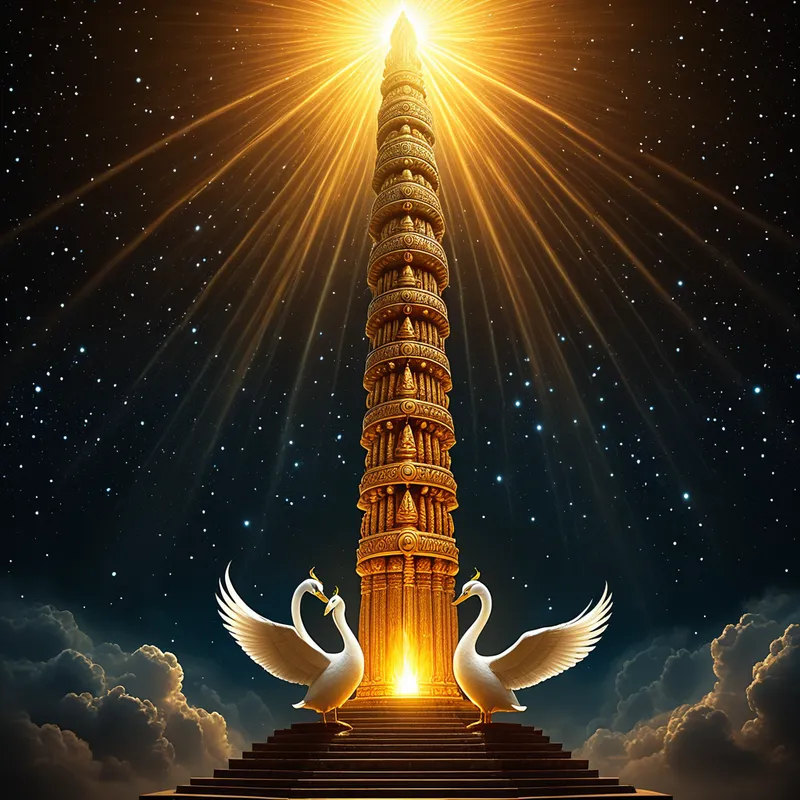
In the time before time, when the worlds were still young and the gods walked with the certainty of kings, a quarrel arose in the high halls of creation. Brahma, the four-faced lord who spun [the lotus](/myths/the-lotus “Myth from Hindu culture.”/) of the universe from his navel, and [Vishnu](/myths/vishnu “Myth from Hindu culture.”/), the dark-skinned god who sleeps upon the serpent of eternity, fell into a debate of cosmic proportions. Each claimed supremacy, each believed himself the source and [the summit](/myths/the-summit “Myth from Taoist culture.”/) of all that is.
Their divine words, heavy with power, began to shake the pillars of the heavens. The air crackled with the tension of unbridled ego. Just as the argument threatened to unravel the very fabric of reality, the space between them rippled. Not with sound, but with a profound, unsettling silence. Then, it appeared—a massive, fiery pillar, a [lingam](/myths/lingam “Myth from Hindu culture.”/) of pure, incandescent light. It pierced down through the celestial realms and drove deep into the netherworlds, a column without beginning, without end, burning with a terrible and beautiful radiance.
Awe swallowed their pride. Brahma and Vishnu, humbled and astonished, devised a plan to measure this impossible [thing](/myths/thing “Myth from Norse culture.”/). Vishnu transformed into a colossal boar, [Varaha](/myths/varaha “Myth from Hindu culture.”/), and plunged downward into the abyssal darkness, seeking the root. Brahma took the form of a swift swan, [Hamsa](/myths/hamsa “Myth from Hindu culture.”/), and soared upward into the infinite light, seeking [the crown](/myths/the-crown “Myth from Various culture.”/). For a thousand celestial years they traveled, Vishnu through the crushing depths, Brahma through the blinding heights, and neither could find an end. The pillar was boundless.
Exhausted, Vishnu returned, admitting his failure. But Brahma, in his journey, encountered a single ketaki blossom, drifting down from an unseen height. Seizing a chance to claim victory, he returned with the flower and falsely testified that he had indeed plucked it from the very summit of the luminous pillar. At that moment of deceit, the pillar split open. From within its heart of fire emerged [Shiva](/myths/shiva “Myth from Hindu culture.”/), in all his terrifying splendor. The ketaki blossom, witness to the lie, was cursed never to adorn [Shiva](/myths/shiva “Myth from Hindu culture.”/) again. Brahma was stripped of his worship for a time. And the truth was laid bare: this infinite column was the true form of the Supreme, the Brahman, of which both Brahma and Vishnu were but aspects. The Lingam stood as the eternal axis of [the world](/myths/the-world “Myth from Tarot culture.”/), the formless taking form only to reveal its own limitlessness.
Cultural Origins & Context
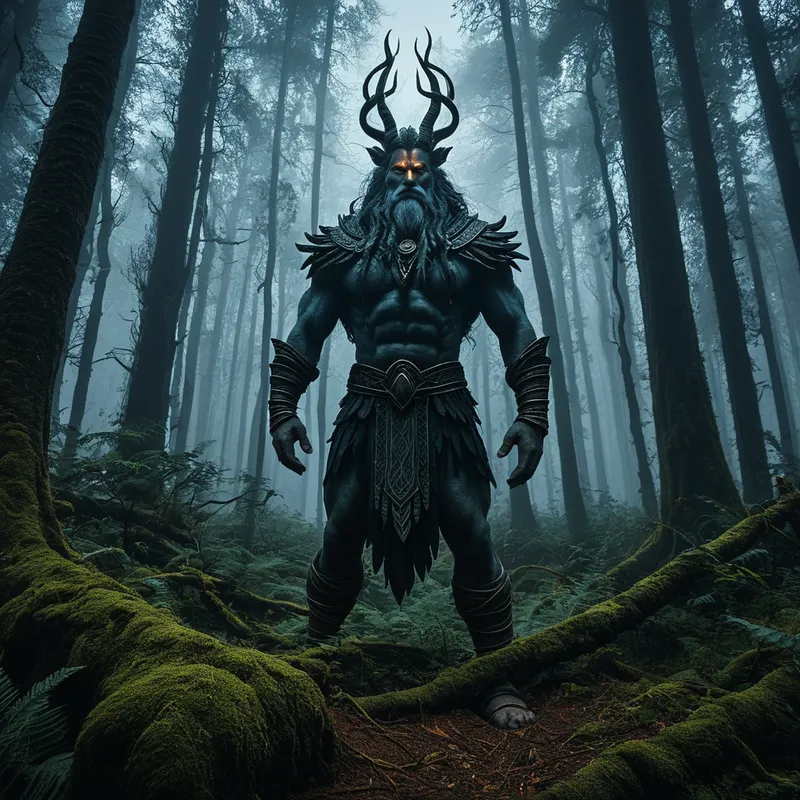
This myth, known as the Lingodbhava, is enshrined in the ancient Puranas, particularly the Shiva Purana and the Linga Purana. It was not merely a story for entertainment but a theological and philosophical cornerstone. Told by sages in forest hermitages and later sculpted onto the walls of colossal temples like those at Ellora, its function was multifaceted. It established the doctrinal supremacy of the Shaiva tradition, which worships Shiva as the ultimate, formless reality. Societally, it served as an antidote to dogmatic contention, teaching that all paths and deities emerge from and return to a single, incomprehensible source. The myth provided the narrative foundation for the worship of the lingam-yoni, transforming an abstract principle into a tangible focus for devotion, meditation, and communal ritual.
Symbolic Architecture
The Lingam is the ultimate [symbol](/symbols/symbol “Symbol: A symbol can represent an idea, concept, or belief, serving as a powerful tool for communication and understanding.”/) of [paradox](/symbols/paradox “Symbol: A contradictory yet true concept that challenges logic and perception, often representing unresolved tensions or profound truths.”/). It is a form that represents the formless; a localized object that signifies the infinite; a [symbol](/symbols/symbol “Symbol: A symbol can represent an idea, concept, or belief, serving as a powerful tool for communication and understanding.”/) of potent masculine [energy](/symbols/energy “Symbol: Energy symbolizes vitality, motivation, and the drive that fuels actions and ambitions.”/) that is utterly inert without its feminine base, the yoni. Psychologically, it represents the irreducible core of [the Self](/myths/the-self “Myth from Jungian culture.”/), the [axis](/symbols/axis “Symbol: A central line or principle around which things revolve, representing stability, orientation, and the fundamental structure of reality or consciousness.”/) mundi of the individual [psyche](/myths/psyche “Myth from Greek culture.”/) that connects the deepest unconscious (the netherworlds) with the highest spiritual aspiration (the heavens).
The Lingam is not an object to be found, but the ground of being from which all searching arises and within which all searching occurs.
Brahma and Vishnu represent the dualistic, projecting mind. Brahma is the creative, [outward](/symbols/outward “Symbol: Movement or orientation away from the self or center; expansion, expression, or externalization of inner states into the world.”/)-spinning ego that constructs identities and worlds. Vishnu is the preserving, ordering principle that seeks to maintain and measure those constructions. Their quarrel is the psyche’s civil war between different aspects of the [personality](/symbols/personality “Symbol: Personality in dreams often symbolizes the traits and characteristics of the dreamer, reflecting how they perceive themselves and how they believe they are perceived by others.”/), each claiming to be the “true self.” The infinite Lingam appears when this conflict reaches an impasse, symbolizing the [eruption](/symbols/eruption “Symbol: A sudden, violent release of pent-up energy or emotion from beneath the surface, often representing transformation or crisis.”/) of the transcendent Self, which shatters all petty comparisons and conceptual frameworks. The failed search is not a failure, but the necessary [revelation](/symbols/revelation “Symbol: A sudden, profound disclosure of truth or insight, often through artistic or musical means, that transforms understanding.”/): the Self cannot be objectified, measured, or claimed. It can only be acknowledged as the prior, boundless [reality](/symbols/reality “Symbol: Reality signifies the state of existence and perception, often reflecting one’s understanding of truth and life experiences.”/).
The Dreamer’s Resonance
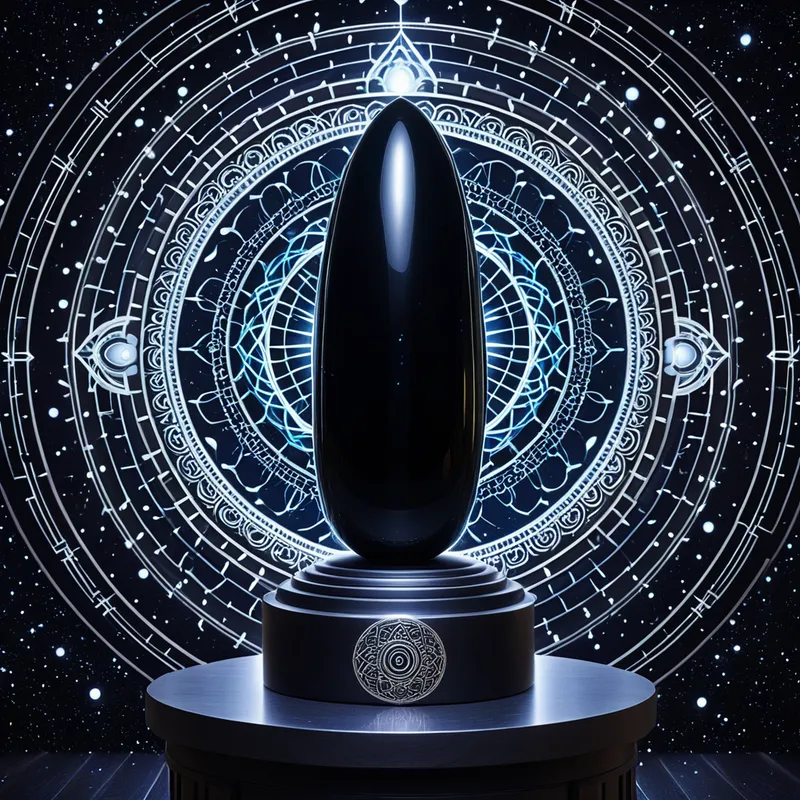
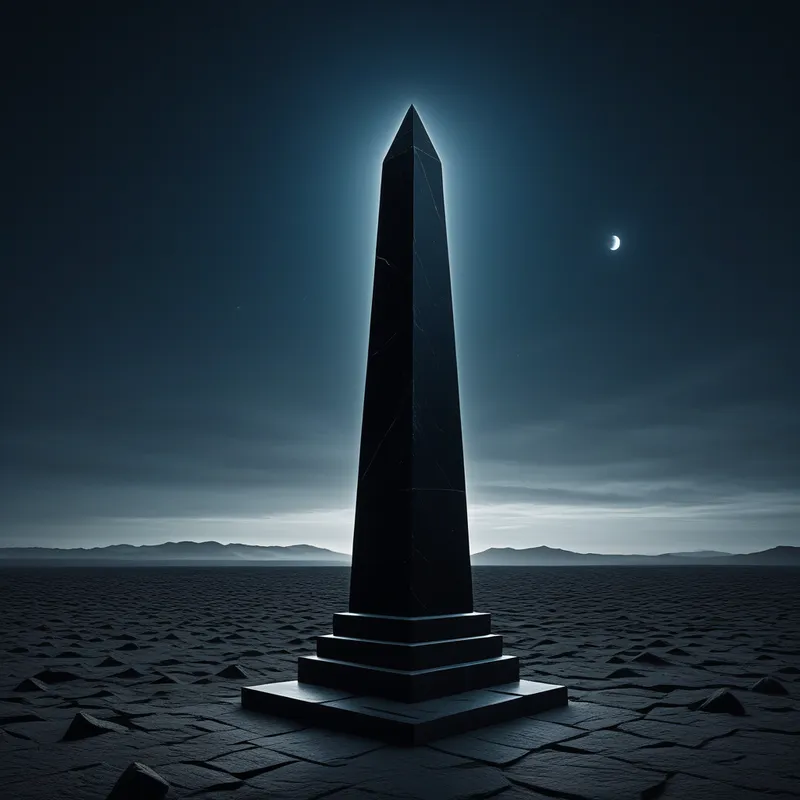
When this mythic pattern stirs in the modern dreamer, it often manifests not as a clear narrative, but as a profound somatic and spatial experience. One might dream of a towering, featureless skyscraper in a vast desert, an endless elevator shaft, or a monolithic, smooth stone in the center of a dark room. The feeling is one of awe mixed with disorientation—a confrontation with something that dwarfs the dreamer’s personal identity.
Psychologically, this signals a process where the conscious ego is being humbled. The dreamer may be embroiled in an internal or external conflict of “who is right” or “what is my true purpose,” a modern echo of Brahma and Vishnu’s quarrel. The appearance of the monolithic symbol marks the psyche’s attempt to introduce a transpersonal perspective. It is the Self intervening to say, “Your current frame of [reference](/myths/reference “Myth from Global/Universal culture.”/) is too small.” The somatic feeling—often a vibration, a pull, or a weighty silence—indicates this is not an intellectual insight, but a whole-being recalibration. [The ego](/myths/the-ego “Myth from Jungian culture.”/) is not being destroyed, but being re-contextualized within a vastly larger, and ultimately incomprehensible, totality.
Alchemical Translation
The alchemical process modeled here is the [nigredo](/myths/nigredo “Myth from Alchemical culture.”/) leading to the unio mentalis—the darkening and confusion of the ego leading to a [sacred marriage](/myths/sacred-marriage “Myth from Alchemy culture.”/) within the mind. The first step is the acknowledgment of the “divine quarrel,” the pride and conflict within our own psyche. We must allow this conflict to reach its crisis, to feel its futility. This is the fertile darkness before the appearance of the light.
The appearance of the Lingam is the moment of grace, the irruption of the numinous that transcends the opposites. The task for the individual is not to “understand” it, but to cease the frantic searching (the boar and swan’s journey) and to simply witness. This requires the humility of Vishnu, who admits failure, and the repentance for the ego’s inherent deceit, symbolized by Brahma’s lie.
Individuation is not about building a better, shinier ego. It is about the ego discovering itself as a temporary wave on the ocean of the Self, finding its dignity not in separation, but in its capacity to reflect the depths from which it arose.
The final, alchemical translation is the establishment of the inner axis. The external, worshipped Lingam becomes an internal reality: a still, central point of consciousness within the individual. This point does not move, though all of life’s dualities—pleasure and pain, success and failure, creation and destruction—revolve around it. One becomes grounded in the formless, which allows one to engage with form without being enslaved by it. The union of Lingam and Yoni is internalized as [the sacred marriage](/myths/the-sacred-marriage “Myth from Various culture.”/) of consciousness (Shiva) and the energy of life ([Shakti](/myths/shakti “Myth from Hindu culture.”/)), where one’s very existence becomes an altar, and every moment an act of worship to the infinite mystery residing at the core of being.
Associated Symbols
Explore related symbols from the CaleaDream lexicon: