Shiva's Ashes Myth Meaning & Symbolism
A myth of cosmic sacrifice where Shiva's ashes, born from his own fiery destruction, become the sacred mark of impermanence and transcendent consciousness.
The Tale of Shiva’s Ashes
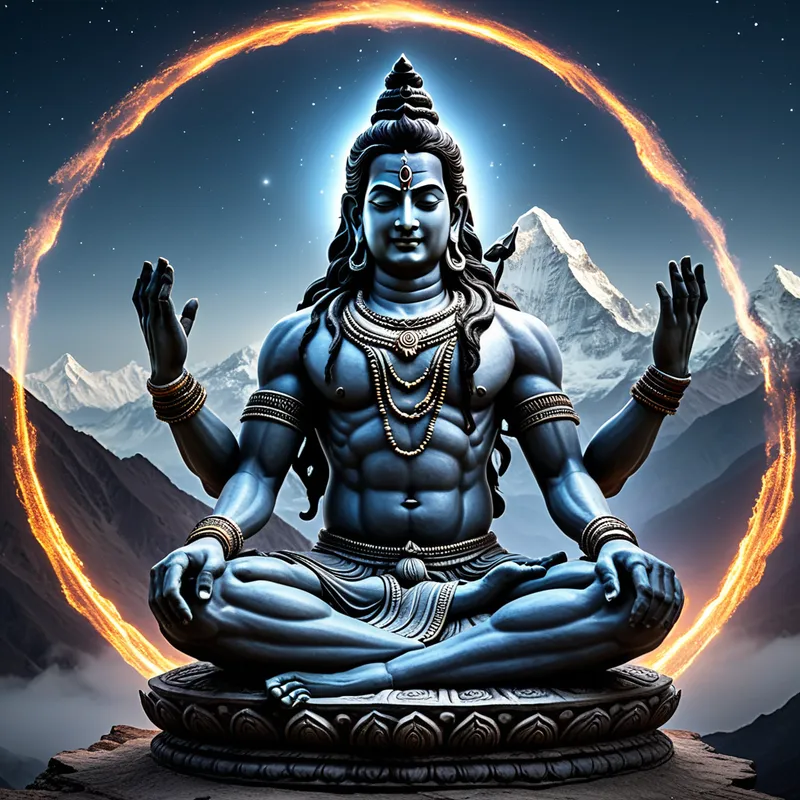
Listen. Before time was measured, in the high, silent fastness where [the world](/myths/the-world “Myth from Tarot culture.”/) meets the infinite, the great ascetic sat. [Shiva](/myths/shiva “Myth from Hindu culture.”/), the Adiyogi, was deep in [samadhi](/myths/samadhi “Myth from Buddhist culture.”/). His matted locks were the nesting place of galaxies, his breath [the wind](/myths/the-wind “Myth from Various culture.”/) that turns the ages. He was the still axis of the turning wheel.
But in the worlds below, a terrible imbalance grew. A demon, Taraka, had won a boon of invincibility—he could be slain only by a son of Shiva. Yet Shiva was lost to the world, a mountain of solitude, a widower of the cosmos after the death of his first love, Sati. The gods despaired. The universe tilted toward tyranny.
The solution was as desperate as the plight. They needed to wake the Yogi, to draw him back into the dance of creation and procreation. They needed to ignite the fire of desire in the heart of the great renunciate. The task fell to Kama, and his consort, Rati. On a spring day heavy with the scent of mango blossoms, Kama approached. He saw Shiva, a statue of perfect stillness, and drew his bow. The arrow, tipped with the essence of longing, flew.
In that instant, Shiva’s [third eye](/myths/third-eye “Myth from Hindu culture.”/)—the eye of transcendent wisdom that sees beyond illusion—blazed open. A searing, white-hot beam of pure cosmic fire erupted. It was not the fire of anger, but the fire of absolute reality, incinerating all that is fleeting and false. Kama, the god of worldly desire, was instantly reduced to ashes. The very concept of formless attraction was annihilated.
A wail pierced the heavens. Rati fell upon the smoldering pile of fine, gray dust that was all that remained of her lord. Her tears fell like monsoons upon the ashes. Moved by a compassion deeper than [the void](/myths/the-void “Myth from Buddhist culture.”/) from which he arose, Shiva spoke. His voice was the rumble of tectonic plates. “He will live again,” he declared, “but not as before. He will be Ananga, the bodiless one. Desire will henceforth be an unseen force, moving in the hearts of all beings.”
Then, Shiva did something unimaginable. He reached down, gathered the ashes of the god of desire—ashes created by his own fiery power—and smeared them upon his own body. The pure white of his ascetic’s ash, the vibhuti, was now mingled with this new, potent residue. He anointed his forehead, his arms, his chest. The destroyer wore the remains of what he had destroyed. The ashes became his ornament, his shield, his skin. From that day forth, the bhasma was not just a sign of renunciation, but a living testament to a sacrifice that saved the cosmos. It held within it the memory of desire’s death and its resurrection as a subtle, animating force—the very force that would later draw him to Parvati, and lead to the birth of the warrior-god [Kartikeya](/myths/kartikeya “Myth from Hindu culture.”/), the slayer of Taraka.

Cultural Origins & Context
The myth of Shiva’s ashes is woven from multiple threads in the vast tapestry of Puranic literature, particularly the Shiva Purana and the Kumarasambhava. It is not a single, isolated tale, but a thematic constellation that explains the origin of one of Shaivism’s most potent symbols: the bhasma.
Passed down through generations by gurus and storytellers, this narrative served a crucial societal and theological function. It established the theological rationale for the daily ritual of applying sacred ash, transforming a simple physical act into a profound spiritual reminder. It was told in temples during puja, by wandering ascetics, and within households to instill the core Shaivite values of detachment, the transcendence of ego-driven desire, and the recognition of the divine as both destroyer and compassionate restorer. The myth legitimized the path of the [sannyasin](/myths/sannyasin “Myth from Hindu culture.”/) while also explaining the mysterious, necessary place of desire (kama) within the cosmic order, once it is purified and sublimated.
Symbolic Architecture
The ashes are the central, multivalent [symbol](/symbols/symbol “Symbol: A symbol can represent an idea, concept, or belief, serving as a powerful tool for communication and understanding.”/). They are the [residue](/symbols/residue “Symbol: What remains after a process or event; traces left behind that persist beyond the original occurrence.”/) of a sacred combustion, the [product](/symbols/product “Symbol: This symbol represents tangible outcomes of one’s efforts and creativity, often reflecting personal value and identity.”/) of the encounter between transcendent [consciousness](/symbols/consciousness “Symbol: Consciousness represents the state of awareness and perception, encompassing thoughts, feelings, and experiences.”/) (Shiva’s third eye) and binding, worldly attachment ([Kama](/symbols/kama “Symbol: A ritual sickle or curved blade used in Hindu and Buddhist traditions, symbolizing the cutting of attachments and spiritual liberation.”/)).
The ash is what remains when the fire of awareness burns away the dross of identification. It is the self, stripped of name and form, yet potent with memory.
Psychologically, Shiva represents the transcendent Self, [the witness](/symbols/the-witness “Symbol: A figure observing events without direct participation, representing conscience, memory, or societal judgment.”/) consciousness that remains immutable. Kama represents [the ego](/myths/the-ego “Myth from Jungian culture.”/)’s attachments, its cravings, and its fragile, [identity](/symbols/identity “Symbol: Identity represents the sense of self, encompassing personal beliefs, cultural background, and social roles.”/)-forming desires. [The third eye](/myths/the-third-eye “Myth from Hindu culture.”/)’s fire is the devastating, clarifying power of self-inquiry or profound [insight](/symbols/insight “Symbol: A sudden, deep understanding of a complex situation or truth, often arriving unexpectedly and illuminating hidden connections.”/)—the [moment](/symbols/moment “Symbol: The symbol of a ‘moment’ embodies the significance of transient experiences that encapsulate emotional depth or pivotal transformations in life.”/) we see the [truth](/symbols/truth “Symbol: Truth represents authenticity, honesty, and the quest for knowledge beyond mere appearances.”/) of our attachments and they “burn up.” The resulting ashes symbolize the state after this ego-[death](/symbols/death “Symbol: Symbolizes transformation, endings, and new beginnings; often associated with fear of the unknown.”/): not annihilation, but a refined essence. [The ego](/myths/the-ego “Myth from Jungian culture.”/) is not destroyed utterly but is transformed from a tyrannical ruler (like Taraka) into a useful, transparent servant (Ananga). By wearing the ashes, Shiva demonstrates a supreme [integration](/symbols/integration “Symbol: The process of unifying disparate parts of the self or experience into a cohesive whole, often representing psychological wholeness or resolution of internal conflict.”/). He does not reject the experience of desire’s destruction; he incorporates it into his very being. The ash on the [skin](/symbols/skin “Symbol: Skin symbolizes the boundary between the self and the world, representing identity, protection, and vulnerability.”/) becomes a permanent, somatic reminder of [impermanence](/myths/impermanence “Myth from Buddhist culture.”/) (anicca/anitya).
The Dreamer’s Resonance
When this mythic pattern stirs in the modern dreamer, it often signals a profound process of psychic incineration and integration. To dream of ashes—especially being covered in them, applying them, or seeing a revered figure anointed with them—points to a somatic experience of purification underway.
The [psyche](/myths/psyche “Myth from Greek culture.”/) is conducting its own agni hotra (fire sacrifice). You may be in a period where old passions, entrenched identities, or compulsive desires are being seen through and are losing their binding power. This is not a gentle process. It can feel like a devastating loss, a burning away of what once felt essential (the “death of Kama”). The accompanying somatic sensation might be one of eerie calm, emptiness, or a light, ashen dryness—the body registering the dissolution of a psychic weight. The dream is the psyche’s way of ritualizing this death and initiating the next phase: wearing the ashes. It prepares the dreamer to integrate this experience, to carry the wisdom of loss and the mark of impermanence not as a wound, but as a badge of a hard-won, more authentic state of being.

Alchemical Translation
The alchemical journey modeled here is the opus contra naturam—the work against our ingrained nature of clinging and identification. The myth provides a precise map for individuation.
First, Calcinatio: The intense, fiery meditation of Shiva represents the focused heat of introspection. The ego’s desires and attachments (Kama) are subjected to this heat. This is the often-painful stage of analysis, shadow-work, and disillusionment where our cherished self-images and drives are burned up in the light of honest self-confrontation.
Second, Mortificatio and Sublimatio: The reduction to ashes is the mortificatio—the experience of ego-death, feeling formless and “burnt out.” But Shiva’s act of gathering and wearing the ashes is the critical sublimatio. The substance is not discarded; it is elevated and spiritualized. The insight gained from the “death” is integrated. The pure, detached awareness (Shiva) consciously takes up the refined essence of the transformed personality complex (the ashes).
Individuation is not the killing of desire, but the wearing of its ashes—a daily reminder that what we once were is now fuel for what we are becoming.
Finally, Coagulatio: The ashes become the sacred mark, the bhasma, a new, stable form on the skin of the soul. This is the new, grounded attitude. The individual no longer identifies with the burning passions but moves through the world marked by the wisdom of their transience. They carry the memory of the fire, which now protects them from future identifications. They become, like Shiva, a walking testament to the cycle of destruction and renewal, capable of engaging with the world (with Parvati, with duty) from a place of integrated freedom, not unconscious compulsion. The sacred ash is the philosopher’s stone of the psyche—the proof that the base metal of ego-driven life has been transmuted into the gold of conscious being.
Associated Symbols
Explore related symbols from the CaleaDream lexicon: