Shiva Lingam Myth Meaning & Symbolism
A myth of cosmic argument, divine fire, and the emergence of the primordial pillar of light, uniting creation and dissolution in a single, eternal form.
The Tale of Shiva Lingam
Listen, then, to a tale from the time before time, when the worlds were still soft and the gods walked with the weight of their own arguments.
In a deep, whispering forest, a gathering of great sages, the Rishis, had convened. They were mighty in their penance, powerful in their rituals. Yet, a seed of pride had taken root in their hearts. “Through our austerities,” they declared to one another, “we command the very laws of the universe. What need have we of the gods, who are but concepts born of our own focused will?” To prove their supremacy, they kindled a colossal sacrificial fire, a yajna, whose purpose was not praise, but challenge.
The flames, fed by their arrogance, grew monstrous and wild. From its heart, summoned by the perversion of sacred rite, burst forth a ferocious tiger, its stripes like shadows of violence, leaping to devour them. The sages chanted louder, and from the fire came a great serpent, hissing poison, and a dwarf demon, Muyalaka, dancing with a club. Chaos reigned. But the sages, stubborn, believed they could control these manifestations of their own hubris.
Their cries and the disruptive energy of their corrupted ritual vibrated through the fabric of being, reaching the icy, silent peaks of [Mount Kailash](/myths/mount-kailash “Myth from Hindu culture.”/). There, in perpetual meditation, sat [Shiva](/myths/shiva “Myth from Hindu culture.”/), his body smeared with ash, the crescent moon cool upon his matted locks. His consort, Parvati, felt the disturbance. “The balance is broken,” she whispered.
Shiva opened his eyes. There was no anger in them, only an infinite, profound stillness. He rose. And as he stepped forward, a form emerged from his own boundless being—a being of terrifying, beautiful wrath. This was Bhairava. With a mere glance, the tiger’s fury was stilled, its skin becoming a garment. With a touch, the serpent became a sacred necklace. The dwarf demon, the very embodiment of ignorance, was pressed beneath Bhairava’s foot, not destroyed, but subdued.
The sages stood frozen, not in [triumph](/myths/triumph “Myth from Roman culture.”/), but in terror. They had summoned a power they could not comprehend. In their fear, they performed one last, desperate rite. From the heart of their fire, they conjured a final, ultimate weapon: a blazing, sharp-edged discus, the [Sudarshana Chakra](/myths/sudarshana-chakra “Myth from Hindu culture.”/). It flew towards Bhairava, who simply smiled. He caught the discus on his fingertip, and it began to spin, humming with a cosmic frequency.
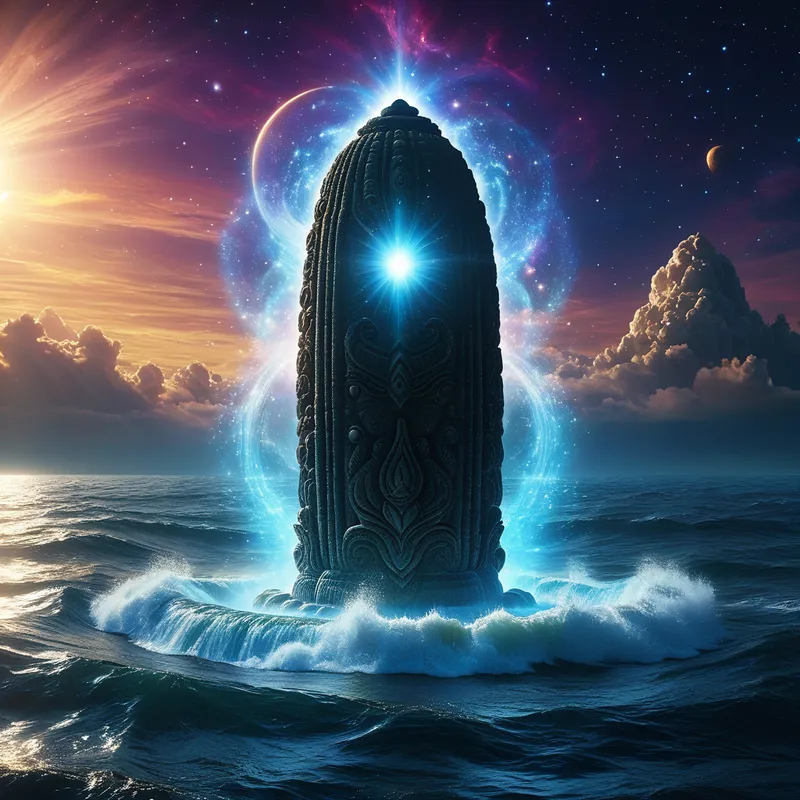
Then, Shiva himself appeared, not as Bhairava, but in his essential form. A silence deeper than [the void](/myths/the-void “Myth from Buddhist culture.”/) fell. To show the sages the true source of all form, the origin they had foolishly believed they could bypass, he began a cosmic dance. And as he danced, he withdrew into his own absolute essence. His form dissolved. In its place, a pillar of fire erupted—a column of brilliant, unbearable light that had no beginning and no end. It pierced upwards through the heavens and downwards through the underworlds, a radiant axis of existence itself.
The creator god Brahma, taking the form of a swan, flew upwards for a thousand years, seeking its summit. The preserver god [Vishnu](/myths/vishnu “Myth from Hindu culture.”/), as a boar, burrowed downwards for a thousand years, seeking its base. Neither could find its limit. Exhausted and humbled, they returned, offering worship to the infinite pillar. From within it, a sound emerged, the primordial syllable AUM. And from that sound, Shiva reappeared, gracious and calm. The sages fell prostrate, their pride incinerated, replaced by awe. The pillar remained, a permanent testament: the [Lingam](/myths/lingam “Myth from Hindu culture.”/), established upon a base, the Yoni, representing the goddess, the necessary vessel for the boundless to manifest.

Cultural Origins & Context
The myth of the Shiva Lingam is not a single, fixed story but a profound motif woven into the fabric of Puranic literature, most notably in the Shiva Purana, Linga Purana, and [Kurma](/myths/kurma “Myth from Hindu culture.”/) Purana. Its transmission is oral and textual, carried by storytellers, temple priests, and wandering ascetics for millennia. Its societal function is multifaceted. On one level, it is an etiological myth, explaining the origin of the primary form of worship for one of Hinduism’s principal deities. It answers [the child](/myths/the-child “Myth from Alchemy culture.”/)‘s question, “Why do we worship a stone pillar?”
On a deeper level, it served as a theological and philosophical corrective. In the ancient forest academies of India, debates between different schools of thought—those emphasizing ritual action ([Karma](/myths/karma “Myth from Hindu culture.”/) Marga), those emphasizing personal devotion (Bhakti Marga), and those emphasizing formless meditation—were vigorous. This myth elegantly synthesizes these paths. It chastises the arrogance of mere ritualism (the sages) while validating the ultimate goal of realizing the formless absolute (the pillar of light), and finally, it presents the solution: the worship of a form (Lingam) that points directly to the formless, a symbol that contains its own negation, making the transcendent accessible to human devotion.
Symbolic Architecture
The Lingam is not a phallic [symbol](/symbols/symbol “Symbol: A symbol can represent an idea, concept, or belief, serving as a powerful tool for communication and understanding.”/) in a reductive sense. It is an aniconic representation—a form that points beyond form. The myth encodes a profound non-dualistic metaphysics.
The Lingam is the axis mundi, the world-pillar, the still point around which the chaos of creation spins. It is consciousness itself, prior to its entanglement in the objects it perceives.
The sages represent [the ego](/myths/the-ego “Myth from Jungian culture.”/)-[consciousness](/symbols/consciousness “Symbol: Consciousness represents the state of awareness and perception, encompassing thoughts, feelings, and experiences.”/), the [aspect](/symbols/aspect “Symbol: A distinct feature, quality, or perspective of something, often representing a partial view of a larger whole.”/) of [psyche](/myths/psyche “Myth from Greek culture.”/) that believes it is the author of its own [reality](/symbols/reality “Symbol: Reality signifies the state of existence and perception, often reflecting one’s understanding of truth and life experiences.”/) through [effort](/symbols/effort “Symbol: Effort signifies the physical, mental, and emotional energy invested toward achieving goals and personal growth.”/), discipline, and will (their rituals). The monstrous creations from their fire are the [shadow](/symbols/shadow “Symbol: The ‘shadow’ embodies the unconscious, repressed aspects of the self and often represents fears or hidden emotions.”/) contents—the rage ([tiger](/symbols/tiger “Symbol: The tiger symbolizes power, courage, and primal instincts, often representing untamed energy and aggression.”/)), poison ([serpent](/symbols/serpent “Symbol: A powerful symbol of transformation, wisdom, and primal energy, often representing hidden knowledge, healing, or temptation.”/)), and ignorant malevolence ([dwarf](/symbols/dwarf “Symbol: A dwarf often represents hidden potential, undervalued wisdom, or primal instincts. It can symbolize something small but powerful or foundational aspects of the self.”/))—that erupt when spiritual practice is divorced from humility and directed by egoic pride. Shiva’s intervention is the irruption of [the Self](/myths/the-self “Myth from Jungian culture.”/), the total [psyche](/myths/psyche “Myth from Greek culture.”/), which integrates these [shadow](/symbols/shadow “Symbol: The ‘shadow’ embodies the unconscious, repressed aspects of the self and often represents fears or hidden emotions.”/) elements (wearing the [skin](/symbols/skin “Symbol: Skin symbolizes the boundary between the self and the world, representing identity, protection, and vulnerability.”/), the serpent) and subdues core ignorance.
The infinite pillar is the ultimate symbol of the transcendent Self, the Brahman in its aspect of pure, unmanifest potential. Brahma and Vishnu’s futile search signifies that the origins and limits of consciousness cannot be found by traveling [outward](/symbols/outward “Symbol: Movement or orientation away from the self or center; expansion, expression, or externalization of inner states into the world.”/) into manifestation or [inward](/symbols/inward “Symbol: A journey toward self-awareness, introspection, and the exploration of one’s inner world, thoughts, and unconscious mind.”/) into [regression](/symbols/regression “Symbol: A psychological or spiritual return to earlier states of being, often involving revisiting past patterns, memories, or developmental stages for insight or healing.”/); it is the very ground of being. The final form—the Lingam settled in the Yoni—is the sacred [marriage](/symbols/marriage “Symbol: Marriage symbolizes commitment, partnership, and the merging of two identities, often reflecting one’s feelings about relationships and social obligations.”/) of [Purusha](/myths/purusha “Myth from Hindu culture.”/) and Prakriti. It symbolizes that absolute consciousness (Lingam) is inseparable from the creative [energy](/symbols/energy “Symbol: Energy symbolizes vitality, motivation, and the drive that fuels actions and ambitions.”/) of the [universe](/symbols/universe “Symbol: The universe symbolizes vastness, interconnectedness, and the mysteries of existence beyond the individual self.”/) (Yoni); the transcendent is always and already immanent.
The Dreamer’s Resonance
When this myth pattern stirs in the modern dreamer, it often signals a profound crisis of meaning and a confrontation with spiritual or psychological hubris. To dream of a raging, out-of-control fire you have built may reflect a realization that your driven ambitions or rigid self-improvement rituals are generating destructive anxiety and internal monsters. The appearance of a terrifying, yet awe-inspiring, figure like Bhairava can symbolize the necessary, fierce grace of the psyche that must dismantle a fragile ego-structure.
The core dream image of the pillar of light—or its modern equivalents: an endless skyscraper, a brilliant beam through the ceiling, an infinite tree—manifests as a somatic experience of vertigo and expansion. The dreamer may feel simultaneously infinitesimally small and cosmically connected. This is the Self announcing its presence, breaking the dreamer’s identification with their limited, “sage-like” personal identity. It is often followed by a deep, post-dream calm, a sense of having touched something eternal that puts daily struggles into a vast, peaceful perspective.
Alchemical Translation
The psychic transmutation modeled here is the alchemy of humiliation into humility, leading to the unio mentalis, [the sacred marriage](/myths/the-sacred-marriage “Myth from Various culture.”/) within the psyche. The modern individual’s journey often begins like the sages: we build our identities through effort, achievement, and controlled practices (career, therapy, fitness regimes). We mistake this constructed self for the true Self. The ensuing crisis—burnout, depression, a feeling of emptiness despite success—is the “monsters from the fire.”
The individuation process requires the death of the ego’s claim to sovereignty. One must be humbled by an encounter with something infinitely greater than one’s personal narrative.
The lesson is not to abandon discipline, but to redirect it. The ritual fire must be kindled not for the ego’s glory, but as an offering to the transcendent. Psychologically, this means engaging in practices—whether meditation, art, or deep relationship—with an attitude of surrender, as a means of connecting with the inner axis, the Lingam of consciousness.
The ultimate alchemical goal is symbolized by the established Lingam-Yoni. It is the stable, centered state where one’s conscious life (the manifested world) is recognized as the inseparable play of the eternal, formless consciousness within. The individual no longer seeks the source “up there” or “down deep” in a linear way, but realizes they are, and always have been, a unique point of manifestation upon that infinite pillar. The struggle for self-creation dissolves into the grace of participation in a creativity that is both profoundly personal and utterly universal.
Associated Symbols
Explore related symbols from the CaleaDream lexicon: