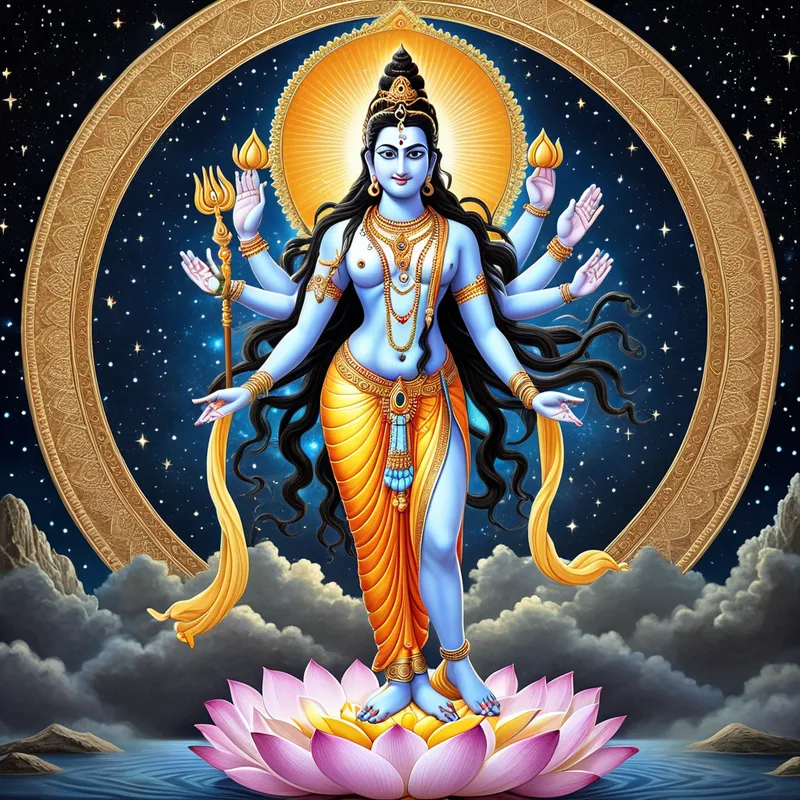
Shiva as Ardhanarishvara Myth Meaning & Symbolism
A myth of divine androgyny where Shiva and Shakti unite as one being, symbolizing the ultimate reconciliation of all dualities within consciousness.
The Tale of Shiva as Ardhanarishvara
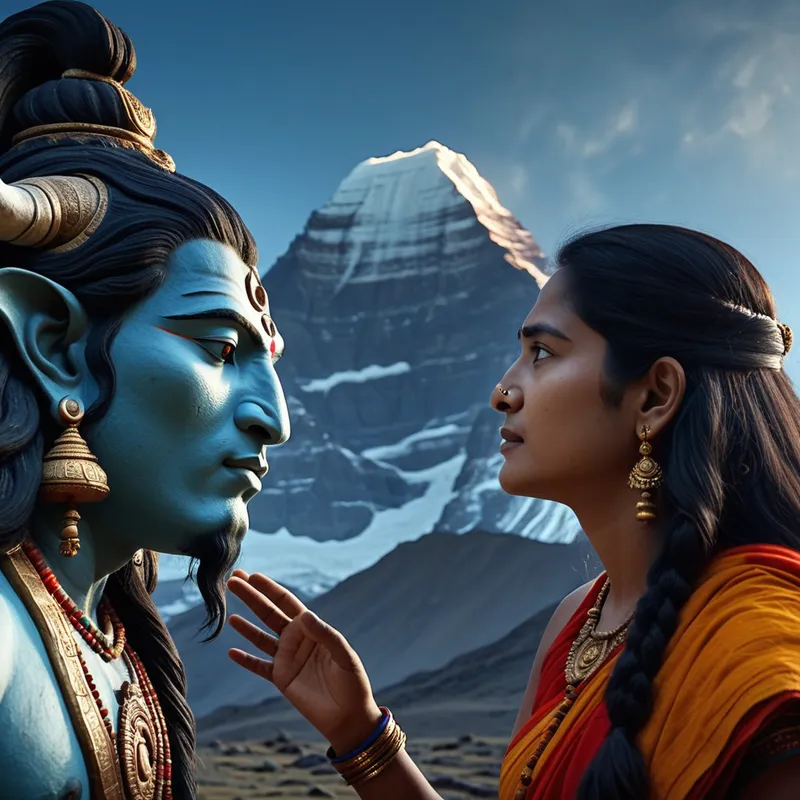
Listen. In the high, silent fastness where the air is thin and time slows to a trickle, there stands a mountain. This is [Mount Kailash](/myths/mount-kailash “Myth from Hindu culture.”/), a pillar of [the world](/myths/the-world “Myth from Tarot culture.”/), its peaks sheathed in eternal snow and its roots sunk deep into the bones of [the earth](/myths/the-earth “Myth from Hindu culture.”/). Here dwells [Shiva](/myths/shiva “Myth from Hindu culture.”/), the Lord of Ascetics, his body pale as [moonstone](/myths/moonstone “Myth from Various culture.”/), smeared with the ash of burned-out universes. His matted locks cradle the crescent moon and the raging, sacred [Ganga](/myths/ganga “Myth from Hindu culture.”/). His [third eye](/myths/third-eye “Myth from Hindu culture.”/), a sealed furnace of world-ending fire, remains closed in meditation. By his side is Parvati, daughter of the mountain king. Where he is stillness, she is the pulse of life. Where he is [the void](/myths/the-void “Myth from Buddhist culture.”/), she is the fullness of form. Her grace is the vine that climbs the stark cliff; her love is [the hearth](/myths/the-hearth “Myth from Norse culture.”/)-fire in the cosmic cold.
For ages, they dwelt thus, two perfect complements, yet forever two. Shiva, in his boundless, detached consciousness, encompassed all, yet remained aloof, a dancer observing his own dance from a great height. Parvati, the very heart of the manifest world, felt a subtle sorrow. To be beside him was bliss, yet a chasm remained—the chasm between the witness and the experienced, between pure consciousness and the vibrant tapestry of creation. “How can I truly be one with you,” she once implored, her voice like the murmur of a sacred stream, “when you hold the entire universe within, yet I remain outside, a separate devotee at your feet?”
The sages and gods, who often gathered to partake of their divine presence, saw only the perfect couple. They praised Shiva’s transcendent power and Parvati’s devoted beauty, never grasping the silent yearning that echoed in the mountain halls. Parvati’s plea hung in the air, a vibration too profound for words. Shiva, the Mahayogi, heard it not with his ears, but in the very fabric of his being. It was a call from the other half of his own soul, a reminder that transcendence, without immanence, is incomplete.
He did not answer with words. In a moment that stretched across eternity, a profound intention blossomed within his infinite awareness. It was not an act of creation, but of revelation. A soft, golden light began to emanate from his form, not from without, but from the very core where Parvati resided in his heart. The light did not surround him; it reconfigured him. There was no sound, yet the cosmos felt a shudder of realignment.
Before the astonished gaze of Parvati and all celestial onlookers, the form of Shiva began to shift. From the midline of his body, a transformation unfolded, seamless and absolute. His left side softened, curves emerging where there were angles, the ash-gray skin warming to a luminous gold. Silken garments appeared, draping the newly formed limb, jewels glittering at the wrist and ankle. The matted locks on that side smoothed into flowing, dark tresses adorned with flowers. It was Parvati—not beside him, but as him. The right side remained unmistakably Shiva: [the ascetic](/myths/the-ascetic “Myth from Christian culture.”/)‘s bare chest, the serpents as adornments, the posture of eternal calm.
Where two stood, now there was one. A single being, perfectly bifurcated yet utterly unified. Male and female. Ascetic and householder. Destroyer and creator. Transcendent stillness and dynamic power. This was Ardhanarishvara, “The Lord Who Is Half Woman.” The divine couple did not embrace; they had become the embrace itself. The argument was not settled by compromise, but dissolved in a truth so fundamental it rendered the conflict obsolete. In that form, they stood—a complete circle, a resolved paradox, the living icon of non-duality. The universe, for a breath, knew perfect equilibrium.
Cultural Origins & Context
The myth of Ardhanarishvara finds its roots in the ancient theological and philosophical currents of Hinduism that grappled with the nature of ultimate reality. Its earliest textual references appear in the Vedas and are elaborated upon in the later Puranas, such as the Shiva Purana and the Skanda Purana. This was not merely a story told for entertainment; it was a metaphysical argument rendered in narrative form, emerging from a culture deeply engaged with concepts of Brahman (the absolute) and its manifestations.
The myth functioned on multiple societal levels. For temple sculptors and artists, it was a supreme artistic and theological challenge—to carve unity from stone, to paint wholeness onto a wall. In philosophical discourse, it served as a potent visual aid for non-dual (Advaita) thought, illustrating that the masculine principle ([Purusha](/myths/purusha “Myth from Hindu culture.”/)) and the feminine principle (Prakriti) are not competing forces but inseparable aspects of the one divine substance. Socially, while interpreted in various ways across history, the image presented a profound model of gender complementarity at a cosmic level, suggesting that completeness itself is androgynous.
Symbolic Architecture
Ardhanarishvara is the ultimate [symbol](/symbols/symbol “Symbol: A symbol can represent an idea, concept, or belief, serving as a powerful tool for communication and understanding.”/) of reconciled opposites. It is not a hybrid or a [mixture](/symbols/mixture “Symbol: A mixture in dreams represents integration, blending of ideas, or conflicts between differing aspects of the self.”/), but a perfect [integration](/symbols/integration “Symbol: The process of unifying disparate parts of the self or experience into a cohesive whole, often representing psychological wholeness or resolution of internal conflict.”/) where each half retains its essential [nature](/symbols/nature “Symbol: Nature symbolizes growth, connectivity, and the primal forces of existence.”/) while being inextricably fused with its counterpart.
The true Self is not male or female, but the sacred space where both cease to be opposites and become necessary poles of a single, vibrant existence.
Psychologically, this represents the [movement](/symbols/movement “Symbol: Movement symbolizes change, progress, and the dynamics of personal growth, reflecting an individual’s desire or need to transform their circumstances.”/) from a fragmented ego-state to the wholeness of [the Self](/myths/the-self “Myth from Jungian culture.”/). The “[argument](/symbols/argument “Symbol: An argument symbolizes conflict, communication breakdown, and feelings of frustration or misunderstanding.”/)” between [Shiva and Parvati](/myths/shiva-and-parvati “Myth from Hindu culture.”/) mirrors the internal conflict between our transcendent aspirations (the spiritual drive to detach, to understand, to be free) and our immanent yearnings (the [human](/symbols/human “Symbol: The symbol of a human represents individuality, complexity of emotions, and social relationships.”/) need to connect, to feel, to create and belong). We often [exile](/symbols/exile “Symbol: Forced separation from one’s homeland or community, representing loss of belonging, punishment, or profound isolation.”/) one in [favor](/symbols/favor “Symbol: ‘Favor’ represents the themes of acceptance, goodwill, and the desire for approval from others.”/) of the other, becoming cold ascetics in our pursuits or losing ourselves in worldly attachments. Ardhanarishvara declares this war unnecessary. The right side (Shiva) symbolizes [consciousness](/symbols/consciousness “Symbol: Consciousness represents the state of awareness and perception, encompassing thoughts, feelings, and experiences.”/), [structure](/symbols/structure “Symbol: Structure in dreams often symbolizes stability, organization, and the framework of one’s life, reflecting how one perceives their environment and personal life.”/), order, and the penetrating [insight](/symbols/insight “Symbol: A sudden, deep understanding of a complex situation or truth, often arriving unexpectedly and illuminating hidden connections.”/) of the mind. The left side (Parvati) represents the unconscious, [emotion](/symbols/emotion “Symbol: Emotion symbolizes our inner feelings and responses to experiences, often guiding our actions and choices.”/), [chaos](/symbols/chaos “Symbol: In Arts & Music, chaos represents raw creative potential, uncontrolled expression, and the breakdown of order to forge new artistic forms.”/), creativity, and the nurturing wisdom of the [body](/symbols/body “Symbol: The body in dreams often symbolizes the dreamer’s self-identity, personal health, and the relationship they have with their physical existence.”/). Wholeness is the conscious [marriage](/symbols/marriage “Symbol: Marriage symbolizes commitment, partnership, and the merging of two identities, often reflecting one’s feelings about relationships and social obligations.”/) of mind and [body](/symbols/body “Symbol: The body in dreams often symbolizes the dreamer’s self-identity, personal health, and the relationship they have with their physical existence.”/), order and [chaos](/symbols/chaos “Symbol: In Arts & Music, chaos represents raw creative potential, uncontrolled expression, and the breakdown of order to forge new artistic forms.”/), [logic](/symbols/logic “Symbol: The principle of reasoning and rational thought, often representing order, structure, and intellectual clarity in dreams.”/) and [intuition](/symbols/intuition “Symbol: The immediate, non-rational understanding of truth or insight, often described as a ‘gut feeling’ or inner knowing that bypasses conscious reasoning.”/).
The unified deity also symbolizes the [dissolution](/symbols/dissolution “Symbol: The process of breaking down, dispersing, or losing form, often representing transformation, release, or the end of a state of being.”/) of all foundational dualities: subject and object, self and other, [eternity](/symbols/eternity “Symbol: The infinite, timeless state beyond human life and measurement, often representing the ultimate or divine.”/) and time. To encounter this [archetype](/symbols/archetype “Symbol: A universal, primordial pattern or prototype in the collective unconscious that shapes human experience, behavior, and creative expression.”/) is to be shown that every perceived opposite is, in its deepest ground, a complementary part of a hidden unity.
The Dreamer’s Resonance
When the Ardhanarishvara pattern stirs in the modern dreamer’s [psyche](/myths/psyche “Myth from Greek culture.”/), it often signals a critical juncture in the process of psychological integration. One does not typically dream of the deity directly, but of its symbolic equivalents.
You may dream of a house perfectly split between stark, minimalist rooms and wildly overgrown, organic spaces, feeling a compulsion to open the door between them. You may see yourself in a mirror, but your reflection shows a different gender, or a fusion of traits you consider masculine and feminine, not with horror, but with a sense of eerie familiarity. There may be a recurring motif of two powerful figures—a stern authority and a passionate lover, a logical scientist and an intuitive artist—who are revealed to be the same person. These dreams carry a somatic signature: a feeling of tension at the body’s midline, a sense of being pulled in two directions, culminating in a release or a vision of a merging point.
This is the psyche working to heal its own fractures. The dream is not about literal gender, but about reconciling internalized opposites that have been split apart by culture, trauma, or personal adaptation. The rising action of the myth—the tension, the plea—is felt as anxiety or dissatisfaction. The resolution—the miraculous fusion—manifests as a dream image of profound peace, balance, or creative synthesis, pointing [the way](/myths/the-way “Myth from Taoist culture.”/) toward a more authentic, undivided way of being.

Alchemical Translation
The alchemical journey mirrored in this myth is the conjunctio oppositorum—[the sacred marriage](/myths/the-sacred-marriage “Myth from Various culture.”/) of opposites that produces the gold of the integrated personality. For the modern individual, the path of Ardhanarishvara is the path of individuation.
[The first stage](/myths/the-first-stage “Myth from Alchemical culture.”/) is the recognition of the “divine couple” within: acknowledging the two dominant, often opposing, forces in one’s life. Perhaps it is the driven professional versus the nurturing parent, the rational skeptic versus the mystical seeker, the need for independence versus the longing for deep union. Like Parvati, one part feels excluded, yearning for integration with the other’s seemingly aloof power.
The alchemical fire is not willpower, but the heat of conscious attention turned equally upon both sides of one’s nature without judgment.
The transmutation occurs not by one side conquering the other, nor by a bland compromise, but through a radical act of inner hospitality. It requires the Shiva-like consciousness to descend from its detached mountain and fully embrace the Parvati-like reality of emotion, relationship, and embodiment. Conversely, it asks the Parvati-like energy to comprehend and honor the Shiva-like need for solitude, boundaries, and transcendent perspective. This is the “argument” that leads not to a winner, but to a revelation.
The resulting “Ardhanarishvara state” is the hallmark of psychological maturity. It is the ability to hold tension without collapsing into one pole. It is the creative who has mastered discipline, the leader who leads with compassion, the scientist filled with wonder, the individual who is both fully autonomous and capable of deep communion. One becomes a vessel for a more complete consciousness, where every action and creation arises from the synergy of all one’s parts. The myth teaches that our ultimate spiritual and psychological task is not to choose between the mountain and the valley, but to become the very range that contains them both.
Associated Symbols
Explore related symbols from the CaleaDream lexicon: