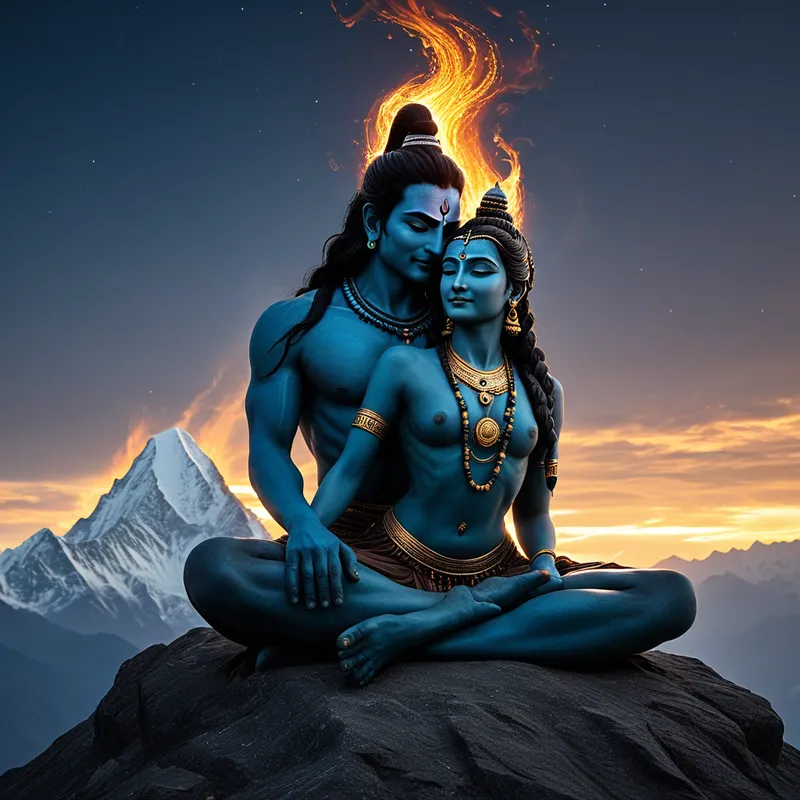
Shiva and Shakti Myth Meaning & Symbolism
The cosmic dance of consciousness and energy, where stillness and motion unite to birth and dissolve all reality.
The Tale of Shiva and Shakti
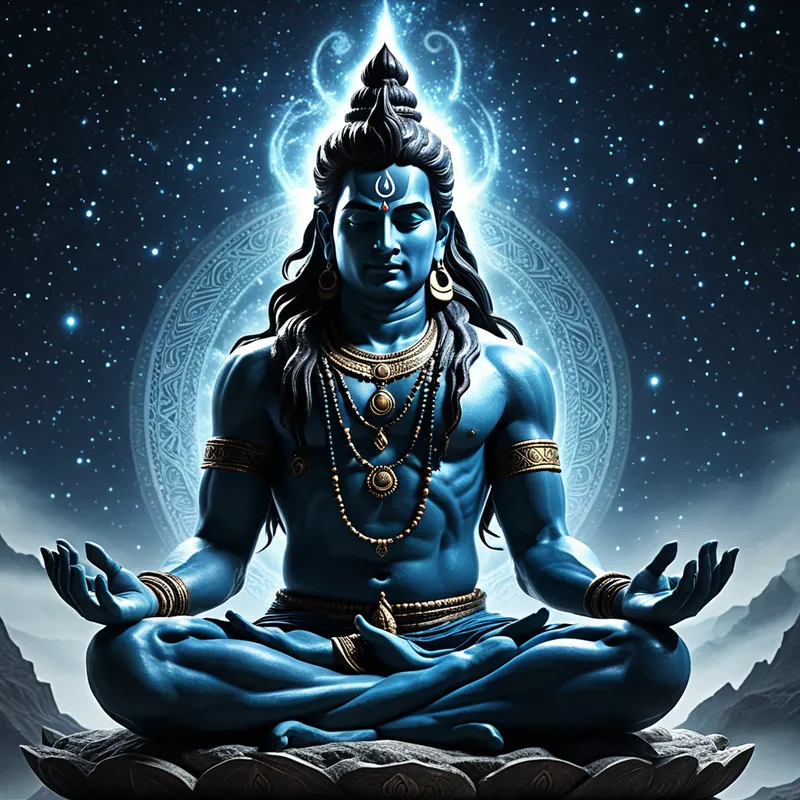
In the beginning, before time was measured, there was only the great silence. In the highest reaches of the Himalayas, where the air is thin and the stars burn cold, sat Shiva. He was not asleep, nor was he awake. He was absorbed, a statue of pure consciousness, his eyes closed upon an inner infinity. His body was smeared with the ash of burned universes; a crescent moon, cool and detached, rested in his matted locks. Around him, the cosmos turned, galaxies were born and died, but within him, there was only the profound, unmoving void. He was the still center, the axis of the wheel that does not turn.
But a wheel cannot turn without its rim. And so, from the longing of that very stillness, a presence began to stir. It was a warmth at the edge of the infinite cold, a whisper in the absolute quiet. She was Shakti, the primal pulse. She took form as Parvati, daughter of the mountain king, her beauty the very essence of life’s yearning. She approached the silent god, her heart a drumbeat against the silence. She brought him flowers, sang songs of creation, danced the dance of the seasons at his feet. But Shiva did not stir. He remained the perfect ascetic, the Mahayogi, untouched by the world of form and feeling.
Parvati’s grief was a tide that could drown worlds. Yet, her love was not a plea but a power. She resolved to match his austerity, to become stillness itself to win the lord of stillness. She withdrew to the forest, discarding her royal silks for bark, fasting, meditating, becoming an ascetic equal to him. The heat of her tapas shook the heavens. The gods, fearing the balance of the world was undone, sent Kama</ab- br> to awaken Shiva with his flower-tipped arrows. Kama’s arrow struck, and for a fleeting moment, Shiva’s eye opened. A single glance, a beam of pure fire from his third eye, and Kama was reduced to ashes. But the seal was broken.
Moved not by desire, but by recognition—by the sight of his own absolute austerity mirrored in another—Shiva finally arose. He looked upon Parvati, no longer as a distraction, but as his own lost half, the very power of his consciousness seeking expression. In that moment of mutual recognition, the cosmic dichotomy dissolved. The unmoving mover embraced the dynamic force. Their union was not a meeting, but a remembering. From their ecstatic dance, the Tandava, all rhythms of existence emerged: the beating heart, the orbiting planet, the cycle of birth and death. He was the silence; she was the song. Together, they were the symphony.
Cultural Origins & Context
This myth is the bedrock of the Tantric worldview, which emerged around the middle of the first millennium CE, weaving itself through Hinduism, Buddhism, and Jainism. Unlike orthodox paths that often saw the material world as an illusion to transcend, Tantra sought to realize the divine within the world, through the body, the senses, and the union of opposites. The story of Shiva and Shakti was not merely a theological account but a living, experiential map passed down from guru</ab- br> to disciple through oral tradition, ritual, and meditative visualization.
It functioned as a societal and psychological blueprint. In a culture with strong ascetic ideals, it validated the householder’s path, showing that spiritual realization could bloom in the embrace of relationship and worldly life. The myth was enacted in temple rituals, where the deity was always worshipped as a coupled unity (Ardhanarishvara, the half-male, half-female form, is a direct icon of this), and encoded in sophisticated philosophical systems like Kashmir Shaivism. Here, Shakti is not separate from Shiva but his active, expressive power—Vimarsha to his Prakasha. The story served to dissolve hierarchy, teaching that without energy, consciousness is inert; without consciousness, energy is blind chaos.
Symbolic Architecture
At its heart, this is a myth of non-duality. Shiva represents pure, undifferentiated consciousness—the witness, the space in which phenomena appear. Shakti represents the dynamic energy that manifests as all phenomena—thought, emotion, matter, and time itself.
The deepest truth is not Shiva and Shakti, but Shiva as Shakti. Stillness is not the absence of motion, but its source and substance.
Psychologically, Shiva maps to the transcendent Self, the still, observing center of the psyche that remains untouched by the dramas of the ego. Shakti is the libido, the life force, the swirling contents of the unconscious with all its creative and destructive potentials. The initial separation—Shiva’s deep meditation and Parvati’s yearning—symbolizes a psyche out of balance: the dissociated intellect severed from feeling, or the chaotic emotions untethered from conscious awareness.
The burning of Kama by Shiva’s third eye is a pivotal symbol. It is not the destruction of love, but the incineration of possessive, objectifying desire. It clears the way for a union based on sacred recognition, not need. Parvati’s asceticism signifies the necessary discipline (sadhana) to refine raw energy into a force capable of meeting pure consciousness as an equal.
The Dreamer's Resonance
When this myth stirs in the modern dreamscape, it often manifests as a profound somatic tension between opposing states. One might dream of being paralyzed in a raging storm, or of frantically searching for a lost, utterly still object in a chaotic city. These are dreams of the Shiva-Shakti split.
To dream of a merging of two distinct beings into one light, or of a dance that creates harmonious patterns from chaos, signals the beginning of integration. The psyche is attempting to marry its own opposites: logic and intuition, action and reflection, solitude and relationship. The somatic experience can be a palpable feeling of tension resolving into flow, or a vibrational hum as if the very cells are realigning. It is the dream-body processing the reconciliation of the drive to transcend with the drive to fully inhabit one’s life.
Alchemical Translation
The individuation process, the journey toward psychic wholeness, is perfectly modeled by this myth. We all contain an inner Shiva—a part that seeks detachment, understanding, and peace—and an inner Shakti—a part that craves expression, relationship, and creative ferment. The modern neurosis often lies in privileging one and repressing the other: the workaholic driven by relentless Shakti with no still center, or the spiritually bypassing seeker using Shiva-like detachment to avoid life’s messy engagements.
Individuation is the sacred marriage within. It is the moment your awareness becomes the serene witness to your own passionate existence, without judgment or flight.
The alchemical process begins with recognizing the separation. One must honor the Shiva phase: cultivating mindful stillness, learning to be the witness to one’s own mental and emotional chaos. Simultaneously, one must honor the Shakti phase: courageously engaging with the world, expressing creativity, and embracing the full spectrum of feeling. The “burning of Kama” is the crucial, often painful, stage of letting go of egoic attachments—the desire for specific outcomes, for validation, for the other to complete us—that block true union.
The final transmutation is not a static state but a dynamic dance. It is the ability to be fully engaged in life (Shakti) while resting in a deep, inner calm (Shiva). The integrated individual creates, loves, and works not from lack, but from the overflowing joy of their own realized unity. They become the Ardhanarishvara, a living testament that wholeness is found not in choosing a side, but in embodying the sacred circle where all opposites are held as essential notes in the single chord of being.
Associated Symbols
Explore related symbols from the CaleaDream lexicon: