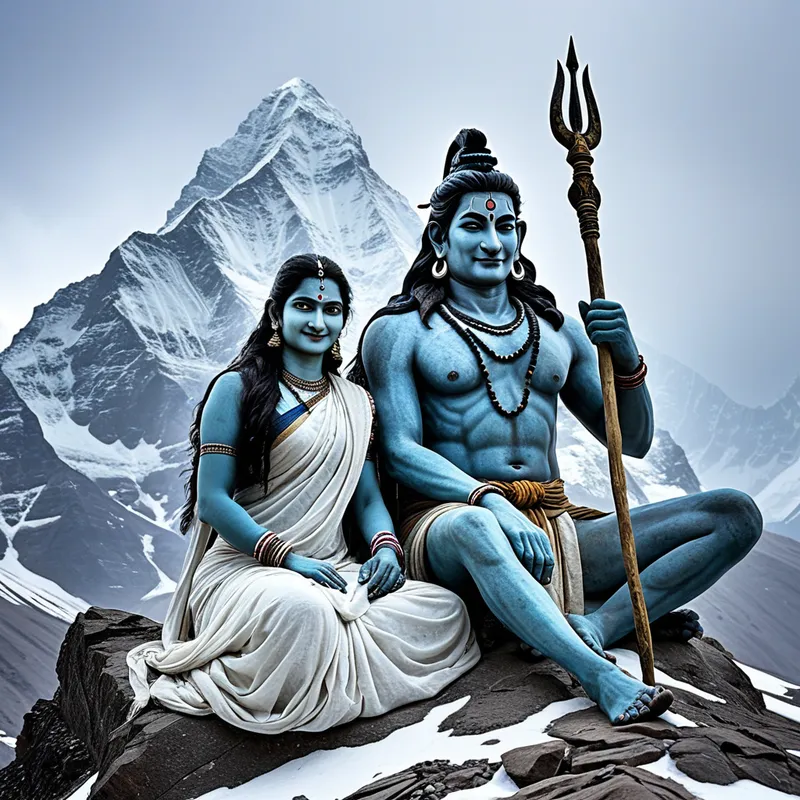
Shiva and Parvati Myth Meaning & Symbolism
The myth of the ascetic god Shiva and his devoted consort Parvati, a story of cosmic union, fierce tapas, and the alchemical birth of consciousness.
The Tale of Shiva and Parvati
In the high, silent fastness where the world begins, where rock meets sky and breath turns to ice, there was a loneliness older than time. It was the loneliness of Shiva, the Lord of Tandava. He sat on the peak of Mount Kailash, his body smeared with the ashes of burnt universes, his matted locks coiled like serpents holding the crescent moon and the raging Ganga. His eyes were closed, turned inward upon the infinite void. He was the unmoved mover, the still point of the turning world, absorbed in samadhi. The cosmos pulsed around his silence, but he was apart, complete in his terrible solitude.
But the cosmos cannot bear such perfect stillness for long. The gods trembled. For from the seed of Shiva’s withdrawn energy, a demon, Taraka, had arisen, one who could only be slain by a son of Shiva. Yet Shiva was lost to the world, a yogi wedded only to the absolute. Despair spread like a chill wind.
Then, from the heart of the Himalayan mountains themselves, a new warmth was born. She was Parvati, daughter of the mountain king Himavan. She was not born of whim, but of will—the re-embodiment of Sati, whose love for Shiva had once ended in fire. Parvati knew her destiny in her bones. She saw the austere god on his icy throne and felt not fear, but a recognition that shook the very roots of her soul. Her love was not a gentle sigh, but a tectonic certainty.
She approached the solitary ascetic, offering flowers, speaking of devotion. Shiva did not stir. His eyes remained shut, his awareness untouched by the fragrance of blossoms or the sound of a maiden’s voice. The world saw a beautiful princess being ignored by an ash-covered hermit. Parvati saw the ultimate challenge: to awaken the conscious universe from its own dream.
So, she turned away from the palace and walked into the forest. She cast off her silks and donned the bark of trees. She became an ascetic equal to the ascetic. She performed tapas so fierce that her form glowed like a contained sun. She stood on one leg for millennia, chanting his name, her devotion burning through the layers of cosmic illusion. The seasons swirled around her unheeded; her focus was a spear aimed at the heart of divine indifference. The heat of her tapas shook the heavens and finally, it stirred the depths of Shiva’s samadhi.
He opened his eyes. And in that opening, the universe changed. He saw not a supplicant, but a force. Not a petitioner, but a principle. Her tapas was the equal and opposite pole to his stillness. Sent by the gods, the love-god Kama had once tried to pierce Shiva with a flower-arrow, and had been reduced to ashes by a glance from Shiva’s third eye. But Parvati needed no external arrows. Her love itself was the arrow, forged in the fire of her own will.
Shiva, the destroyer, was conquered. Not by force, but by the irresistible power of a devotion that had become identical to his own consciousness. He arose. He approached her, the ice of his isolation melting in the radiance of her earned grace. The marriage of Shiva and Parvati was not a simple union. It was the collision of two cosmic principles—pure consciousness (Purusha) and dynamic creative energy (Prakriti)—recognizing themselves as one. From their union was born Ganesha, the lord of thresholds, and Kartikeya, the slayer of the demon Taraka. The world was set back into balance, not by conquest, but by union.

Cultural Origins & Context
The myth of Shiva and Parvati is woven into the very fabric of Shaiva and Shakta traditions, finding its earliest roots in the epics like the Mahabharata and flourishing in the medieval Puranas, particularly the Shiva Purana and the Devi Bhagavata Purana. It was never a single, fixed tale, but a living narrative performed by bards, elaborated upon by poets like Kalidasa in his sublime Kumarasambhava, and enacted in temple rituals and village festivals.
Societally, the myth functioned on multiple levels. It provided a divine model for marriage, not as a social contract but as a spiritual partnership of equals, where devotion (bhakti) and discipline (jnana) intersect. It also validated the path of asceticism while simultaneously grounding it in the creative power of the world. For the common devotee, Parvati’s success offered a profound hope: that through unwavering dedication, even the most distant, absolute divinity could be approached, touched, and transformed into a benevolent, present force in one’s life. The myth was a map showing that the journey to the transcendent (Shiva) goes through the fierce, transformative fire of immanent will (Parvati’s tapas).
Symbolic Architecture
At its core, this is not merely a love story. It is a precise allegory for the structure of reality and the dynamics of the human psyche.
Shiva represents pure, undifferentiated consciousness—the silent witness, the awareness behind all thought and form. He is the archetypal ascetic because he has withdrawn all projections from the world to abide in the source.
Parvati represents Shakti—the dynamic, manifesting energy of that consciousness. She is the world, desire, action, and the fierce will to become. She is not separate from Shiva, but his own creative power personified.
Their separation is the primal state of the unenlightened individual: spirit alienated from matter, consciousness feeling trapped in and repelled by the world of form and desire. Shiva’s initial rejection of Parvati symbolizes the spiritual seeker’s rejection of earthly life, mistakenly believing transcendence requires negation of the world. Parvati’s tapas is the critical turning point.
Her austerities symbolize the alchemical process of refining raw, personal desire (for the beloved) into a impersonal, cosmic will. She does not beg; she generates so much spiritual heat that the universe must reconfigure itself to accommodate her.
Her success demonstrates that the world (Shakti) is not the obstacle to consciousness (Shiva), but its necessary complement and the very path to its full realization. Their union, often depicted as the androgynous Ardhanarishvara, represents the ultimate psychic integration: the marriage of masculine and feminine, transcendence and immanence, stillness and movement within a single being.
The Dreamer’s Resonance
When this mythic pattern stirs in the modern dreamer, it often signals a profound interior process of reconciliation. To dream of an immovable, distant, or icy figure (a Shiva-image) alongside a persistent, fiery, or devoted presence (a Parvati-image) suggests a critical phase in one’s individuation.
Somatically, this may manifest as a tension between a desire for absolute withdrawal (fatigue, dissociation, a feeling of being “frozen” or “ash-like”) and a powerful, almost volcanic surge of creative or emotional energy that feels disruptive. The psyche is staging the conflict between a part that wants to renounce complex life for a simple, detached peace, and a part that is fiercely committed to engagement, creation, and relationship.
The dreamer undergoing this is at the cusp of a great inner marriage. The Parvati-energy is not trying to destroy the Shiva-energy, but to awaken it to its own completeness. The psychological process is one of earning a relationship with one’s own deepest, most transcendent self through disciplined commitment, not through passive longing. It is the dream of the ego (Parvati) performing the tapas required to attract and unite with the Self (Shiva).
Alchemical Translation
For the modern individual, the myth models the alchemical conjunctio oppositorum—the sacred marriage of opposites that births the integrated Self. Our spiritual and psychological development often begins with a “Shiva-phase”: a withdrawal, a deconstruction of old identities, a taste of silent awareness through meditation or crisis. This is necessary, but incomplete. It can lead to spiritual bypassing—using transcendence to avoid the messy work of incarnation.
The Parvati-phase is the heroic, often painful return to the forge of life. It is the decision to take that silent awareness and apply it with fierce devotion to a craft, a relationship, a healing, or a creative act. It is the tapas of showing up, of practicing integrity, of loving something or someone with unwavering focus.
The demon Taraka that must be slain is any aspect of life that arises from unconscious, unintegrated power—be it addiction, a toxic pattern, or a monolithic obstacle. The myth says this demon can only be slain by the “son” of this inner union: the new consciousness (Ganesha) and the capacity for skillful action (Kartikeya) born from the marriage of our deepest awareness and our committed will.
Thus, the alchemy is clear: we do not find wholeness by rejecting the world for spirit, nor by losing ourselves in the world without spirit. We achieve it by making our engagement with the world itself a form of tapas so pure and focused that it awakens the spirit within it. We must become the devoted ascetic and the responsive divinity within one psyche. In doing so, we build our own inner Mount Kailash, where consciousness and creativity sit in eternal, fruitful union.
Associated Symbols
Explore related symbols from the CaleaDream lexicon: