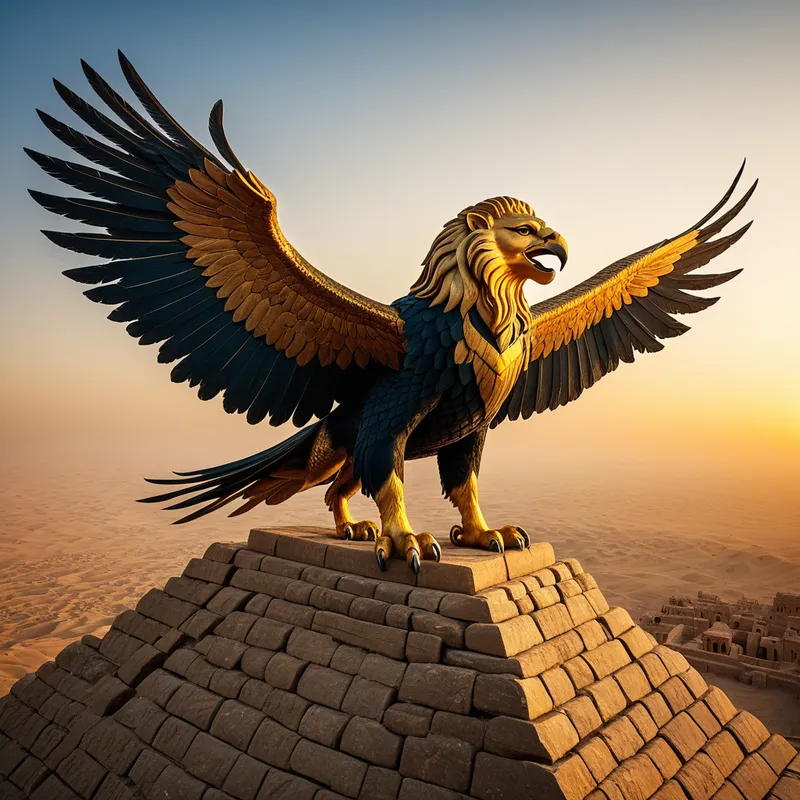
Shirdal Myth Meaning & Symbolism
A majestic, mythical beast of Persia, the Shirdal embodies the sacred union of lion and eagle, guarding treasures and symbolizing the integration of opposing forces.
The Tale of Shirdal
Listen, and let the winds from the Persian plateau carry you back. Before empires of stone, in the time when [the world](/myths/the-world “Myth from Tarot culture.”/)’s bones were still soft with myth, there existed a creature of such majesty that the sun paused to admire its shadow. This was the Shirdal.
Its domain was the liminal space—the mountain pass where eagles dared not fly, the hidden valley where lions feared to tread. From the loins of [the earth](/myths/the-earth “Myth from Hindu culture.”/), it took the body of the lion, king of the beasts, muscles coiled like river stones, fur the color of ripe wheat and desert gold. From the vault of [the sky](/myths/the-sky “Myth from Persian culture.”/), it took the head and wings of the eagle, sovereign of the air, with eyes that were chips of polished obsidian, seeing truth and falsehood from a league away. Its talons could cleave rock; its roar could silence [the wind](/myths/the-wind “Myth from Various culture.”/).
The Shirdal was no mere beast. It was a appointed guardian, a yazata of [the threshold](/myths/the-threshold “Myth from Folklore culture.”/). Its charge was not a hoard of glittering gems, but something far more precious: the sacred boundary between the known and the unknown, the ordered world of asha and the chaotic whispers of [the void](/myths/the-void “Myth from Buddhist culture.”/). It perched upon ziggurats that scraped the belly of the clouds, or slept in the heart of forgotten mountains, its breath the only wind in silent caverns.
To encounter the Shirdal was to face the ultimate test. The foolish hero, armed with greed and a shining sword, would see only a monster to be slain, a gate to be forced. For them, the Shirdal was destruction—a cyclone of feather and claw, a beak that could pierce armor as if it were linen. But the wise seeker, the one who approached with respect and a heart aligned with asha, would find not a barrier, but a guide. The creature’s terrifying visage would soften; its wings would become a bridge, its roar a map written in thunder. It would reveal the path, not by moving aside, but by showing the seeker how to integrate the very forces it embodied—the grounded power of the lion with the transcendent vision of the eagle.
Thus, the Shirdal endured, not in a single tale of slaying, but in a thousand whispers: the guardian who is also the gateway, the terror that is also the teacher, forever watching where earth yearns for sky.
Cultural Origins & Context
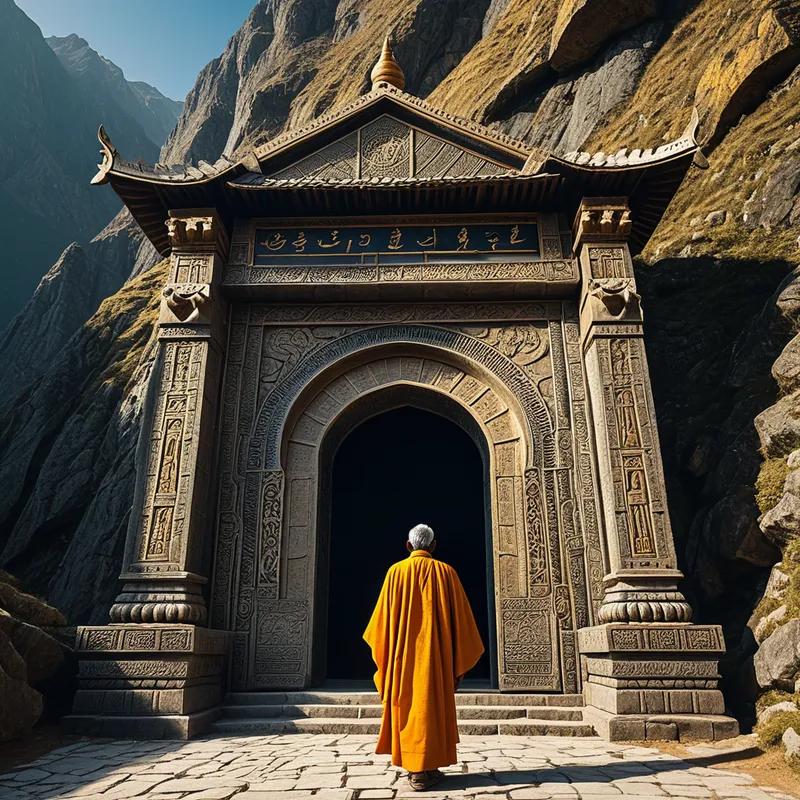
The Shirdal is a primordial image woven into the fabric of Persian culture long before the advent of written epics. Its earliest depictions are not in manuscripts, but in the silent language of artifact and architecture. We find it etched into chlorite vessels from Jiroft, stamped onto seals from Susa, and later, standing as colossal stone sentinels at [Persepolis](/myths/persepolis “Myth from Persian culture.”/), guarding the apadana of kings.
This was not merely decorative. In the Zoroastrian-informed worldview that shaped Persian thought, the cosmos is a battleground between order (asha) and chaos (druj). The Shirdal functioned as a yazata-like embodiment of protective, sovereign power. It was the guardian of royal authority (the lion’s earthly dominion) and divine favor (the eagle’s celestial connection). It protected not just physical treasures, but the spiritual and political integrity of the realm from corruption and invasion.
Passed down through artisans, storytellers, and the very stones of empire, the Shirdal served a profound societal function: it visualized the ideal of integrated strength. It taught that true power is not brute force (lion alone) nor detached observation (eagle alone), but the sacred synthesis of both. It was a symbol of the king’s duty—to be fiercely grounded in the protection of his people while possessing the far-seeing wisdom to guide them justly.
Symbolic Architecture
At its core, the Shirdal is a perfect [symbol](/symbols/symbol “Symbol: A symbol can represent an idea, concept, or belief, serving as a powerful tool for communication and understanding.”/) of coniunctio oppositorum—the [conjunction](/symbols/conjunction “Symbol: In arts and music, a conjunction represents the harmonious or dissonant merging of separate elements to create a new, unified whole.”/) of opposites. It is a living [paradox](/symbols/paradox “Symbol: A contradictory yet true concept that challenges logic and perception, often representing unresolved tensions or profound truths.”/), and in that paradox lies its deepest meaning.
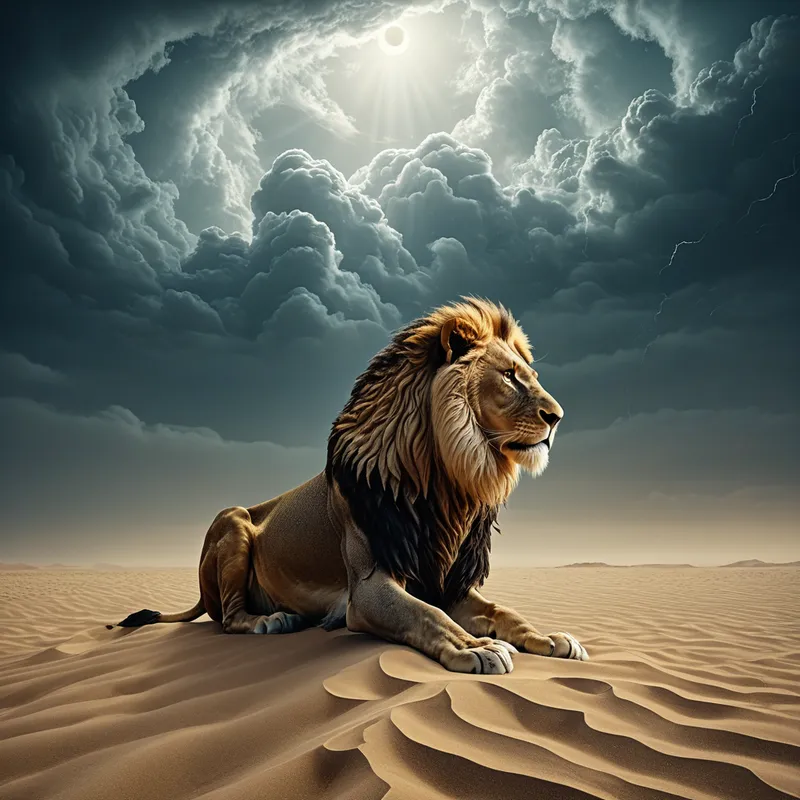
The [Lion](/symbols/lion “Symbol: The lion symbolizes strength, courage, and authority, often representing one’s inner power or identity.”/) represents the earthly principle: instinct, raw power, courage, sovereignty over the [material](/symbols/material “Symbol: Material signifies the tangible aspects of life, often representing physical resources, desires, and the physical world’s influence on our existence.”/) [realm](/symbols/realm “Symbol: The symbol of ‘Realm’ often signifies the boundaries of one’s consciousness, experiences, or emotional states, suggesting aspects of reality that are either explored or ignored.”/), the heat of [passion](/symbols/passion “Symbol: Intense emotional or physical desire, often linked to love, creativity, or purpose. Represents life force and deep engagement.”/), and the [shadow](/symbols/shadow “Symbol: The ‘shadow’ embodies the unconscious, repressed aspects of the self and often represents fears or hidden emotions.”/) of unchecked rage. It is the [animus](/symbols/animus “Symbol: In Jungian psychology, the masculine inner personality in a woman’s unconscious, representing logic, action, and spiritual guidance.”/), the driving force, the will to exist and dominate in the physical world.
The [Eagle](/symbols/eagle “Symbol: The eagle is a symbol of power, freedom, and transcendence, often representing a person’s aspirations and higher self.”/) represents the celestial principle: [spirit](/symbols/spirit “Symbol: Spirit symbolizes the essence of life, vitality, and the spiritual journey of the individual.”/), intellect, [vision](/symbols/vision “Symbol: Vision reflects perception, insight, and clarity — often signifying the ability to foresee or understand deeper truths.”/), transcendence, objectivity, and [the shadow](/myths/the-shadow “Myth from Jungian culture.”/) of cold [detachment](/symbols/detachment “Symbol: A psychological or emotional separation from oneself, others, or reality, often indicating a need for self-protection, perspective, or spiritual growth.”/). It is the soaring mind, the [capacity](/symbols/capacity “Symbol: A measure of one’s potential, limits, or ability to contain, process, or achieve something, often reflecting self-assessment or external demands.”/) to see patterns from a great [height](/symbols/height “Symbol: Height often symbolizes ambition, perspective, and the elevation of one’s self-awareness.”/), to aspire beyond the mundane.
The guardian at the gate is not keeping you out; it is waiting for you to become whole enough to perceive there is no gate.
The Shirdal is the psychic construct that forms when these two powerful, often warring, aspects of [the self](/myths/the-self “Myth from Jungian culture.”/) are forced into [relationship](/symbols/relationship “Symbol: A representation of connections we have with others in our lives, often reflecting our emotional state.”/). It is not a peaceful merger, but a dynamic, tense, and majestic [integration](/symbols/integration “Symbol: The process of unifying disparate parts of the self or experience into a cohesive whole, often representing psychological wholeness or resolution of internal conflict.”/). It guards the threshold to the deeper Self because entry requires that one no longer identifies solely as the grounded [beast](/symbols/beast “Symbol: The beast often represents primal instincts, fears, and the shadow self in dreams. It symbolizes the untamed aspects of one’s personality that may need acknowledgment or integration.”/) or the soaring [bird](/symbols/bird “Symbol: Birds symbolize freedom, perspective, and the connection between the earthly and spiritual realms, often representing the soul’s aspirations or personal growth.”/), but has begun to embody the terrifying and glorious [truth](/symbols/truth “Symbol: Truth represents authenticity, honesty, and the quest for knowledge beyond mere appearances.”/) of being both.
The Dreamer’s Resonance
When the Shirdal appears in the modern dreamscape, it signals a critical juncture in the dreamer’s psychological development. It is the archetype of the Guardian emerging to oversee a profound inner confrontation.
You may dream of a magnificent, terrifying creature blocking a path or a doorway. You might be trying to enter a new phase of life, access a creative insight, or claim a personal “treasure” (like self-worth or a new relationship), but this fused beast stands in your way. The somatic feeling is often one of awe mixed with dread—a tightening in the chest, a sense of immense scale and power.
This dream is not about defeating the guardian. It is a diagnostic image. The dream asks: Which side of yourself are you leading with? Are you all lion—charging forward with blind instinct, trying to muscle your way past the problem with force and will? Or are you all eagle—analyzing from a safe distance, trying to think or intuit your way around the challenge, disconnected from your gut and your passion? The Shirdal manifests to show you that your current, one-sided approach is insufficient. The treasure you seek requires the full synthesis of your animal power and your spiritual vision.
Alchemical Translation
The journey with the Shirdal is a precise model for the alchemical stage of coagulatio—the making solid, the integration that follows the dissolution of old identities. In the process of individuation, we first become aware of our inner opposites (the noble lion of our ambitions vs. the critical eagle of our conscience). We often pit them against each other, causing inner civil war.
The Shirdal represents the formidable, often frightening, psychic structure that arises when we consciously hold this tension without resorting to one side or the other. This is the “guardian” phase of the work. It feels like an obstacle because it demands we stop our forward march and do the harder, internal work of reconciliation.
To pass the Shirdal, you must offer it not your sword, but your wholeness. It feeds on fragmented intent and grants passage only to integrated being.
The alchemical translation is this: you do not slay the beast; you befriend its duality. You acknowledge your earthy passions (lion) without being ruled by them, and you honor your soaring ideals (eagle) without losing touch with the ground. This conscious integration creates a new, third [thing](/myths/thing “Myth from Norse culture.”/)—a cohesive Self that possesses both grounded strength and enlightened perspective. The guardian, having performed its function, transforms. It is no longer a barrier but the very emblem of your hard-won sovereignty. The gate was never locked; it was simply waiting for you to forge the key within [the crucible](/myths/the-crucible “Myth from Alchemical culture.”/) of your own contradictory nature. The Shirdal thus ceases to be a myth outside and becomes the living architecture of the soul within.
Associated Symbols
Explore related symbols from the CaleaDream lexicon: