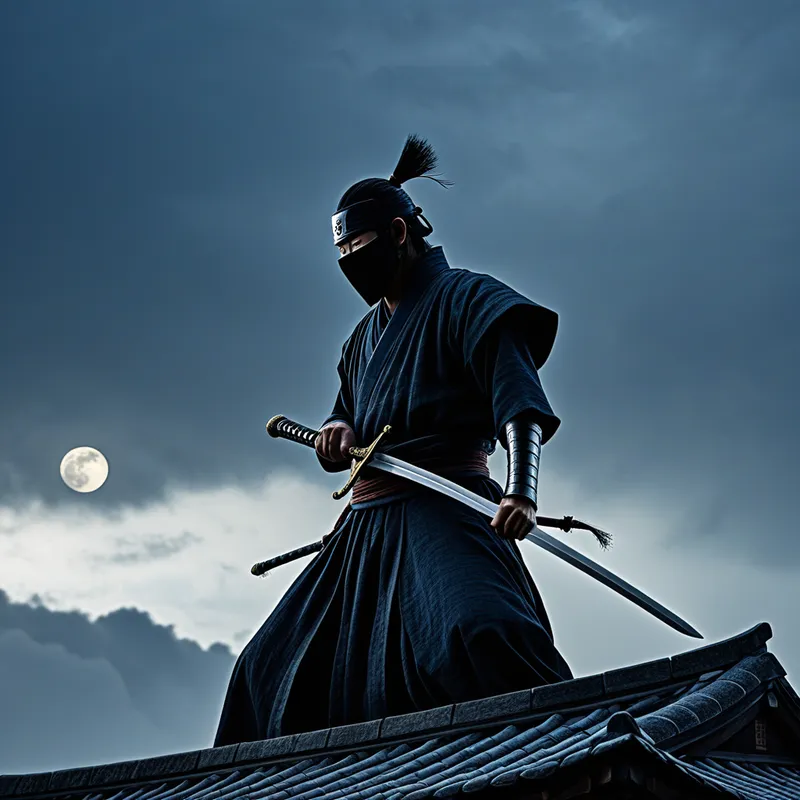
Shinobi Myth Meaning & Symbolism
The myth of the Shinobi is the story of the shadow made human, a being who masters the art of becoming unseen to navigate a world of visible conflict.
The Tale of Shinobi
Listen, and let [the veil between worlds](/myths/the-veil-between-worlds “Myth from Celtic culture.”/) grow thin. This is not a tale of emperors or thundering gods, but of the silence between heartbeats, [the shadow](/myths/the-shadow “Myth from Jungian culture.”/) cast by a solitary candle. In the age when [samurai](/myths/samurai “Myth from Japanese culture.”/) banners fluttered like bright, noisy prayers to the sun, there existed another prayer—a whisper to [the moon](/myths/the-moon “Myth from Tarot culture.”/). This is the story of its answer.
He was born not of a mother, but of a necessity. In a village forgotten by the main road, where [the mist](/myths/the-mist “Myth from Celtic culture.”/) clung to the mountains like a second skin, the people learned to speak with [the earth](/myths/the-earth “Myth from Hindu culture.”/), not upon it. A child of this place did not simply walk; he learned the language of fallen leaves and shifting gravel. He did not simply see; he learned to listen with his skin to the vibrations of approaching feet. They called him Shinobi.
His world was one of visible conflict, of clashing steel and declared loyalties. Yet his masters, lords who dwelled in castles of stone and politics, needed a different kind of sword. They needed a rumor given form, a doubt made flesh. They needed the truth that lived behind the fortress wall, behind the smiling face of a rival. And so, the boy of the mist was honed. He learned to fold his spirit into the shape of a night-heron’s cry, to wear darkness as a second skin, to move as the kami of [the crossroads](/myths/the-crossroads “Myth from Celtic culture.”/) might—present and absent, all at once.
His great trial was not a dragon, but a scroll. A treaty of peace, locked in a keep said to be impregnable, guarded by men who never slept. The conflict was [the world](/myths/the-world “Myth from Tarot culture.”/) of light against the realm of shadow. Could a [thing](/myths/thing “Myth from Norse culture.”/) of whispers survive in a place of torches and iron? We watched him become the rain on the stone, the creak of an old timber settling, the fleeting chill that makes a guard shrug his shoulders. We felt his heart, a frantic drum he forced to beat in time with the slow breath of the night. The rising action was not a charge, but an unbearable tension—the moment a floorboard groaned beneath a weightless step, the second a sleeping man stirred as a shadow passed his door.
The resolution was not a victory roar, but the soft shush of rice paper. The scroll, secured. The path back, through a waking fortress, now an enemy alerted but blind. His [triumph](/myths/triumph “Myth from Roman culture.”/) was not in taking, but in returning—delivering the secret into the light of his lord’s chamber, then melting back into the tapestry of night, leaving no proof he was ever there but the truth he carried. He became a legend without a face, a story told in hushed tones: the one who walks in the world, but is not of it.

Cultural Origins & Context
The myth of the [ninja](/myths/ninja “Myth from Japanese culture.”/) or Shinobi does not stem from a single sacred text, but from the fertile soil of historical necessity and folk imagination. Emerging in the tumultuous Sengoku Jidai (Warring States period), the figure answered a pragmatic need for intelligence, sabotage, and psychological warfare beyond the samurai’s code of open combat. These were likely individuals from marginal regions or lower social strata, masters of survival arts, whose skills were commodified by warring lords.
The myth was passed down through a dual lineage: whispered family traditions (ryūha) guarding actual techniques, and popular culture, which transformed the skilled operative into a near-supernatural figure. In kabuki and kyōgen plays, the Shinobi became a stock character of mystery and intrigue. This folklore served a societal function as a psychological counterweight to the rigid, honor-bound world of bushido. It represented the acknowledgment of the shadow—the necessary, unspeakable actions that sustain the visible order, and the power that flows from the margins.
Symbolic Architecture
The Shinobi is the ultimate [archetype](/symbols/archetype “Symbol: A universal, primordial pattern or prototype in the collective unconscious that shapes human experience, behavior, and creative expression.”/) of the [shadow](/symbols/shadow “Symbol: The ‘shadow’ embodies the unconscious, repressed aspects of the self and often represents fears or hidden emotions.”/) made operative. He is not evil, but other—the set of capacities (cunning, deception, patience, anonymity) that the conscious, social self must disavow to maintain its [identity](/symbols/identity “Symbol: Identity represents the sense of self, encompassing personal beliefs, cultural background, and social roles.”/). He symbolizes the intelligence of the unconscious itself, which moves in indirect ways to achieve its ends.
To become the Shinobi is to master the art of conscious descent into the shadow, not to be consumed by it, but to retrieve its hidden resources.
His tools are profound symbols: the shuriken (throwing star) is not merely a [weapon](/symbols/weapon “Symbol: A weapon in dreams often symbolizes power, aggression, and the need for protection or defense.”/), but a manifestation of focused, dispersed [intention](/symbols/intention “Symbol: Intention represents the clarity of purpose and direction in one’s life and can symbolize motivation and commitment within a dream context.”/)—a single point of [purpose](/symbols/purpose “Symbol: Purpose signifies direction, meaning, and intention in life, often reflecting personal ambitions and core values.”/) cast [outward](/symbols/outward “Symbol: Movement or orientation away from the self or center; expansion, expression, or externalization of inner states into the world.”/) in multiple directions. The black garb is the [persona](/symbols/persona “Symbol: The social mask or outward identity one presents to the world, often concealing the true self.”/) of non-existence, the ultimate camouflage that allows true essence to move unseen. His greatest power, shinobi-iri, is the psychological [capacity](/symbols/capacity “Symbol: A measure of one’s potential, limits, or ability to contain, process, or achieve something, often reflecting self-assessment or external demands.”/) for true observation, for becoming so still and receptive that the world reveals its secrets. He represents the [paradox](/symbols/paradox “Symbol: A contradictory yet true concept that challenges logic and perception, often representing unresolved tensions or profound truths.”/) of power through restraint, influence through [absence](/symbols/absence “Symbol: The state of something missing, void, or not present. Often signifies loss, potential, or existential questioning.”/), and victory through understanding rather than force.
The Dreamer’s Resonance
When the Shinobi archetype emerges in modern dreams, it signals a profound engagement with the personal shadow. Dreaming of moving silently through unfamiliar houses, of hiding in plain sight, or of possessing secret knowledge others seek, points to a somatic process of navigating unconscious territory. The [psyche](/myths/psyche “Myth from Greek culture.”/) is conducting covert operations.
The feeling is often one of heightened, anxious alertness—a somatic state of hyper-vigilance where every sense is acute. This mirrors the psychological process of integrating repressed aspects of [the self](/myths/the-self “Myth from Jungian culture.”/). The dream-ego is learning to move through the inner landscape of shame, hidden talent, or unexpressed anger without being identified and destroyed by the inner “guards” of the critical superego or rigid self-concept. The Shinobi dream is a training ground for developing finesse with one’s own darkness, learning its pathways and leveraging its unique intelligence for a psychic objective.

Alchemical Translation
The myth of the Shinobi models the alchemical stage of [nigredo](/myths/nigredo “Myth from Alchemical culture.”/)—the willing descent into the blackness of the unknown self. The modern individual’s “castle” is their own rigid identity, their conscious worldview fortified against uncomfortable truths. The “scroll” to be retrieved is a piece of vital, hidden self-knowledge—a repressed memory, a denied talent, a core wound.
The individuation journey requires one to become their own Shinobi: to employ shadow-skills of patience, indirect approach, and silent observation on the contents of one’s own soul.
The process is one of psychic transmutation. The base metal of raw, unconscious impulse (fear, aggression, cunning) is not expelled, but refined through discipline (shugyō) into a higher function: intuitive insight, strategic patience, and the ability to adapt to any inner or outer environment. The triumph is not the eradication of the shadow, but the development of a conscious relationship with it. One learns to “steal back” the projected aspects of the self from the outer world (seeing the “enemy” out there as a part of oneself within) and return them to the inner lord—the emerging, more complete consciousness. The ultimate goal is not to live in the shadows, but to move freely between the worlds of light and dark, integrated and whole.
Associated Symbols
Explore related symbols from the CaleaDream lexicon: