Shikoku Pilgrimage Myth Meaning & Symbolism
A sacred 88-temple circuit embodying the soul's arduous journey toward awakening, mirroring the life and teachings of the wandering saint Kūkai.
The Tale of the Shikoku Pilgrimage
Listen. The path is not drawn on any map you can hold in your hands. It is etched into the bones of the land, a serpentine whisper through mountains that scrape the belly of the sky, along coasts where the salt-laden wind sings of forgotten voyages. This is Shikoku, the “Four Provinces,” and upon its back lies a circle of eighty-eight sacred places, a pilgrimage of the body that is, in truth, a pilgrimage of the soul.
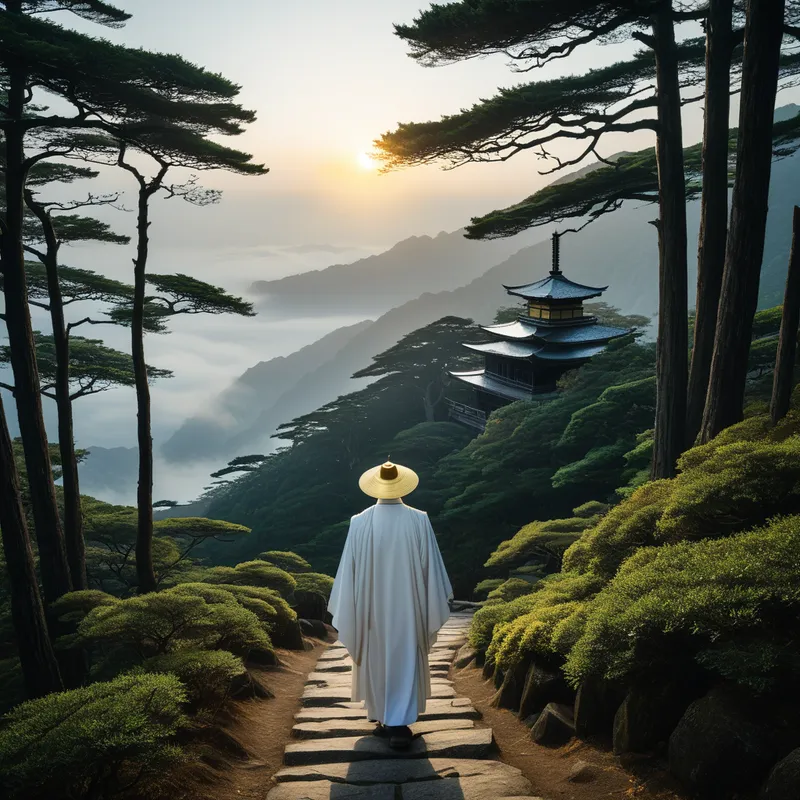
The journey begins not with a first step, but with a last look over the shoulder. The pilgrim, the henro, dons the white vestments of the dead. In this act, the old self is shed like a chrysalis. The world of attachments—name, status, home—falls away with the donning of the simple straw hat and the taking up of the staff. The staff itself is called kongō-zue, the “diamond scepter,” and it is said the great saint himself walks with you, its tip tapping a rhythm on stone and earth that is the heartbeat of the island.
The way is unforgiving. It leads up vertiginous slopes where the mist clings like a cold shroud, through valleys so deep the sunlight is a rare and fleeting gift. At each of the eighty-eight temples, the pilgrim performs the same rituals: washing the hands, ringing the bell to announce their presence, chanting the Hannya Shingyō before the main hall and the Daishi-dō. They receive the temple’s seal, a crimson stamp and black calligraphy, in their nōkyō-chō. Each stamp is not a trophy, but a brand upon the spirit, a mark of passage through a station of contemplation.
But the true deities of this path are not only enshrined in the halls. They are the driving rain that soaks you to the skin, the blister on the heel that pulses with every step, the profound silence of a forest at dusk. They are the generosity of strangers—the osettai—a cup of tea, a piece of fruit, a place to rest, given without expectation. In these moments, the boundary between giver and receiver, between self and other, begins to dissolve.
The circle closes. After weeks or months of walking, the pilgrim returns to the first temple, Ryōzen-ji. But they are not the same person who left. The white robes are stained with earth and sweat, the staff worn smooth by the grip of a thousand hands. The circle is complete, yet the journey has just begun. The path has been walked, and in walking, the pilgrim has been walked by the path. The island has inscribed itself upon them. They have died to one world and been born, raw and awakened, into another.
Cultural Origins & Context
The Shikoku Pilgrimage is inextricably linked to the historical figure Kūkai, known reverently as Kōbō Daishi. While the precise origins of the 88-temple circuit are obscure, emerging between the 12th and 17th centuries, the tradition crystallizes around the belief that Kūkai, in his lifelong quest for enlightenment and his deep communion with the natural world, sanctified these sites through his practice and presence. He is not merely a historical founder but a living companion on the path; pilgrims believe his spirit eternally walks the route, guiding and protecting all who undertake it.
This was never a pilgrimage for the elite. It was, and is, a profoundly populist spiritual practice. It functioned as a great social and psychological equalizer. Samurai, farmers, merchants, and the bereaved all walked the same path in the same simple garb. For many, it was a form of penance or a quest for healing. For others, it was a rite of passage or a way to accumulate spiritual merit. The pilgrimage served as a living theatre of Shingon Buddhist cosmology, where the island itself became a mandala, with the temples corresponding to different states of consciousness and stages toward Buddhahood. It was transmitted not through formal texts alone, but through the oral traditions of the pilgrims, the folk tales of the islanders, and the physical, grueling, transformative act of walking.
Symbolic Architecture
At its core, the pilgrimage is a master symbol of the individuation process—the soul’s journey toward wholeness. The number 88 is profoundly symbolic, echoing the 88 earthly passions or defilements (bonnō) recognized in Buddhism. Each temple visited represents the confrontation with, and potential purification of, one of these passions.
The circle is the primary geometry of the psyche. To walk a sacred circle is to enact the circumambulation of the Self, gathering the scattered fragments of one’s being back to the center.
The pilgrim’s white robes symbolize the death of the ego, the persona one presents to the world. The staff is the axis mundi, the connection between the earthly struggle and the divine guidance (Kūkai) that makes it possible. The arduous terrain—the mountains, forests, and coasts—are not obstacles but essential teachers. They represent the rugged, often painful, landscape of the unconscious itself. The osettai, the unexpected gifts, symbolize the grace that emerges when the ego surrenders; they are manifestations of the supportive, interconnected nature of reality when one is aligned with the purpose of the journey.
The Dreamer’s Resonance
When the pattern of the Shikoku Pilgrimage appears in modern dreams, it rarely manifests as a literal walk around a Japanese island. Instead, it surfaces as the feeling of being on a mandatory, circular journey. The dreamer may find themselves walking an endless staircase, driving a car on a looping highway with no exits, or moving through a series of nearly identical rooms, compelled to perform a specific, ritualistic action in each.
Somatically, this dream pattern correlates with a process of profound psychological digestion and integration. The body in the dream is often tired, sore, but determined. This mirrors a waking-life process where the psyche is laboriously working through a complex set of old wounds, habits, or patterns (the 88 passions). Each “temple” or station in the dream represents a specific cluster of memory or emotion being processed. The circular, inescapable nature of the dream indicates there is no shortcut; the process must be completed. The dream is a map of the nervous system rewiring itself, step by arduous step.

Alchemical Translation
For the modern individual, the myth of the Shikoku Pilgrimage provides a profound model for psychic transmutation. Our secular lives lack formal rites of passage. The pilgrimage myth tells us we must create our own.
The first alchemical stage is Nigredo, the blackening. This is the decision to begin, the conscious recognition of one’s suffering, fragmentation, or longing. It is the donning of the “white robes”—the voluntary shedding of an old identity. The long walk itself is the Albedo, the whitening, the grueling work of purification. Each step is a small act of mindfulness. Each challenge faced on the path (the blister, the lost way, the loneliness) is an externalized shadow to be integrated, not defeated.
The goal is not to reach the end, but to become the path. Enlightenment is not a destination at the circle’s close, but the quality of attention brought to each stone on the road.
The osettai, the grace of strangers, represents the Citrinitas, the yellowing, the dawning of an inner light that comes from realizing one is supported by a reality larger than the isolated ego. Finally, the return to the start is the Rubedo, the reddening, the culmination. One arrives back at the beginning, but transformed. The circle is closed, and in that closure, the center—the integrated Self—is revealed. The pilgrim realizes the path was not outside, but within. The eighty-eight temples were stations of their own soul, and the entire arduous, beautiful journey was the process of coming home to a self they had never truly left.
Associated Symbols
Explore related symbols from the CaleaDream lexicon: