Shennong Myth Meaning & Symbolism
The myth of the divine emperor who tasted hundreds of plants, discovered agriculture and medicine, and sacrificed himself to guide humanity toward civilization.
The Tale of Shennong
In the dawn-time of the world, when the earth was a vast, untamed wilderness and humanity huddled in caves, gnawing on raw flesh and bitter roots, a great stirring began. It was not a sound, but a presence—a deep, resonant hum from the very heart of the soil. From this primordial vibration, he was born. They called him Shennong.
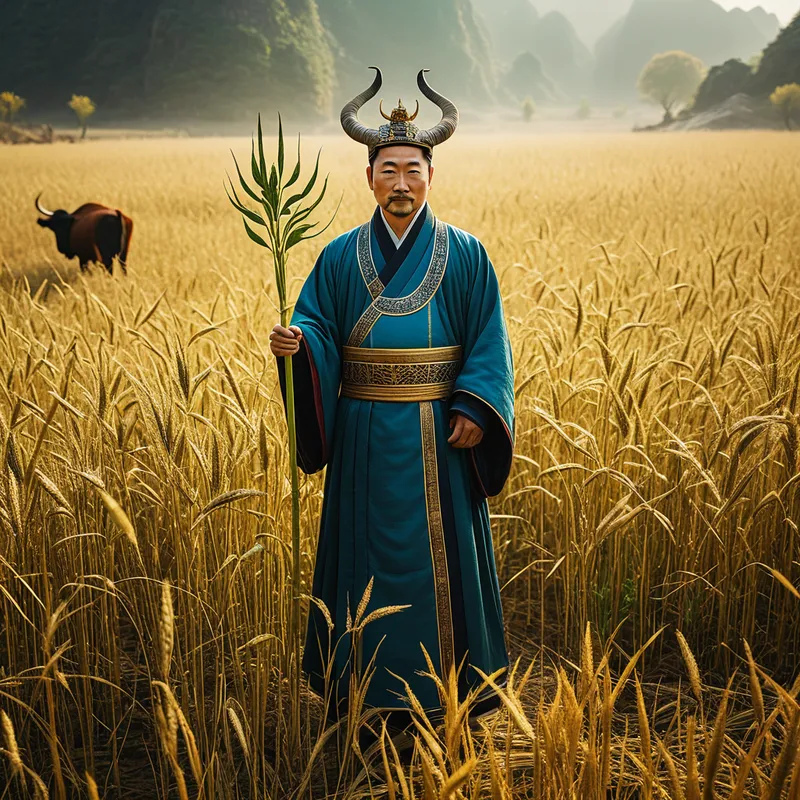
He appeared not as a man, but as a being of two natures: the body of a man, strong and enduring, crowned with the head of an ox, the patient beast of the field. His eyes held the deep knowing of the earth and the bright clarity of the sun. He saw his people suffering, their bellies aching with hunger, their bodies wracked with the poisons of unknown plants and the fevers of unchecked illness. Their cries were the wind through the barren reeds.
And so, Shennong walked. He left the smoky fires of the settlements and ventured into the whispering green chaos of the world. He knelt in the mud by riverbanks, his fingers tracing the veins of leaves. He climbed sun-baked cliffs to taste the dew on strange blossoms. He built the first plow from wood and stone, and where he dragged it, the hard ground softened and yielded. Seeds, which had been scattered and lost, he gathered and buried with intention. He taught the people to watch the sun and the rain, to listen to the seasons. The wilderness began to bow, not in conquest, but in partnership, offering up rows of golden grain.
But grain was not enough. Pain remained. Death came swift and mysterious from a wrong bite. Shennong’s great work deepened. He declared, “For my people to live, I must know what kills and what cures.” He fashioned a magical tool, a shenbian, a crimson whip that would reveal the essence of plants. Yet, for true knowing, this was not enough. The ultimate test required the ultimate instrument: his own body.
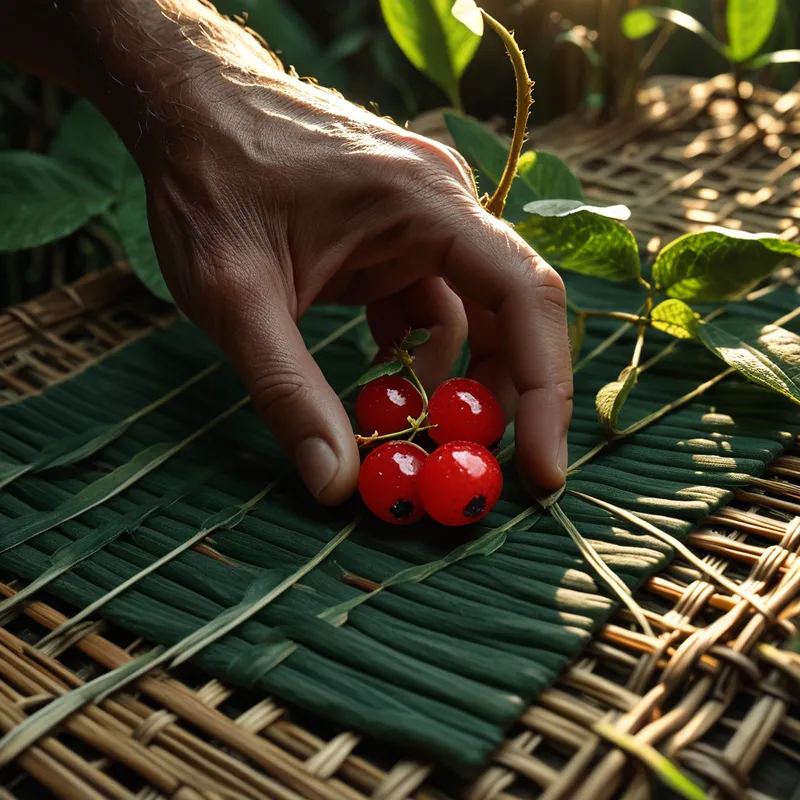
Day after day, under the watchful eye of heaven, Shennong tasted. He built a fire and boiled waters, creating the first cauldron of tea from a curative leaf. He chewed bitter stems that cleared the mind, and sweet berries that strengthened the heart. His divine form, resilient beyond mortal measure, withstood a hundred poisons. His stomach, they say, was transparent, so he could witness the dance of essence and toxin within his own vessel. He catalogued the hot and the cold, the poisonous and the benign, the tonic and the lethal. Each taste was a story written in his flesh, a law inscribed for humanity.
The legend says his work numbered in the tens of thousands. But in the heart of every healer lies the knowledge of the limit. One day, he encountered a plant whose venom was swift and absolute—the duanchang cao, the “gut-breaking herb.” Knowing its danger, yet compelled by the completeness of his knowledge, he partook. Before the poison could claim him, he used his last moments to etch its warning into the jade tablet of eternal lore. He died not in failure, but in ultimate, conscious sacrifice, having mapped the perilous, healing soul of the world for those who would come after.
Cultural Origins & Context
The figure of Shennong is not the product of a single story, but a cultural accretion, a foundational layer in the bedrock of Chinese civilization. He is one of the San Huang, the Three Sovereigns, who bridge the gap between pure myth and proto-history. His narratives are compiled in texts like the Shanhaijing and later historical works that sought to order the ancient past.
He is the archetypal culture hero, a deity who moves humanity from a state of nature to a state of culture. His myth was not merely entertainment; it was a sacred charter. It explained the origins of the two pillars of settled life: agriculture (nong) and herbal medicine (yao). In a society where the state’s legitimacy was tied to its ability to feed and care for the people, Shennong provided a divine mandate and a model for the righteous ruler—the “father and mother” of the people.
The myth was passed down by shamans, historians, and farmers alike. It functioned as a moral and practical compass, emphasizing empirical investigation, self-sacrifice for the collective good, and the sacred, reciprocal relationship between humanity and the natural world. Shennong was the divine patron of farmers, herbalists, and merchants (as he is also credited with establishing the first markets), making his veneration both a spiritual and a profoundly practical societal force.
Symbolic Architecture
Shennong is the embodiment of conscious, suffering wisdom. His ox-head symbolizes immense strength, patience, and a fundamental connection to the earth and its cycles—the brute, enduring force required to cultivate the wild. His human body represents the application of intellect, observation, and will upon that raw, natural strength.
The Sage does not command nature from afar, but enters into its substance, allowing its truths to be written upon his own flesh. Knowledge is not extracted, but ingested.
The act of tasting hundreds of plants is the ultimate metaphor for direct, experiential knowledge. It moves beyond theory into the realm of embodied truth. His transparent stomach is a powerful symbol of consciousness itself—the ability to observe the inner processes, to see cause and effect within the vessel of the self. This is the birth of internal awareness, of understanding that the outer world (the plant) has a direct, knowable correspondence to the inner world (the body’s reaction).
His death by the “gut-breaking herb” is not a tragedy of failure, but the completion of the archetype. It represents the acceptance of the final, necessary shadow of the seeker’s path: that total knowledge includes knowing the limit, the thing that destroys the knower. It is the ultimate integration of mortality into the quest for wisdom.
The Dreamer’s Resonance
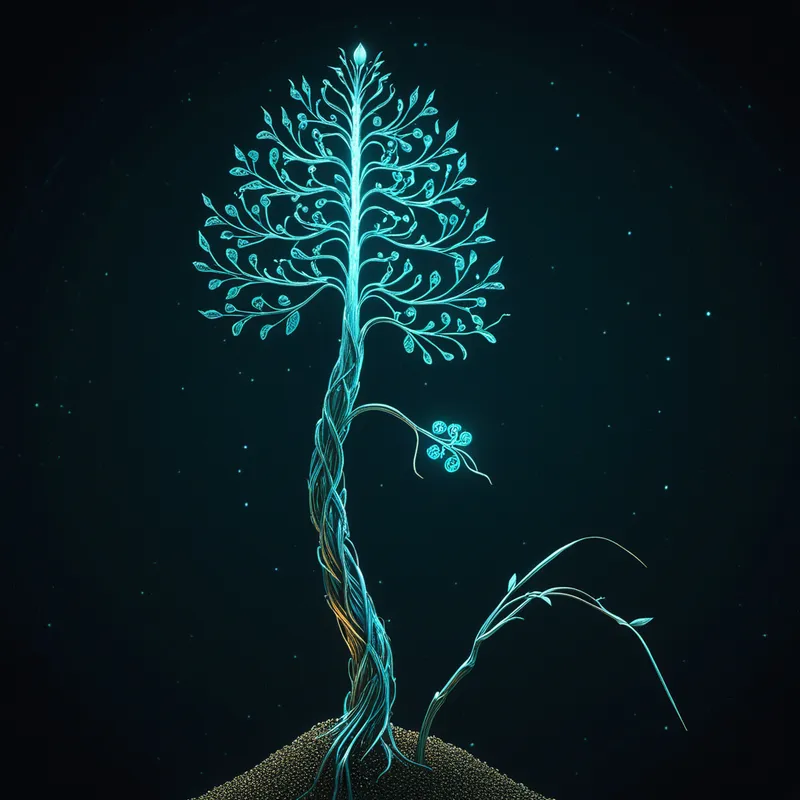
When the pattern of Shennong stirs in the modern psyche, it often manifests in dreams of foraging, of being in a lush but unfamiliar garden or jungle. The dreamer may feel compelled to taste unknown berries, leaves, or soils. There is a mix of deep curiosity and profound anxiety.
Psychologically, this signals a critical phase of discernment and internal testing. The dreamer is in a life period where they are encountering a plethora of new “substances”—ideas, relationships, career paths, spiritual practices, or emotional states. The unconscious is asking: What nourishes you? What poisons you? What is merely inert? The somatic feeling is often in the gut—a literal “gut feeling” being tested and formed. This dream pattern calls for a courageous, conscious engagement with life’s offerings, urging the dreamer to move beyond book-learning and safely held theories, and to begin the risky, essential work of direct experience to build their own personal “materia medica” of the soul.

Alchemical Translation
The Shennong myth is a precise map for the alchemical stage of separatio and mortificatio on the path to individuation. The undifferentiated wilderness of the unconscious must be plowed and ordered (agriculture). The chaotic swirl of impulses, complexes, and potentialities within must be identified, tasted, and categorized (herbal testing).
Individuation requires one to become both the experiment and the experimenter, to willingly ingest the contents of one’s own psyche to distinguish the healing virtue from the latent toxin.
The modern seeker’s “hundred plants” are their own thoughts, emotions, memories, and drives. The shenbian, the red whip, is the faculty of critical judgment and conscious attention that begins to probe these elements. But the true alchemy happens in the vas, the vessel of the self, where these elements are “cooked” by the fire of attention and lived experience. To see one’s own “transparent stomach” is to develop introspection—to observe how a certain memory (a bitter root) triggers a specific emotional poison, or how a disciplined practice (a tonic herb) leads to integration and strength.
The ultimate sacrifice—the tasting of the fatal herb—translates to the conscious encounter with one’s own mortality, limitations, or core wound. It is the moment when the ego, in its quest for self-knowledge, willingly confronts the thing that threatens to dissolve it. This is not ego-death as annihilation, but as the necessary mortificatio that precedes transformation. By consciously “dying” to the illusion of total control or perfect safety, the individual, like Shennong, completes their sacred text. They gain not omnipotence, but wisdom—the hard-earned, embodied knowledge of what truly sustains a human life, and what, in the end, gives even its ending meaning.
Associated Symbols
Explore related symbols from the CaleaDream lexicon: