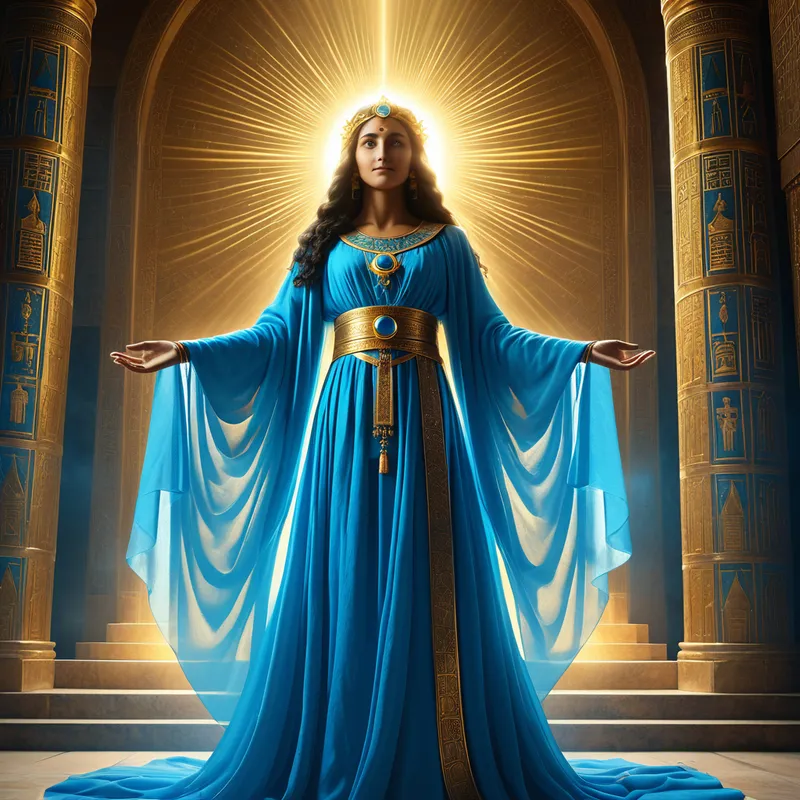
Shekinah Myth Meaning & Symbolism
The story of the divine feminine presence, exiled from the world, whose return is the secret longing of the soul and the cosmos.
The Tale of Shekinah
Listen. Before the words of scripture were etched, before the stones of the temple were laid, there was a Presence. Not a god on a distant throne, but a breath within the sanctuary, a warmth in the holy dark. They called her Shekinah.
In the beginning, she walked with them. In the cool of the garden, her light was the dappled sun through leaves, her voice the rustle of life. She was the pillar of cloud by day, a gentle shade from the desert’s fury. She was the pillar of fire by night, a hearth-light for a wandering people, a promise that they were not alone. Where they pitched their tent, she settled. Where they built an altar, she descended. Her home was the Tabernacle, a tent of meeting where heaven and earth whispered secrets through the veil.
Then came the dream of permanence. A king, Solomon, built a house not of cloth and poles, but of cedar and gold, a mountain of a temple anchored in Jerusalem. And she, in her grace, entered. The glory filled the house so that the priests could not stand to minister. She rested upon the Ark of the Covenant, between the wings of the golden cherubim. Here, in the Holy of Holies, in perfect stillness, the world knew its center.
But the human heart is a fickle altar. Kings turned to other gods. Justice became a forgotten language. The prophets wept, their cries echoing in the courts of the temple that had become a den of ritual without heart. And the Presence, the Shekinah, began to withdraw. Not in anger, but in a sorrow too deep for words. She retreated, step by step, from the inner sanctum to the courtyard, from the courtyard to the threshold.
The day the Babylonian hordes breached the walls, the priests saw it. A light, soft as a sigh, lifted from between the cherubim. It lingered for a moment at the temple door, a last look at the home she had loved. Then, like a dove ascending from a flood, she rose and was gone. The temple was burned. The Ark was lost. And the world was cast into a long twilight, a cosmic loneliness.
The sages said she went into exile with her people. They said she wanders by the rivers of Babylon, her light hidden, her voice a murmur in the wind. They said she hides in the small, unnoticed acts of kindness between strangers, in the silent devotion of the broken-hearted, in the fragile hope that persists in the dark. The world is now a shell from which the kernel has been removed. But the story does not end in exile. It whispers of a return. It speaks of a time when the scattered sparks will be gathered, when the vessel will be made whole, and the Beloved Presence will come home—not to a temple of stone, but to a world made sanctuary.
Cultural Origins & Context
The myth of the Shekinah is not a single, canonical narrative from mainstream Christian scripture, but a profound undercurrent flowing from the deep well of Jewish mysticism—specifically the Kabbalah—into the imaginal world of Christian esoterics, mystics, and depth theologians. It represents a “Christian” engagement with a pre-Christian, Hebraic understanding of the divine.
In its original context, Shekinah is a Talmudic and Kabbalistic concept: the immanent, dwelling presence of the transcendent Ein Sof. She is the tenth and final Sefirah, Malkhut, the divine bridge to creation. This myth was kept alive not in pulpits but in rabbinic commentaries, mystical texts like the Zohar, and in the lived, aching poetry of a people in diaspora, for whom God’s presence felt both intimately close and tragically absent.
Christian mystics and heterodox thinkers, particularly those leaning into gnostic or sophianic traditions, recognized in the Shekinah a missing piece: the divine feminine principle within the Godhead. They saw her exile as the theological explanation for the sense of sacred absence in the world, and her promised return as the secret goal of all redemption—personal and cosmic. This myth was passed down in whispers, in the writings of visionaries, and in the symbolic language of alchemy, where the lost femina awaited reunion with the spirit.
Symbolic Architecture
At its core, the myth of the Shekinah is a master symbol of the psyche’s own structure and its fundamental wound. She represents the experience of the sacred—the felt sense of meaning, connection, and immanent value. She is not the abstract lawgiver or the distant judge, but the comforting presence, the intuitive knowing, the nourishing ground of being.
The exile of the Shekinah is the psyche’s primal trauma: the separation of consciousness from its own sacred ground.
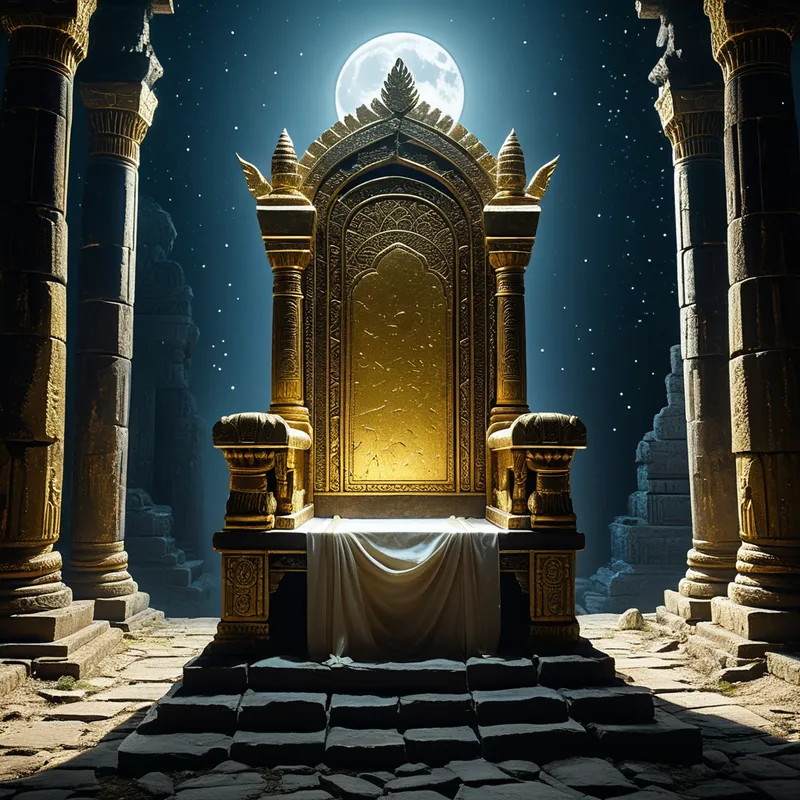
Her withdrawal from the temple symbolizes what happens when the structures of our life—our beliefs, our relationships, our institutions—become hollow, rigid, and devoid of authentic feeling. We are left with an empty throne, a beautiful but lifeless form. The temple stands, but the glory has departed. Psychologically, this is the state of depression, alienation, or performing a life that has lost its soul-connection.
Her exile with her people is the crucial turn. The divine presence does not abandon creation but goes into the shadow, into the suffering, into the diaspora of our own fragmented selves. She becomes the hidden spark in our pain, the unexpected moment of grace in our failure, the unconscious wisdom that guides us when our conscious plans have crumbled.

The Dreamer’s Resonance
When this myth stirs in the modern soul, it often manifests in dreams of profound longing and searching. One might dream of a beautiful, radiant woman who is lost, imprisoned, or veiled, and the entire dream is a quest to find her. Alternatively, the dreamer may find themselves in a vast, magnificent building—a library, a museum, a grand hotel—that is eerily empty, its purpose forgotten. The architecture is perfect, but the life is gone.
Somatically, this can feel like a hollow ache in the chest, a sense of “homesickness” for a place you’ve never known. Psychologically, it is the process of confronting the “god-shaped hole,” not with theological answers, but with the raw experience of absence. The dreamer is being asked to feel the exile, to stop trying to fill the void with noise and distraction, and to instead honor the emptiness as the space where the Presence once dwelt—and may again. It is the beginning of the soul’s own lament, which is the first prayer of return.
Alchemical Translation
The alchemical work modeled by the Shekinah myth is not one of conquest, but of reception and reunion. The individuation process it outlines is the hieros gamos, the sacred marriage, on the innermost stage.
The first operation is recognizing the exile. We must see the empty throne in our own lives—the career that no longer holds meaning, the relationship sustained by habit, the spiritual practice that has become rote. This is the nigredo, the blackening, a necessary despair that destroys our illusions about where the “glory” can be found.
The second is following her into the diaspora. This is the deep shadow work. We must look for the divine spark not in our successes, but in our failures and fractures. We find the Shekinah in our vulnerability, our grief, our unhealed wounds, and in simple, unheralded acts of compassion. This is gathering the scattered sparks (Tikkun in Kabbalah).
The return of the Shekinah is not an external event, but the moment the psyche turns inward and makes a home for the presence it has been seeking in all the wrong places.
The final transmutation is the reconstruction of the inner temple. This is not rebuilding the old, rigid structure, but creating a living sanctuary in the heart. It is the capacity to hold stillness, to listen, to let the felt sense of the sacred—intuition, empathy, awe—dwell within our daily consciousness. When this inner vessel is prepared, the Beloved Presence, the feeling of being utterly at home in oneself and the world, returns. The exile ends not with a triumphal entry into a city, but with a quiet sigh of recognition in the soul’s own depths: “Here I am. I have been here all along.”
Associated Symbols
Explore related symbols from the CaleaDream lexicon: