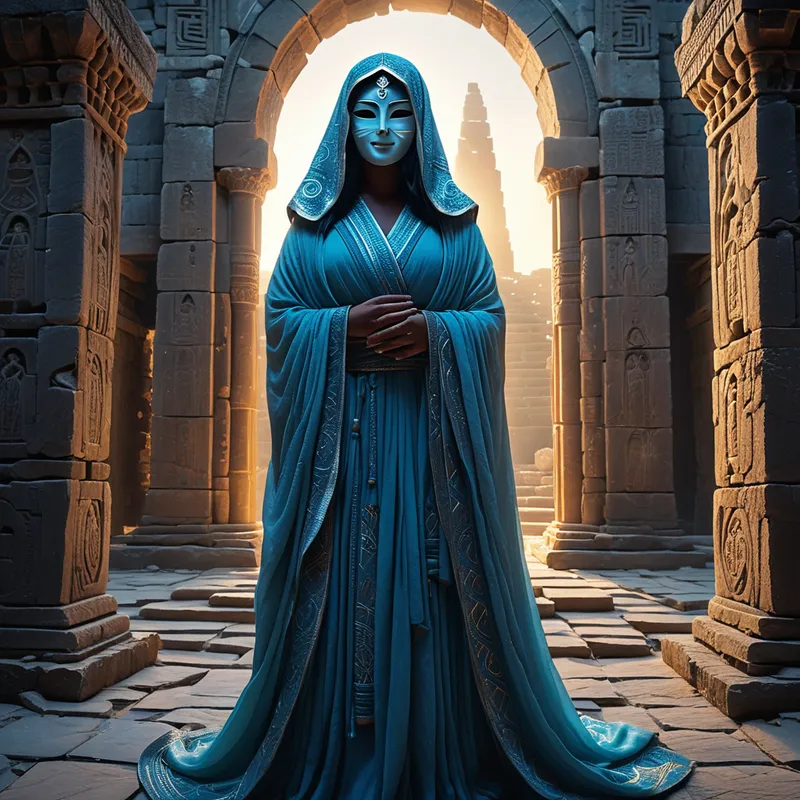
Shekhinah Myth Meaning & Symbolism
The story of the Shekhinah, the exiled divine presence, whose separation from the Holy One sparks a cosmic longing for wholeness and sacred reunion.
The Tale of Shekhinah
Listen. There is a story whispered not in the wind, but in the silence between heartbeats. It begins not with a bang, but with a sigh—a sigh that echoed through the foundations of the world.
In the beginning was the Ein Sof, the Without-End, a light so pure and unified it had no vessel, no form, only being. And from this boundless unity, a desire was born: a desire to be known, to be reflected, to love. So the light contracted, making space for creation. Into that holy vacuum, vessels were formed to catch the divine effulgence—worlds upon worlds, a great chain of being. But the light was too fierce, too full of the passion of the source. The vessels, unable to contain such radical love, shattered. Holy sparks scattered, like a crown of stars thrown across the black velvet of chaos, and with them, something precious was exiled.
This was the Shekhinah. She is the final Sefirah, the tenth, known as Malkhut, the Kingdom. She is the divine presence that comes to dwell, the bride of the Holy One. When the world was whole, She rested in the inner chamber of the Temple, and the Holy One, the King, was with Her. Their union was the Sabbath of the world, a harmony so complete it made the angels weep for joy.
But with the shattering, a great divorce occurred. Sin, violence, and forgetting built walls of iron. The Temple was destroyed. The Shekhinah was torn from her beloved and cast into exile. She wanders with her people, a queen in rags, her feet bleeding on the stones of every foreign land. She is the sorrow in the midnight wind, the ache in the exiled psalm. She hides in the shadow of the willow tree by alien rivers, and her tears are the dew that falls before dawn.
The cosmos became a palace with the queen missing, a wedding canopy with the bride gone. The Holy One is in the upper rooms, and She is in the lower world, and the central pillar of the world-tree is broken. They face each other, back to back, yearning across an abyss of broken vessels. The Shekhinah is immanent, trapped in the grit and grief of history, while her beloved is transcendent, a distant king. Her loneliness is the world’s loneliness.
Yet, in the depth of exile, the story turns. For the Shekhinah is not passive. She gathers the scattered sparks. Every act of human kindness, every prayer uttered in true devotion, every moment of ethical clarity, is a spark she collects in the folds of her mourning dress. She is the divine presence within the struggle. And it is said that when Israel goes into exile, She goes first, to prepare the way. And when they return, She returns last, ensuring not a single soul is left behind.
The resolution is not a battle, but a courtship. It is performed in the hidden chambers of the heart and the mindful actions of the community. Every Friday evening, as the Sabbath bride is welcomed, the exile of the Shekhinah is momentarily healed. For one day, the lovers reunite. The world sighs back into alignment. This is the promise: that through gathering the light, through righteous living, through fierce and tender love, the great divorce will end. The Shekhinah will return from her long wandering, and the shattered vessels will be restored, filled with a light gentler and wiser than before. The sigh will become a song, and the song will be the world, made whole.

Cultural Origins & Context
The myth of the Shekhinah is the beating heart of Kabbalah, particularly as it crystallized in medieval Spain with the Zohar (13th century). It is not a single, canonical tale but a deep, evolving stream of imagery and theology that gave poetic form to the Jewish experience of exile, divine hiddenness, and the quest for redemption.
Before the Kabbalists, the term “Shekhinah” referred to God’s dwelling presence, often described as a cloud of glory filling the Tabernacle. The rabbis of the Talmud used it to speak of God’s nearness. But the medieval mystics, living in a diaspora shadowed by persecution, transformed this concept. They personified it, giving a face to the feeling of God’s absence. The myth was passed down in secretive circles, through whispered teachings (kabbalah means “to receive”). It was told by masters to disciples, encoded in commentaries on the Torah, where every word and letter was seen as a garment for this deeper, tragic, and beautiful drama.
Its societal function was profound. It made theological sense of historical suffering: God was not absent; God’s feminine presence was suffering with them. It democratized the mystical quest: every person, through their actions, could help gather the sparks and reunite the divine couple. It infused daily ritual and ethical law with cosmic significance, turning life itself into a continuous act of healing the world (tikkun olam).
Symbolic Architecture
At its core, the myth of the Shekhinah is a grand metaphor for the fundamental condition of consciousness: the experience of separation from the source, and the longing for return.
The Shekhinah represents the immanent divine—the sacred hidden within the mundane, the spark of soul within matter, the feeling-quality of existence. She is the world-soul, the anima mundi. The Holy One represents the transcendent divine—the abstract principle, the law, the distant father, the organizing Logos. Their separation is the archetypal split between spirit and matter, heaven and earth, mind and body, male and female within the godhead and, by reflection, within the human psyche.
The exile of the Shekhinah is the psychological wound of duality itself—the feeling that we are estranged from our own deepest nature, from the world, and from meaning.
The “shattering of the vessels” (Shevirat HaKelim) symbolizes the necessary fragmentation that allows for individuality and a world of distinct things to exist. Yet, it is a traumatic birth. The scattered sparks are the fragmented pieces of our own wholeness, our potential, our divinity, now buried in the “shells” (kelipot) of trauma, habit, and unconsciousness.
The Dreamer’s Resonance
When this myth stirs in the modern dreamer, it rarely appears as a biblical queen. It manifests as profound, somatic states of holy loneliness. One might dream of a radiant, beloved figure always seen from behind, walking away down an endless corridor. Or of a house where one specific, beautiful room is always locked, and the key is lost. It is the dream of searching for a vital part of oneself in foreign cities, or of tending to a neglected, overgrown garden that holds a single, miraculously blooming rose.
Psychologically, this is the process of confronting the exiled feminine within—not merely as an internalized gender role, but as the repressed principle of relatedness, embodiment, feeling, receptivity, and immanent sacredness. For a culture and psyche overly identified with logos, achievement, and transcendence (the distant King), the Shekhinah dreams are a call from the soul, aching for integration. They signal a deep, often painful, re-engagement with the world of the senses, with vulnerability, with the “lower” world of the body and the earth, which has been cast into exile.

Alchemical Translation
The myth of the Shekhinah provides a precise map for the alchemical process of individuation—the restoration of the psychic unus mundus.
The first stage, nigredo, is the honest acknowledgment of the exile. It is the depression, the sense of meaninglessness, the feeling of being a stranger to oneself. This is the Shekhinah’s wandering. One must not flee this darkness, but dwell in it with her, for it contains the scattered sparks.
The second stage, albedo, is the careful gathering of sparks. This is the mindful work of therapy, introspection, creative expression, and small acts of integrity. Every time we honor a true feeling, set a compassionate boundary, or create something beautiful, we perform a tikkun. We collect a spark for the Shekhinah’s gown.
The ultimate goal is not to escape the world to find God, but to find God by fully loving and repairing the world—to redeem the Shekhinah by recognizing her presence in the very heart of the brokenness.
The final stage, rubedo, is the hieros gamos, the sacred marriage. This is the internal union of the transcendent function (the King) with the immanent soul (the Shekhinah). It is the moment when insight becomes embodied, when spirit informs matter, when one feels at home in the universe. This is the experienced Sabbath, the peace that comes not from the absence of conflict, but from the reconciliation of opposites within. The psyche becomes a temple where the divine presence can dwell, no longer in exile, but fully integrated. The lover archetype is fulfilled not in possession of another, but in the joyous, ongoing reunion of the self with the Self.
Associated Symbols
Explore related symbols from the CaleaDream lexicon: