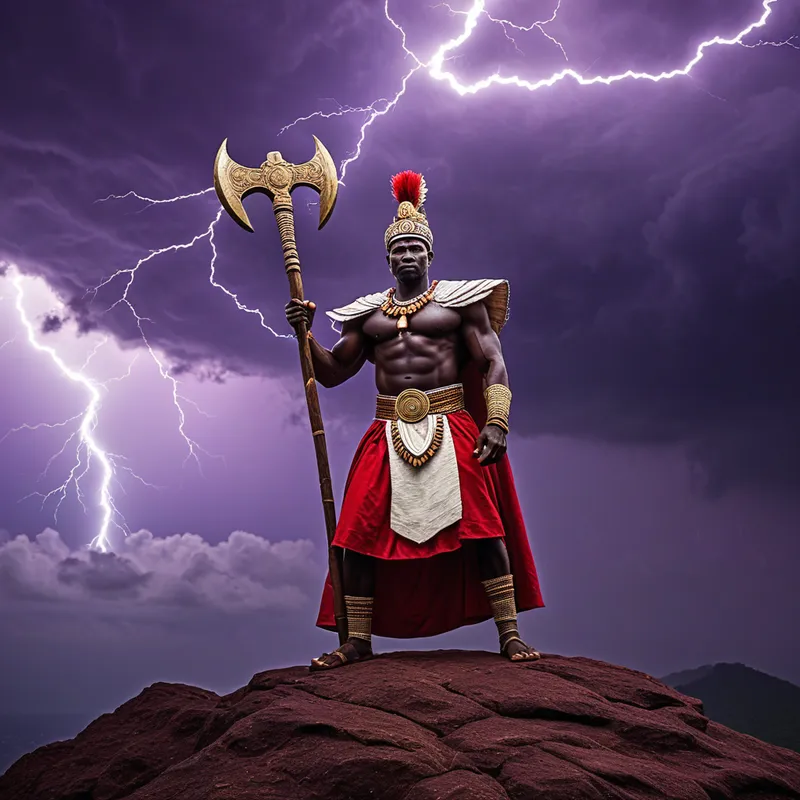
Shango Myth Meaning & Symbolism
The myth of Shango, a king who wields divine lightning, explores the volatile nature of power, the cost of hubris, and the alchemy of rage into sacred authority.
The Tale of Shango
Listen, and hear the tale that rides on the drum’s skin and lives in the crack of the storm.
In the golden age of the Oyo Empire, there was a king. His name was a tremor in the earth, a promise of rain: Shango. He was the fourth Alaafin, a ruler of formidable strength and charisma, whose very gaze could command armies. But within his chest beat a heart forged in a more ancient fire. He was the son of the storm, though he did not yet know it.
His reign was one of conquest and splendor. Yet, whispers slithered through the palace like serpents. Envious chiefs plotted in shadowed corners, questioning his right, his might. A deep, smoldering frustration began to burn in Shango. He desired not just obedience, but awe. Not just respect, but a fear that would etch his name into eternity.
Driven by this rising tide of pride and fury, he sought the ultimate power. In secret, he journeyed to the base of the great Iroko tree. There, he learned the forbidden incantations from a wise and wary Babalawo. The words tasted of ozone and ash on his tongue. He swallowed them, and the change began.
Back in his court, challenged by his foes, the power erupted. It was no longer the metaphorical fire of anger, but the literal fire of heaven. Lightning, raw and white-hot, leapt from his mouth and eyes. He hurled thunderstones to shatter the earth. His enemies were turned to cinder, their plots to smoke. The people fell prostrate, not in loyalty, but in terror. He had his awe, but it was a cold, isolating thing.
Then came the calamity. In a fit of rage—some say directed at his own people for their fear, others say at the treacherous whispers that would not cease—he lost control. The divine fire, meant for his enemies, rained upon his own palace. The roof, thatch and timber, ignited in an instant. The royal compound became a pyre. In the roaring, crackling inferno, his beloved wives and children perished.
The silence after the fire was more terrible than the storm. Standing amidst the ashes of his own life, Shango was hollowed out. The awe he had craved was now a blanket of ash. The power that had defined him had become his executioner. Grief, deeper than any ocean, swallowed his pride. In that moment of utter ruin, the king was dead.
Consumed by remorse and shame, he fled the city he had built and destroyed. He wandered to a forest near the town of Koso. There, with the weight of a world upon him, he made his choice. He would not live as a broken man in a world of his own ashes. With the last of his divine will, he summoned the very forces that had undone him. He challenged the earth itself. He drove his axe into the ground and called down a final, cataclysmic bolt of lightning upon his own head.
The people found no body. Only the serene, terrible silence of a clearing scoured by celestial fire. They declared he had hanged himself in despair. But the priests and the drummers knew a different truth. They felt it in the next storm. The thunder was not random chaos; it was a voice. The lightning was not mere fire; it was an axe cleaving the sky. Shango had not died. He had undergone the ultimate alchemy. In sacrificing his mortal kingship and ego, he had become what he was always meant to be: no longer a man who wielded power, but the very embodiment of Power itself. He ascended, transforming from a failed king into an Orisha—the god of thunder, lightning, and justice.
Cultural Origins & Context
The myth of Shango originates with the Yoruba people of what is now southwestern Nigeria and parts of Benin and Togo. His story is intrinsically linked to the historical Oyo Empire, where he is remembered as a deified fourth king. This myth is not a mere folktale but a foundational narrative carried across the Atlantic in the minds and spirits of enslaved Africans during the Middle Passage.
It survived and transformed within the African Diaspora through the sacred technologies of memory: the rhythm of the Bata drums, whose complex language replicates his voice; the swirling, precise movements of dance that invoke his fiery energy; and the ritual narratives sung during ceremonies in Santería (Lucumí), Candomblé, and Shango/Orisha Baptists. The myth served a crucial societal function: it explained the terrifying yet necessary force of nature (thunderstorms), established a model of divine justice that transcends human failing, and provided a framework for understanding the transformation of profound human trauma (the experience of enslavement and displacement) into a source of indomitable spiritual power and identity.
Symbolic Architecture
At its core, the myth of Shango is a masterclass in the psychology of power. It maps the journey of raw, undifferentiated energy—be it anger, ambition, or creative force—as it moves through the human vessel.
Shango begins as the archetype of the Potentate, ruling through sheer force of personality. His acquisition of lightning symbolizes the ego’s inflation, the identification with one’s own power to a god-like degree. This is the seductive and dangerous peak of the personality, where one feels invincible.
The fire that forges the crown is the same fire that can reduce the palace to ashes.
The destruction of his home and family is the pivotal moment of catastrophic initiation. It represents the inevitable consequence of unintegrated power: it turns inward and destroys what it seeks to protect. This is not a punishment from the gods, but the intrinsic nature of a force that is not yet conscious of itself. His subsequent flight and suicide are the death of the ego-structure that could not contain the divine force it invoked.
His final act and ascension symbolize the ultimate psychic transmutation. The ego (the mortal king) is not merely destroyed, but sacrificed willingly. The raw libidinal energy (lightning) is no longer possessed by the individual; instead, the individual consciousness becomes a vessel for a transpersonal archetype. Shango becomes the Orisha: the principle of righteous force, transformative fire, and the swift, impartial justice of the cosmos.
The Dreamer’s Resonance
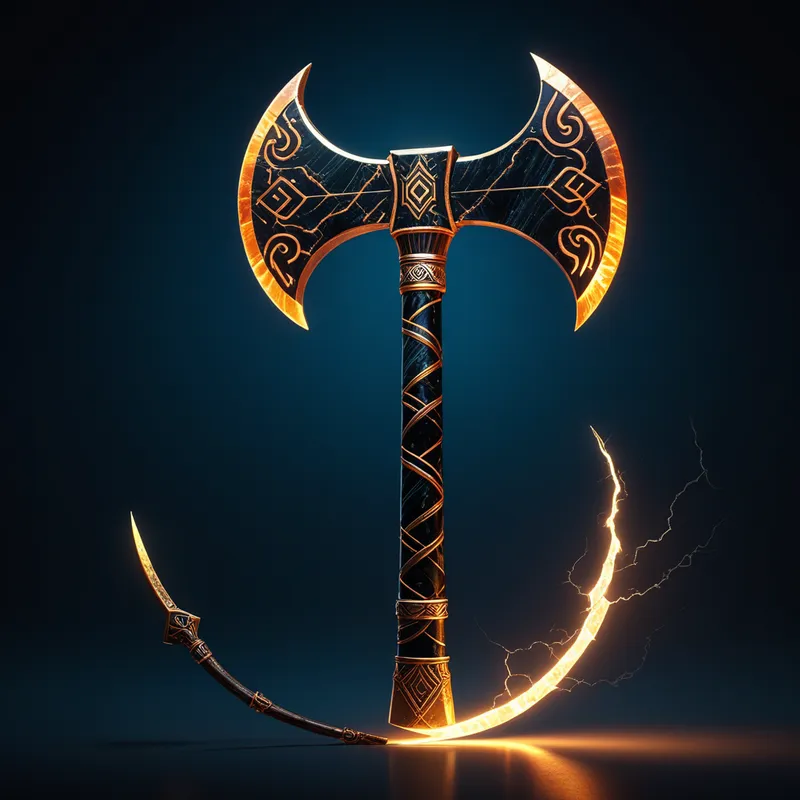
When the pattern of Shango storms into modern dreams, it often signals a profound crisis of power within the dreamer’s psyche. One may dream of uncontrollable electrical fires in their home, of speaking and causing shocks, or of being pursued by a terrifying yet majestic storm.
Somnologically, this points to a somatic upwelling of immense energy—often rage, passion, or a desperate drive for autonomy—that the conscious ego is ill-equipped to handle. The body may feel charged, restless, or hot. Psychologically, the dreamer is at the “palace-burning” stage. An old structure of life (a relationship, career, or self-image) is being consumed by an inner fire they can no longer suppress. The dream is not a warning of mere destruction, but an enactment of a necessary, if brutal, initiation. The ego is being confronted with the shadow-side of its own potency: its capacity for ruinous pride and its terror of its own deepest strengths. The dream asks the terrifying question: What in your life must be reduced to ash for your true authority to be born?
Alchemical Translation
The myth of Shango provides a brutal but precise map for the process of psychic individuation, specifically the integration of the Shadow and the alignment with the Self.
The first stage is Conflation: The individual discovers a potent inner force (ambition, creativity, righteous anger) and mistakenly identifies it as their personal property, their ego’s achievement. This is “I am powerful.”
The inevitable second stage is Conflagration: The undifferentiated power, lacking a transpersonal channel, becomes destructive. It burns the very structures that gave the ego its identity and security. This is the dark night, the experience of being destroyed by one’s own gift. It feels like failure, madness, or annihilation.
The king must die in the fire of Koso so the Orisha can be born in the heart of the storm.
The final, alchemical stage is Consecration: This is the conscious sacrifice. It is the moment the dreamer, in the ashes of their old life, stops fleeing their power and instead turns to face it fully. They surrender the ego’s claim to own the lightning. They offer themselves as a conduit. This is not passivity, but the ultimate act of will—to will the service of something greater. The energy is then transmuted. Personal rage becomes the capacity for fierce boundaries and justice. Destructive passion becomes unstoppable creative fervor. The mortal’s hubris becomes the divine ruler’s authority, exercised not for the self, but as an instrument of a cosmic order. One no longer wields power; one embodies a principle of power. This is the sacred Oshe: the tool that cleaves illusion from truth, channeling chaotic force into decisive, transformative action.
Associated Symbols
Explore related symbols from the CaleaDream lexicon: