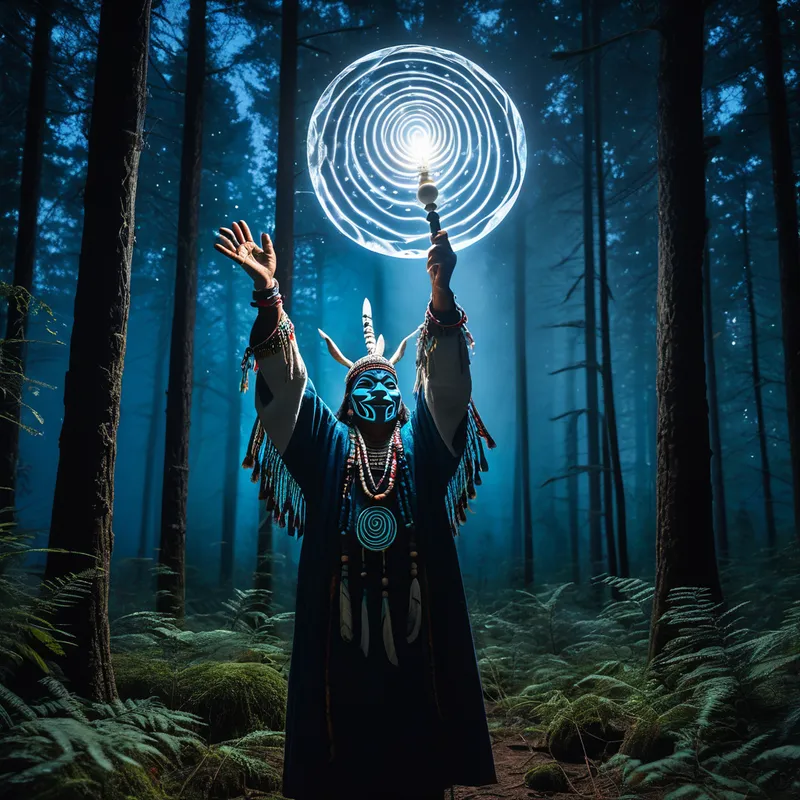
Shaman's Rattle Myth Meaning & Symbolism
A myth of a shaman who journeys to the spirit world, sacrificing his voice to craft the first rattle, a vessel for healing sound and ancestral wisdom.
The Tale of Shaman’s Rattle
Listen. In the time before memory, when [the world](/myths/the-world “Myth from Tarot culture.”/) was raw and [the veil](/myths/the-veil “Myth from Various culture.”/) between the people and the spirit world was thin as morning mist, there lived a man named Shaman. He was a listener. He heard the whisper of [the wind](/myths/the-wind “Myth from Various culture.”/) through the pine needles, the secret language of [the river](/myths/the-river “Myth from Buddhist culture.”/) over stones, and the low hum of [the earth](/myths/the-earth “Myth from Hindu culture.”/) itself. But he could not hear the spirits of the ancestors, nor the guiding voices of the animal powers. His people suffered; sickness walked among them like a cold shadow, and confusion clouded their hearts, for they had no bridge to the wisdom beyond the seen world.
One night, beneath a blanket of stars so thick it seemed you could scoop them with your hands, Shaman built a small fire of cedar and sage. The smoke curled upward, a gray prayer. He sat until his bones ached, calling out with his voice, singing until his throat was raw. But the spirit world remained silent, a vast, dark forest just beyond the firelight. Despair, cold and heavy, settled in his chest. He knew his voice alone was not enough. It was a [thing](/myths/thing “Myth from Norse culture.”/) of this world, of flesh and air, and could not cross [the threshold](/myths/the-threshold “Myth from Folklore culture.”/).
Then, a knowing came to him, not as a voice, but as a feeling deep in his marrow—a memory of sound from the world’s dawn. He remembered the rattle of the Snake’s tail in the dry grass, the chatter of pebbles in a flooding stream, the seed pods shaking on the grandfather cottonwood. These were the world’s first songs, the percussion of life itself.
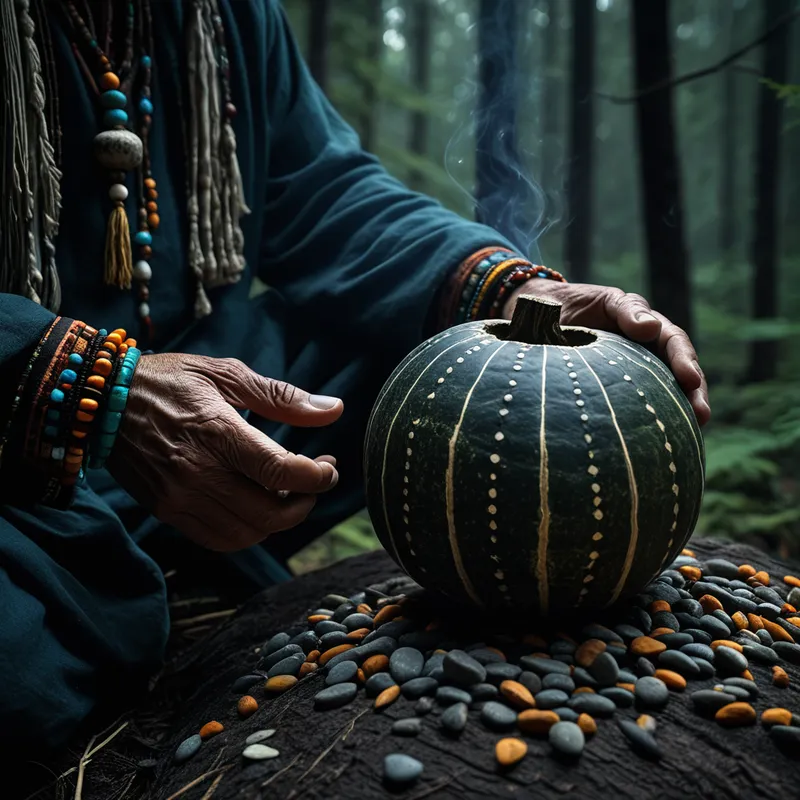
With resolve hardening like frost, Shaman made a vow to the four directions and the starry sky above. He would not speak again until he could speak with the spirits, not just to them. He took a sharp stone and a hollow gourd, dried and light as a bird’s skull. For days he worked, carving a small hole. He gathered tiny, smooth stones from the riverbed, each one chosen for its unique whisper. He collected the hardest seeds from the most resilient plants. These he placed inside the gourd, sealing the opening with pine pitch and sinew.
Then, from a fallen branch of ash, straight and strong, he fashioned a handle. As he bound the gourd to the wood with strips of wet leather that would shrink and hold fast, he felt a final, terrifying pull. Opening his mouth, he breathed his own breath—the warm, moist air of his life and his now-silenced voice—into [the vessel](/myths/the-vessel “Myth from Alchemical culture.”/) before sealing it completely. His personal sound was now trapped within, mingling with the stones and seeds.
In the deep silence of his vow, he lifted the instrument. He shook it.
Shhh-shhh-aah-ke. Shhh-shhh-aah-ke.
The sound was not loud, but it was deep. It did not travel out; it traveled in. It vibrated in the soil beneath his feet. It echoed in the hollow of his own chest. And as he shook it, focusing his entire being into the rhythm, the world around him began to change. The firelight stretched and danced, forming shapes: the flickering outline of the Bear, the swift shadow of the Hawk, the wise, slow form of the Turtle. From the darkness beyond the fire, whispers coalesced into understanding. The spirits were speaking. They spoke through the rattle’s song, and Shaman, in his profound silence, heard them perfectly. He had not made a tool; he had built a doorway. And through it, healing flowed back into the world of his people.
Cultural Origins & Context
This myth, in its countless localized variations, is foundational to many Indigenous American spiritual practices. It is not merely a story about the origin of an object, but an etiological narrative explaining the origin of sacred technology itself—the technology of connection. Passed down orally through generations by medicine people, elders, and storytellers, its telling was often reserved for specific teachings or initiations.
The societal function was multifaceted. Primarily, it established the rattle not as a mere instrument, but as a consecrated vessel of immense power and responsibility. It encoded the proper relationship between the practitioner and the spirit world: one based on sacrifice, respectful dialogue, and the understanding that human agency is only part of a larger conversation. The myth also served as a pedagogical tool, teaching that true power comes not from shouting demands into [the void](/myths/the-void “Myth from Buddhist culture.”/), but from creating the conditions—the sacred sound—through which the void might choose to answer.
Symbolic Architecture
At its [heart](/symbols/heart “Symbol: The heart symbolizes love, emotion, and the core of one’s existence, representing deep connections with others and self.”/), the myth is a profound map of symbolic exchange and the creation of a tertium quid—a third thing that mediates between opposites.
The [Shaman](/symbols/shaman “Symbol: A spiritual mediator who bridges the human and spirit worlds, often through altered states, healing, and guidance.”/)’s sacrificed voice represents the individual ego’s demand, its [linear](/symbols/linear “Symbol: Represents order, predictability, and a direct, step-by-step progression. It symbolizes a clear path from cause to effect.”/), propositional [language](/symbols/language “Symbol: Language symbolizes communication, understanding, and the complexities of expressing thoughts and emotions.”/). By giving it up, he surrenders the illusion of one-way control. His [breath](/symbols/breath “Symbol: Breath symbolizes life, vitality, and the connection between the physical and spiritual realms.”/) trapped inside the rattle symbolizes the infusion of his [life](/symbols/life “Symbol: The symbol of ‘Life’ represents a journey of growth, interconnectedness, and existential meaning, encompassing both the joys and challenges that define human experience.”/) force and [intention](/symbols/intention “Symbol: Intention represents the clarity of purpose and direction in one’s life and can symbolize motivation and commitment within a dream context.”/) into the [instrument](/symbols/instrument “Symbol: An instrument symbolizes creativity, communication, and the means by which one expresses oneself or influences the world.”/); it becomes an extension of his very being, but one transformed.
The gourd is the [womb](/symbols/womb “Symbol: A symbol of origin, potential, and profound transformation, representing the beginning of life’s journey and the unconscious source of creation.”/) of potential, the container of [chaos](/symbols/chaos “Symbol: In Arts & Music, chaos represents raw creative potential, uncontrolled expression, and the breakdown of order to forge new artistic forms.”/). The stones and seeds are the raw materials of the [earth](/symbols/earth “Symbol: The symbol of Earth often represents grounding, stability, and the physical realm, embodying a connection to nature and the innate support it provides.”/)—the mineral and the organic, the eternal and the generative. Together, sealed inside, they represent the [cosmos](/symbols/cosmos “Symbol: The entire universe as an ordered, harmonious system, often representing the totality of existence, spiritual connection, and the unknown.”/) in [microcosm](/symbols/microcosm “Symbol: A small, self-contained system that mirrors or represents a larger, more complex whole, often reflecting the universe within an individual.”/).
The rattle is not a megaphone for the human will, but a resonator for the world’s soul. It translates the monologue of the ego into the dialogue of the cosmos.
The resulting sound is the transcendent [symbol](/symbols/symbol “Symbol: A symbol can represent an idea, concept, or belief, serving as a powerful tool for communication and understanding.”/). It is not speech, but pre-speech; not [melody](/symbols/melody “Symbol: A melody symbolizes emotion, memory, and communication, often representing the subconscious expressing itself through sound.”/), but the [rhythm](/symbols/rhythm “Symbol: A fundamental pattern of movement or sound in time, representing life’s cycles, emotional flow, and universal order.”/) that makes melody possible. It represents the vibrational substrate of [reality](/symbols/reality “Symbol: Reality signifies the state of existence and perception, often reflecting one’s understanding of truth and life experiences.”/), the [frequency](/symbols/frequency “Symbol: In dreams, frequency often represents rhythm, cycles, patterns, or the rate of occurrence of events, thoughts, or emotions.”/) at which [spirit](/symbols/spirit “Symbol: Spirit symbolizes the essence of life, vitality, and the spiritual journey of the individual.”/) and matter momentarily align. [The shaman](/myths/the-shaman “Myth from Siberian culture.”/), by mastering this sound, becomes a [conductor](/symbols/conductor “Symbol: A conductor represents guidance, leadership, and the orchestration of life’s various elements toward harmony.”/) of this alignment, a [healer](/symbols/healer “Symbol: A figure representing restoration, transformation, and the integration of physical, emotional, or spiritual wounds. Often symbolizes a need for care or a latent ability to mend.”/) whose work is to restore resonant [harmony](/symbols/harmony “Symbol: A state of balance, agreement, and pleasing combination of elements, often associated with musical consonance and visual or social unity.”/) where there was [dissonance](/symbols/dissonance “Symbol: A lack of harmony or agreement in musical tones or artistic elements, often representing internal conflict, unresolved tension, or societal discord.”/).
The Dreamer’s Resonance
When this myth pattern stirs in the modern dreamer, it often signals a critical juncture in one’s psychological development where old modes of communication have broken down. To dream of being voiceless, or of desperately trying to make a sound that won’t come, mirrors the shaman’s initial despair. It is the somatic feeling of [the ego](/myths/the-ego “Myth from Jungian culture.”/) hitting its limit.
Dreaming of crafting an object—especially one that makes sound, like a rattle, drum, or bell—from disparate, earthy materials points to the unconscious assembling a new psychic organ. The dreamer is in the process of building a capacity, not for louder self-expression, but for deeper listening. The shaking of the rattle in a dream can feel immensely cathartic; it is the vibration shaking loose calcified emotions or awakening dormant intuitions. It signifies the birth of an internal technology designed not to shout [the self](/myths/the-self “Myth from Jungian culture.”/) into the world, but to hear the world into the self.

Alchemical Translation
The myth models the alchemical process of individuation—the journey toward psychic wholeness—with stunning clarity. The initial state is one of alienation: the conscious mind (the shaman) feels separate from the nourishing, guiding depths of the unconscious (the spirit world).
The sacrifice of the personal voice is the crucial [nigredo](/myths/nigredo “Myth from Alchemical culture.”/), the darkening. It is the voluntary humiliation of the ego, which must admit its one-sidedness and incompleteness. This is the death of the old, heroic identity that believed it could think or will its way to wholeness.
The crafting of the rattle is the albedo, the whitening. It is the conscious, disciplined work of the ego, now in service to the Self. The ego gathers the contents of the unconscious (the stones, seeds, symbols) and contains them within a purposeful structure. It applies its focus and skill not to dominate, but to create a vessel for relationship.
Individuation is not about finding your voice and shouting your truth. It is about losing your solitary voice to discover the instrument through which the greater truth can sound.
Finally, the shaking and the resulting dialogue represent the [rubedo](/myths/rubedo “Myth from Alchemical culture.”/), the reddening, and the coniunctio, [the sacred marriage](/myths/the-sacred-marriage “Myth from Various culture.”/). The ego does not disappear; it becomes the handle that grips and directs the vessel. The unconscious does not overwhelm; it flows through the vessel as sound and wisdom. The healed shaman is the integrated [psyche](/myths/psyche “Myth from Greek culture.”/): the conscious mind in steady, rhythmic dialogue with the deep Self. The modern individual’s “rattle” might be a creative practice, a meditative discipline, or a mode of therapy—any crafted, consistent practice that transforms the noise of internal conflict into the resonant rhythm that guides one home.
Associated Symbols
Explore related symbols from the CaleaDream lexicon: