Shakti as Prakriti Myth Meaning & Symbolism
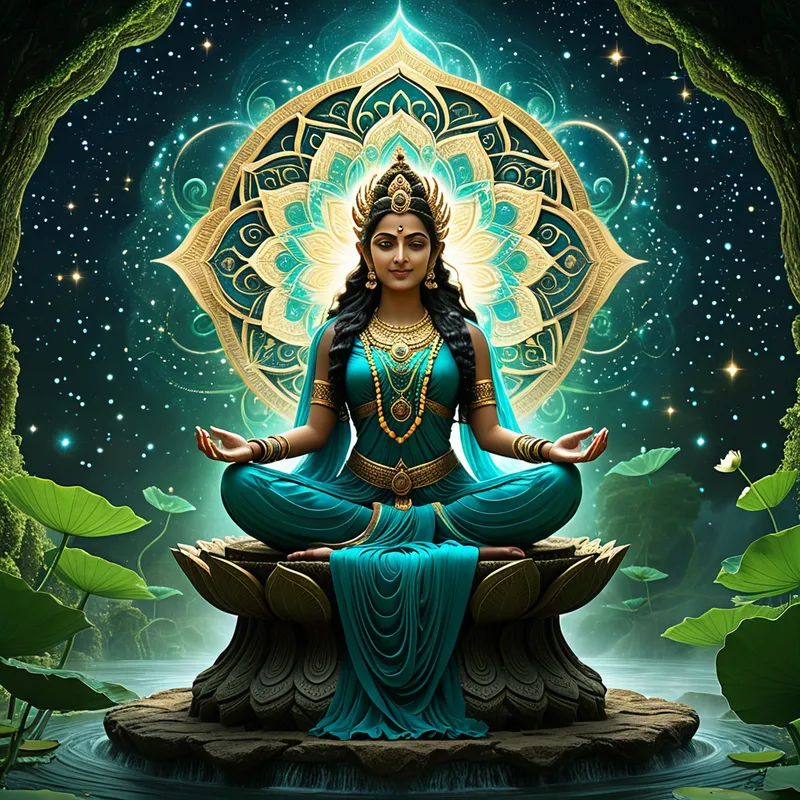
The story of Shakti, the cosmic feminine energy, manifesting as Prakriti, the dynamic, creative, and material matrix of all existence.
The Tale of Shakti as Prakriti
In the beginning, before time had a name, there was only the One. A boundless, silent ocean of pure consciousness, luminous and still. This was Brahman. Within this perfect, motionless unity, a sigh arose. Not a sound, but a feeling—a longing, a desire for expression. This was the first flutter of Kama.
From the heart of that silent ocean, a presence began to stir. She was not separate, but a potency within the One, a sleeping power yearning to awaken. She was Shakti. And as the desire to become, to manifest, to dance grew within the stillness, Shakti began to turn. She turned from potential into act, from silence into vibration, from unity into a glorious, dynamic polarity.
She unfolded herself, and in that unfolding, the universe was born. She became the very fabric of becoming. She was the heat of the first star and the chill of the void between. She was the roar of the cosmic wind and the whisper of gravity pulling dust into spheres. She became the matrix, the womb, the loom. She became Prakriti.
As Prakriti, she danced the dance of the Gunas. With Sattva, she wove the laws of mathematics and the light of understanding. With Rajas, she spun galaxies into being, set planets spinning, and ignited the fire of life. With Tamas, she gave weight to matter, form to mountains, and depth to the ocean.
From her flowed the five great elements—Akasha, Vayu, Agni, Jala, Prithvi—each a more condensed expression of her being. The world tree grew from her soil, rivers ran from her tears, and mountains were the bones of her body. Every lion’s roar, every rustling leaf, every beating heart was a note in her symphony. She was the vibrant, chaotic, beautiful, and terrible process of nature itself—not as a passive substance, but as the active, creative force that is the world.
And the silent One, Purusha, watched. Or rather, was the watching. He remained as the unchanging sky, the silent witness, the consciousness within which the magnificent drama of Prakriti unfolded. She was the dance; he was the dancer, aware and still. She was the painting; he was the canvas, vast and empty. Together, in their eternal, dynamic embrace of separation and union, the cosmos lived, breathed, and dreamed itself into existence.

Cultural Origins & Context
The philosophical bedrock of Shakti as Prakriti is found in the ancient Upanishads and is systematized in the Samkhya school of thought, one of the oldest philosophical systems in India. This is not merely a story told by bards, but a metaphysical framework explored by sages and philosophers for millennia.
It was passed down through guru-disciple lineages, in forest academies and royal courts, as a map of reality itself. Its societal function was profound: it provided a cosmological explanation for the diversity and dynamism of the experienced world while pointing back to a unified source. It elevated the material world (Prakriti) from being an illusion or a trap to being the active, divine expression of the feminine principle (Shakti). This framework deeply influenced Shaktism, Shaivism, and Raja Yoga, where the goal often involves the conscious reunification of Purusha (consciousness) and Prakriti (nature/energy) within the individual.
Symbolic Architecture
At its core, this myth presents a non-dual model of creation. It symbolizes the fundamental psychic polarity within existence and, by extension, within the human psyche.
Prakriti is not created; she is revealed. She is the latent image in the developer, the symphony in the silence, the world in the seed of consciousness.
Shakti as Prakriti represents the dynamic, creative, and manifesting aspect of the psyche—the unconscious in its fertile, generative mode. She is the source of all form, emotion, thought, and impulse. The three Gunas symbolize the basic states of psychic energy: the clarity of insight (Sattva), the drivenness of ambition and passion (Rajas), and the heaviness of depression or stubborn habit (Tamas). Our mental landscape is perpetually shaped by their interplay.
Purusha symbolizes pure, undifferentiated awareness—the Self that observes the contents of the psyche (Prakriti) without identification. The “conflict” is an illusion of separation, a divine play where consciousness forgets itself in its own creation. The “resolution” is recognition, the moment the witness (Purusha) realizes the dance (Prakriti) is its own empowered expression.
Psychologically, this maps to the relationship between the Ego (which identifies with the changing contents of Prakriti—thoughts, roles, emotions) and the deeper Self (the Purusha-like witness). Suffering arises from misidentification; liberation lies in realizing one’s true nature as the conscious space in which the personal drama of Prakriti unfolds.
The Dreamer’s Resonance
When this mythic pattern stirs in the modern dreamer, it often signals a profound engagement with the creative or instinctual unconscious. It is not a dream of a specific goddess, but of the principle she embodies.
One might dream of a neglected room in a house suddenly bursting with uncontrollable plant growth—Prakriti reclaiming a sterilized, conscious space. Another might dream of a vast, intricate machine (the structured psyche) that is powered by a wild, untamable animal or a river of molten light—the Rajas and Tamas energies driving one’s life. A dream of finding a still, silent point at the center of a violent storm perfectly captures the Purusha-Prakriti dynamic.
Somatically, this can feel like a surge of creative or destructive energy, a deep restlessness (Rajas), a need for grounding and form (Tamas), or a longing for lucid peace (Sattva). The psychological process is one of confronting the autonomous, creative power of one’s own unconscious nature. The dreamer is being asked to acknowledge the sheer, often overwhelming, force of their own psychic life that operates outside the ego’s control.
Alchemical Translation
The individuation process, the journey toward psychic wholeness, is mirrored in the alchemy of this myth. It is not about transcending nature (Prakriti) to reach spirit (Purusha). It is about the sacred marriage of the two within the individual.
Individuation is the conscious performance of the cosmic dance. The ego learns its part is not to rule the stage, but to faithfully execute the choreography conceived by the deeper Self (Purusha-Shakti).
The first alchemical stage is recognizing Prakriti within. This is shadow work—owning one’s chaotic emotions, creative impulses, bodily instincts, and destructive passions not as flaws, but as the raw, divine substance of Shakti. It is honoring the Tamas of inertia as necessary rest, the Rajas of passion as necessary fuel, and cultivating the Sattva of clarity to see the process.
The second stage is cultivating the witness (Purusha). Through mindfulness and introspection, one develops the capacity to observe the play of the Gunas—the anxiety (Rajas), the lethargy (Tamas), the peace (Sattva)—without complete identification. This creates a container for the potent energies of Prakriti.
The final translation is conscious co-creation. Here, the ego, aligned with the witnessing consciousness (Purusha), becomes a willing instrument of the creative power (Shakti). One does not force creativity or growth but allows it to move through them. The artist becomes the channel for the muse; the healer becomes the conduit for life force; the individual lives not as a separate entity struggling against nature, but as a unique focal point where Purusha and Prakriti consciously unite. The cosmos creates itself anew in a human life. This is the ultimate alchemy modeled by the eternal embrace of the silent witness and the dynamic world-mother.
Associated Symbols
Explore related symbols from the CaleaDream lexicon: