Shakti Myth Meaning & Symbolism
The story of the primordial feminine energy, whose dance of creation, withdrawal, and fierce return models the psyche's journey to wholeness.
The Tale of Shakti
Listen. Before the beginning, there was only Brahman. Not a god, not a [thing](/myths/thing “Myth from Norse culture.”/), but the silent, boundless ocean of pure potential. A stillness so complete it was a kind of music. And within that stillness, a thought arose. A vibration. A desire to know itself.
This was the first movement. This was Shakti.
From that single pulse of self-awareness, the universe unfolded like a [lotus](/myths/lotus “Myth from Hindu culture.”/) blooming in the dark. She became sound, the sacred Aum. She became light, cascading in waves of color and form. She became the dance of atoms and the swirl of galaxies. She was the creative thrill coursing through the veins of existence, the mother of all that is, was, or will be. The gods themselves were born from her laughter.
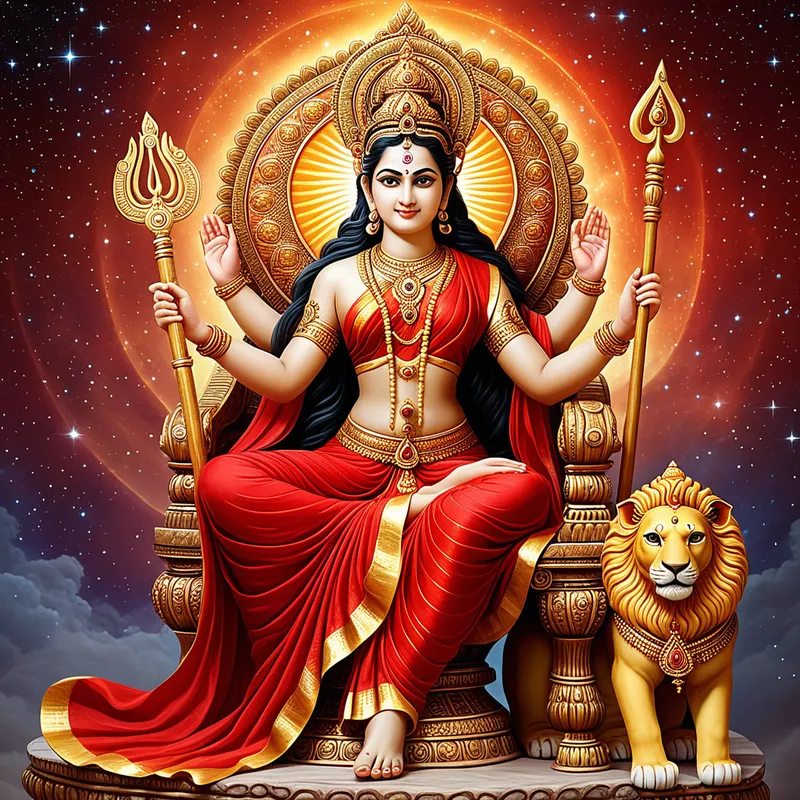
But a story needs tension. So, she took form. She descended as [Lakshmi](/myths/lakshmi “Myth from Hindu culture.”/), bestowing prosperity from her lotus hands. She manifested as [Saraswati](/myths/saraswati “Myth from Global/Universal culture.”/), whose veena’s notes ordered chaos into art and science. And she became Durga, riding a lion, her many arms wielding the weapons of all the gods, born from their collective fury to face a darkness that threatened to swallow the worlds.
The darkness had a name: Mahishasura. He was arrogance made flesh, a shape-shifting beast who believed himself invincible, whose tyranny choked the light from the three realms. The gods, defeated, pooled their radiance—a blazing furnace of divine anger and hope—and from that conflagration, she stepped forth. Durga. Her roar was the cracking of cosmic eggshells.
For nine nights and ten days, the battle raged. Not on a mere field, but in the liminal space between consciousness and oblivion. Mahishasura transformed—from buffalo to lion, from lion to elephant, from elephant back to warrior—each form a new face of delusion. And with each change, Durga met him. Her lion tore at his flanks. Her trident pinned his illusions. Finally, as he charged in his primal buffalo form, she leaped, planting her foot upon his neck, and with a final, decisive thrust, her spear pierced the heart of the darkness. The demon fell, and the universe exhaled a light it had forgotten.
But her story deepens. She is also Kali. After the battle, Durga’s fury did not subside; it transformed. Kali emerged, dancing on the corpse of [the ego](/myths/the-ego “Myth from Jungian culture.”/), her tongue lolling out, wearing a garland of skulls, black as the space between stars. She was creation’s necessary shadow—the furious dissolution that makes room for the new. Even her consort, [Shiva](/myths/shiva “Myth from Hindu culture.”/), the great ascetic, lay still beneath her dance. Only when she saw him at her feet did she stop, her rage turning to bewildered tenderness. The dance of destruction ceased, and in that stillness, the cycle was poised to begin anew.

Cultural Origins & Context
The myth of Shakti is not a single story but a vast, living tapestry woven over millennia. Her earliest threads appear in [the Vedas](/myths/the-vedas “Myth from Hindu culture.”/) as Rta, the active principle of cosmic order, and in the deification of natural forces like Vāc. By the era of the great epics—the Mahabharata and Ramayana—and the subsequent Puranic texts, her forms crystallized into the goddesses worshipped today.
This mythology was carried by sages, poets, and village storytellers. It was performed in temple rituals, enacted in annual festivals like Durga Puja and Diwali, and internalized through tantric practices. Societally, the Shakti myth complex served multiple functions: it explained the dynamic nature of reality, provided a framework for understanding divine power (Shakti) as inseparable from divine consciousness (Shiva), and offered a profound symbolic system for spiritual awakening that elevated the feminine principle to the status of the ultimate source.
Symbolic Architecture
Shakti is not merely a [goddess](/symbols/goddess “Symbol: The goddess symbolizes feminine power, divinity, and the nurturing aspects of life, embodying creation and wisdom.”/); she is the archetypal principle of dynamic [energy](/symbols/energy “Symbol: Energy symbolizes vitality, motivation, and the drive that fuels actions and ambitions.”/) itself. She represents the fundamental force that turns potential into [reality](/symbols/reality “Symbol: Reality signifies the state of existence and perception, often reflecting one’s understanding of truth and life experiences.”/), thought into form, and seed into [tree](/symbols/tree “Symbol: In dreams, the tree often symbolizes growth, stability, and the interconnectedness of life.”/). In psychological terms, she is the libido—not merely sexual, but the total psychic [energy](/symbols/energy “Symbol: Energy symbolizes vitality, motivation, and the drive that fuels actions and ambitions.”/) that drives growth, creativity, and transformation.
Shakti is the elan vital, the restless, creative urge within the unconscious that compels the psyche to move from static potential into lived experience.
Her various forms map the [psyche](/myths/psyche “Myth from Greek culture.”/)‘s [landscape](/symbols/landscape “Symbol: Landscapes in dreams are powerful symbols representing the dreamer’s emotional state, personal journey, and the broader context of life situations.”/). Lakshmi symbolizes the energy of attraction, value, and inner [abundance](/symbols/abundance “Symbol: A state of plentifulness or overflowing resources, often representing fulfillment, prosperity, or spiritual richness beyond material needs.”/). Saraswati represents the energy of discernment, [pattern](/symbols/pattern “Symbol: A ‘Pattern’ in dreams often signifies the underlying structure of experiences and thoughts, representing both order and the repetitiveness of life’s situations.”/)-making, and conscious articulation. Durga is the energy of necessary [defense](/symbols/defense “Symbol: A protective mechanism or barrier against perceived threats, representing boundaries, security, and resistance to external or internal challenges.”/), the fierce integrity that establishes boundaries and confronts inner demons (like Mahishasura, the brutalizing inertia of the unchecked ego). Kali is the most profound: she is the energy of radical [dissolution](/symbols/dissolution “Symbol: The process of breaking down, dispersing, or losing form, often representing transformation, release, or the end of a state of being.”/), the [shadow](/symbols/shadow “Symbol: The ‘shadow’ embodies the unconscious, repressed aspects of the self and often represents fears or hidden emotions.”/)-work that willingly dismantles outworn identities, complexes, and illusions so that renewal is possible. Her dance on Shiva signifies that even the still, observing [consciousness](/symbols/consciousness “Symbol: Consciousness represents the state of awareness and perception, encompassing thoughts, feelings, and experiences.”/) (the transcendent function) must sometimes be overwhelmed by the raw, purgative power of the unconscious for transformation to occur.
The Dreamer’s Resonance
When the Shakti archetype stirs in the modern dreamer, it often signals a critical juncture in the flow of personal energy. Dreaming of a powerful, unknown woman might indicate nascent creative power seeking form. Dreams of being pursued by a terrifying feminine figure could point to a confrontation with repressed vitality or a “demon” of addiction or compulsion that requires a Durga-like fierceness to face.
Somatically, this process can feel like a surge of restless energy—insomnia, creative bursts, or anxiety that has no clear object. Psychologically, it is the process of enantiodromia—the emergence of an opposite force to balance a one-sided conscious attitude. A person overly identified with quiet passivity (a latent Shiva state) may dream of Kali as the unconscious compensates, violently introducing the energy needed for movement and change. The dream is the psyche’s attempt to restore its own [sacred marriage](/myths/sacred-marriage “Myth from Alchemy culture.”/), to reunite consciousness with its vital, dynamic ground.

Alchemical Translation
The myth of Shakti models the entire alchemical opus of individuation. It begins in the [nigredo](/myths/nigredo “Myth from Alchemical culture.”/), the primal darkness of the unconscious (the formless Brahman). The first movement, the desire to know, is the spark that initiates the journey.
The individuation process is Shakti’s dance: an oscillation between creating a conscious personality (Srishti), maintaining it (Sthiti), dissolving its rigid structures (Samhara), concealing the divine within it (Tirobhava), and finally granting the grace of self-recognition (Anugraha).
We first must create a stable ego (a Lakshmi/Saraswati phase of building skills, values, and a place in [the world](/myths/the-world “Myth from Tarot culture.”/)). Then, we inevitably face the demon of that very ego—its inflation, its defenses, its limiting beliefs (the Mahishasura phase). This demands a Durga moment: summoning our inner council (the gifts of all our experiences) to do battle for our authentic self.
The victory, however, is not final. The Kali phase follows, where we must willingly dismantle what we have built, to dance upon the corpse of the [persona](/myths/persona “Myth from Greek culture.”/) that served us but now confines us. This is the terrifying, liberating work of shadow integration. Finally, the myth points to the conjunctio, [the sacred marriage](/myths/the-sacred-marriage “Myth from Various culture.”/). Shakti reunited with Shiva is not a subsumption but a completion: dynamic energy grounded in still awareness, passionate engagement informed by transcendent witness. For the modern individual, this is the ultimate alchemical goal: to become a vessel where life force (Shakti) and conscious being (Shiva) are in constant, creative, and conscious union. We don’t worship the goddess from afar; we undertake the arduous, glorious task of realizing she is the very pulse of our own deepest self.
Associated Symbols
Explore related symbols from the CaleaDream lexicon: