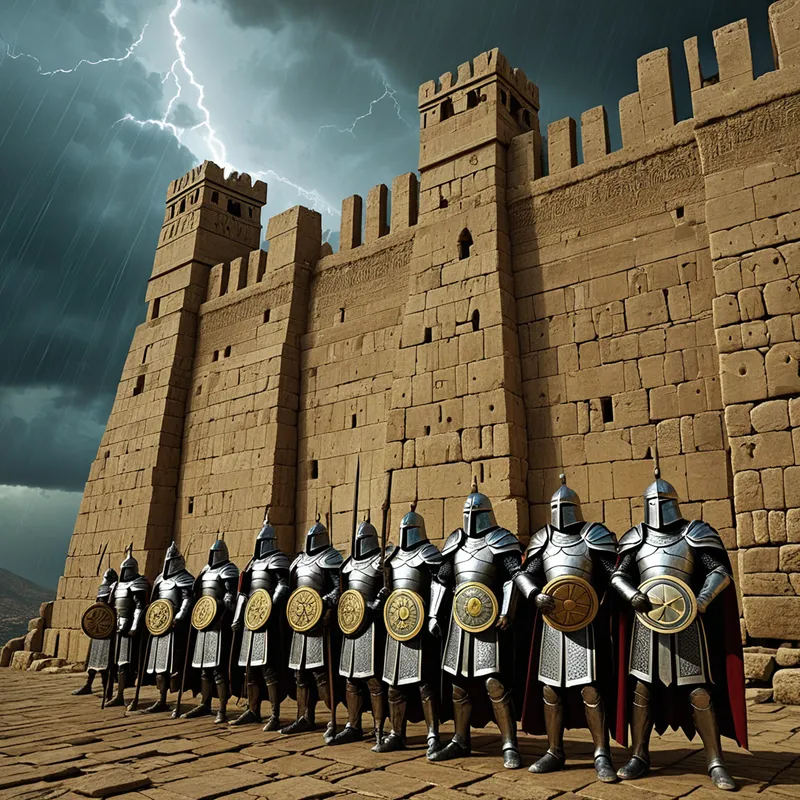
Seven Against Thebes Myth Meaning & Symbolism
A cursed king's sons, Eteocles and Polynices, shatter their oath and destroy each other, fulfilling a family doom and besieging their own city.
The Tale of Seven Against Thebes
Hear now the tale of a house damned by the gods, a story written not in ink but in blood and dust. It begins not with the seven, but with a stain. Laius, king of shining Thebes, defied the warning of Apollo and sired a son. That son, Oedipus, would unknowingly fulfill the oracle’s curse, plunging the royal line into a chasm of shame. From this poisoned root, the tragedy grew.
Years later, an old and blinded Oedipus, having torn out his own eyes in horror, is cast out by his own sons, Eteocles and Polynices. These twin pillars of the cursed house make a pact: to share the throne of Thebes, ruling in alternating years. But when the first year passes, Eteocles, drunk on power, refuses to relinquish the scepter. He bars the gates against his own flesh. Polynices, the exile, becomes a beggar at foreign courts, his heart fermenting with a bitter wine of betrayal.
In the court of Adrastus of Argos, Polynices finds not just shelter, but an army. Six other mighty champions, each nursing their own grievances or seeking glory, swear to see him restored. They are the Seven: Amphiaraus, the reluctant prophet who sees the doom to come; Parthenopaeus, in the bloom of youth; Capaneus, whose pride scorns even the gods; Hippomedon, terrifying in his rage; Tydeus, a feral and brilliant fighter; and Adrastus himself, their king. They march, a glittering, fatal constellation, toward the seven-gated walls of Thebes.
Inside the city, Eteocles prepares. The air is thick with the smell of fear and burning pitch. He stations Thebes’s greatest defenders at each gate, a grim mirror to the attackers outside. The prophet Tiresias whispers of the city’s salvation, but only through a terrible sacrifice. The king’s sister, Antigone, pleads for reason, but her voice is lost in the clamor of arms.
Then, the assault. It is not a battle but a series of horrific duels, a dance of death before each portal. Capaneus, scaling the wall, boasts that not even Zeus himself could stop him. A thunderbolt from the clear sky smites him to ashes. Amphiaraus, the righteous seer, is swallowed whole by the earth, chariot and all, a direct intervention of Zeus. One by one, the attackers fall. But so too do Thebes’s sons.
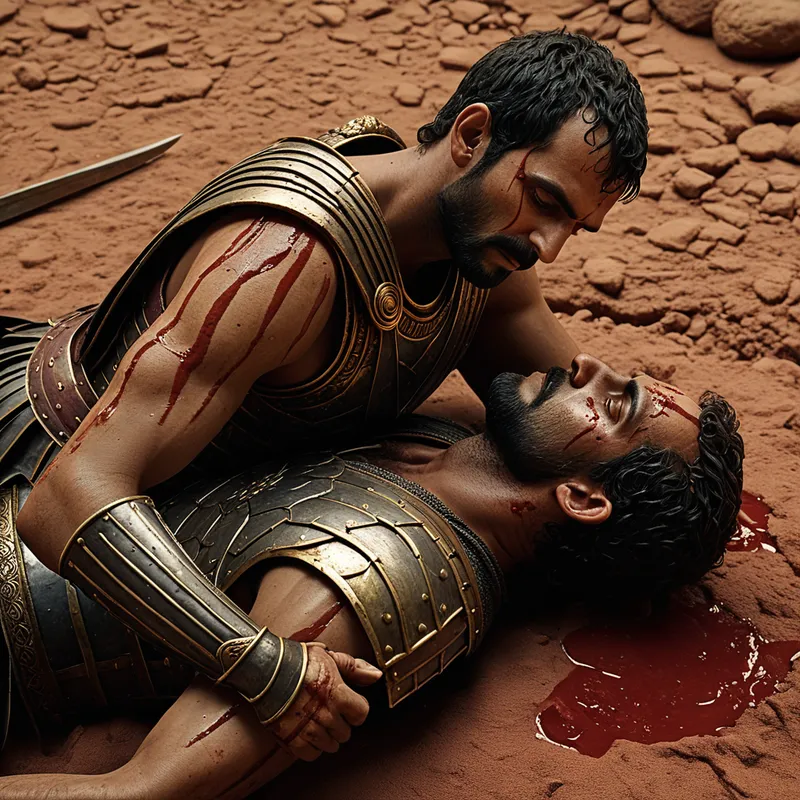
The final act awaits at the seventh gate. Here, the curse completes its circle. Eteocles and Polynices, the two halves of a broken oath, face each other. There is no diplomacy, no memory of shared childhood. Only the hiss of spears and the crash of shields. They fight with the fury of those who know they are already dead. And as the sun bleeds on the horizon, each finds his mark. Brother slays brother. The last breath of one is mingled with the last breath of the other. The throne they fought for is now vacant, drenched in the only thing they truly shared: their blood.
Cultural Origins & Context
This myth is not a singular story but a dense epic cycle, the Theban Cycle, which stood alongside the tales of Troy in the Greek imagination. It reached its most powerful form in the 5th century BCE, the Athenian Golden Age, through the tragic plays of Aeschylus (Seven Against Thebes), Sophocles (Antigone, Oedipus at Colonus), and Euripides (The Phoenician Women). Performed during the great City Dionysia, these plays served as profound civic and religious rituals.
The function was multifaceted. For the polis (city-state), it was a cautionary tale about civil strife (stasis), the worst evil a Greek city could endure. The image of brothers destroying their own city was a potent warning against political factionalism. For the individual, it explored the terrifying limits of human agency against divine will (moira) and inherited guilt. The myth asked the audience: How free are we when shackled by the sins of our fathers? How does a community heal after such self-inflicted devastation? It provided no easy answers, only a cathartic experience of pity and terror, reaffirming the fragile order of the human world against the chaotic forces of fate and passion.
Symbolic Architecture
At its core, the myth is a map of a fractured psyche. Thebes, the “seven-gated” city, is the Self—a complex, defended structure of identity and consciousness.
The true siege is always internal. The walls we build against the world are first erected against the parts of ourselves we have exiled.
Eteocles and Polynices represent a catastrophic psychic split. They are not opposites, but twins—the ruler and the exile, the incumbent and the claimant. One clings to the center of power (the conscious ego, the status quo); the other becomes the shadow, the repressed aspect that gathers force in the darkness of the unconscious (Argos). Their alternating kingship pact is the healthy, conscious agreement to integrate both sides of one’s nature, which the ego (Eteocles) inevitably breaks.
The Seven attackers are not mere invaders. They are the concretized, personified contents of the exiled brother’s (the shadow’s) rage and ambition—pride (Capaneus), feral instinct (Tydeus), doomed insight (Amphiaraus), and youthful idealism (Parthenopaeus). Their assault on the seven gates is the shadow’s violent attempt to be recognized, to storm the citadel of consciousness. The mutual fratricide is the ultimate psychological deadlock: the ego and the shadow are so enmeshed in conflict that their struggle annihilates the very psyche they are fighting to control.
The Dreamer’s Resonance
When this myth stirs in the modern unconscious, it manifests not as a literal dream of ancient warfare, but as a somatic and emotional landscape of civil war. The dreamer may experience:
- Recurring dreams of being besieged in a familiar place (childhood home, workplace) by vague but powerful forces.
- Dreams of fighting a double or a sibling, where every blow struck is also felt as a wound received.
- Somatic sensations: A tightness in the chest, as if armor is constricting the heart; a feeling of being “of two minds,” paralyzed between equally compelling but opposing choices.
- Themes of broken oaths and betrayed trust, often pointing to a betrayal of one’s own deeper values or potential (the exiled self).
The psychological process is one of shadow confrontation at its most intense. The dream ego (Eteocles) has refused to honor an inner pact, perhaps to alternate between work and creativity, duty and desire, tradition and innovation. The exiled self (Polynices) has allied with other repressed energies (the Seven), and they are now at the gate. The dream is the psyche’s urgent, often terrifying, report on the state of this inner siege. The mutual destruction of the brothers in the dream signals a dangerous psychological impasse where one’s identity structure is on the verge of collapse.
Alchemical Translation
The alchemical process mirrored here is the nigredo—the blackening, the stage of mortification and putrefaction. It is the necessary, brutal dissolution of a dysfunctional psychic structure. The old, cursed “kingdom” of the Self, built on a foundation of ancestral trauma (the curse of Laius and Oedipus) and maintained by a brittle, tyrannical ego, must be torn down.
Individuation often requires a thebes-level event. The city of the old self must be besieged by its own exiled truths before a new consciousness can be founded.
The process for the modern individual begins with recognizing the “Polynices” within—the exiled talent, the unexpressed grief, the abandoned passion. This is not about unleashing it to wage war, but about hearing its claim. The disastrous outcome of the myth is not the goal, but the warning. The alchemical work is to prevent the fratricide by facilitating a conjunction before the battle.
This means descending to the seventh gate before the armies are marshaled. It means the conscious ego (Eteocles) must voluntarily open the gate to parley with its shadow-twin, to acknowledge its right to a share of the throne. The integration is not a peaceful merger, but a fierce negotiation that transforms both parties. The champion-energies (the Seven) are then not destroyers, but potent forces to be integrated: righteous anger, fierce instinct, prophetic insight. The result is not a victory for one side, but the death of the old, divided monarchy and the potential birth of a new, more complex and resilient sovereign Self—a Self that has made peace with its own gates and guards them not out of fear, but with wisdom. The myth shows us the catastrophe of failure, so we might find the courage for the terrifying, necessary parley.
Associated Symbols
Explore related symbols from the CaleaDream lexicon: